
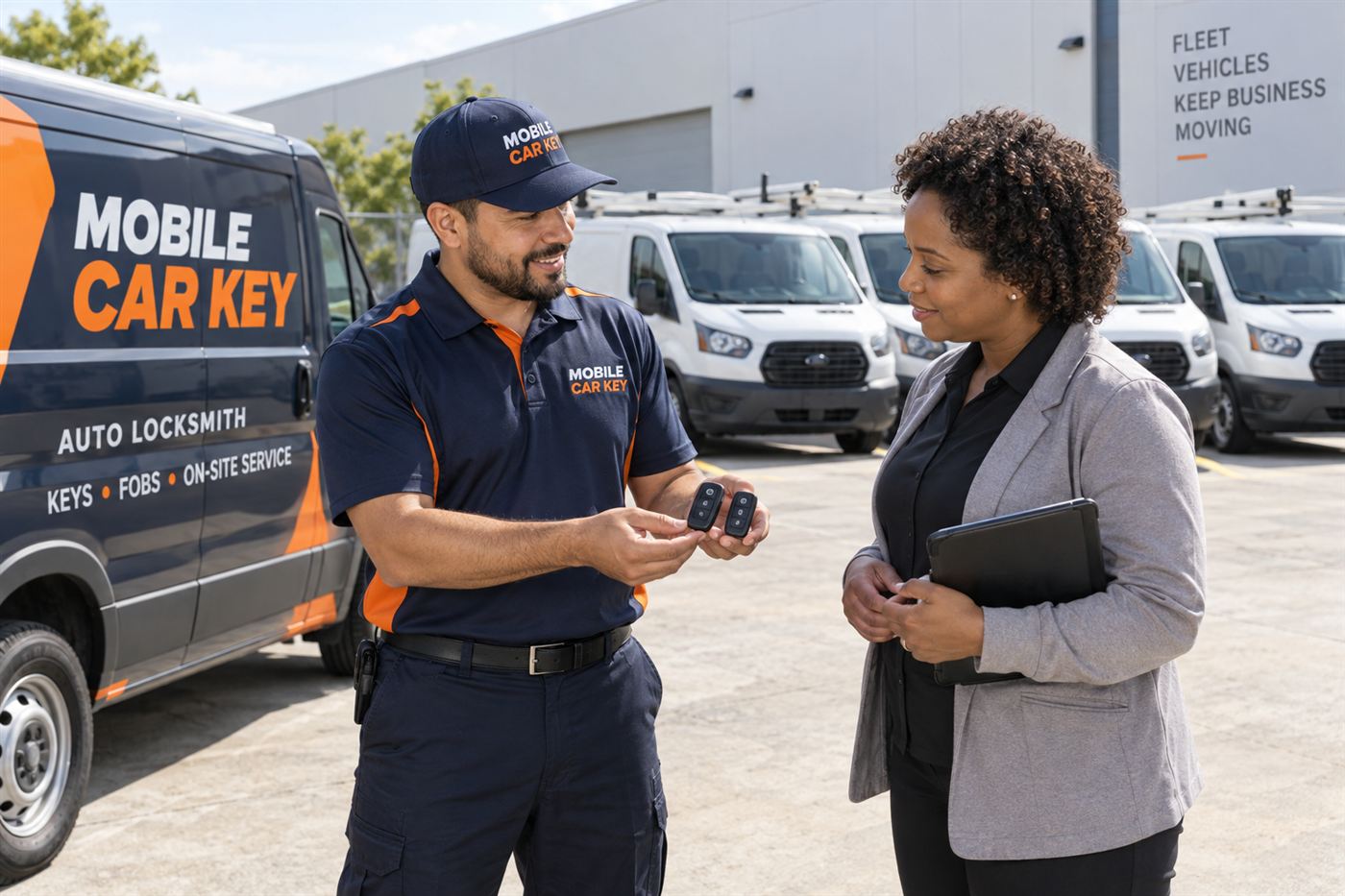
Why a truck key is not just a bigger car key
People often assume a pickup uses an older, simpler key than a sedan. Sometimes that is true, but many modern trucks carry the same electronic security as any other vehicle: a chip in the key, an immobilizer in the truck, and sometimes a remote or proximity fob on top of that. The truck looks rugged, yet the key system can be every bit as sensitive as the one in a family car.
What changes with trucks is the way the key is used. It rides in a work jacket, hangs from a lanyard with a dozen other keys, or sits in a cup holder covered in dust. Those habits create specific failure patterns, from cracked fob cases to worn blades that no longer turn smoothly.
This guide is educational. It does not create a service agreement, and what can be done for your truck depends on the make, the model, the year and the equipment installed. A mobile automotive locksmith confirms those details with you first.
The key types you will find on pickups
Pickup trucks span a wide range of key technology. Some older work trucks still use a plain metal key with no chip. Many others use a transponder key, where the plastic head hides a small chip that the truck must recognize before the engine will run. Newer trucks may use a remote head key with lock and unlock buttons built into the head, or a proximity fob that stays in a pocket while a start button does the work.
Which one your truck uses depends on the make, model and year, so it is better to describe what you hold in your hand than to guess. A technician can usually narrow things down from a short description and a photo of the key.
Here are the common categories a technician thinks about when a pickup owner calls:
- A plain metal blade with no electronics, found mostly on older work trucks.
- A transponder key with a chip inside the plastic head.
- A remote head key that combines the blade, the chip and the buttons.
- A flip key where the blade folds into a fob body.
- A proximity fob used with push-button start.
- A separate small remote carried alongside a basic key.
Habits that wear truck keys out
Truck keys fail in predictable ways. A key carried loose in a pocket with tools wears its cuts faster, and a worn blade may turn in the ignition only if you wiggle it. Fobs dropped from a tailgate crack at the seam and let in dust. Water at a boat ramp or a pressure wash can reach the circuit board and cause buttons to work some days and not others.
None of this means the key is beyond help. A worn blade can often be replaced with a fresh cut from the existing code, and a cracked fob case can sometimes be swapped without losing the programming. A technician looks at the damage before suggesting a path. Photos of the key from both sides, taken before the call, make that conversation easier and help the service judge whether a simple repair is realistic or whether a full replacement makes more sense.
If your key has started to feel stiff, loose or unreliable, treat that as a warning. Having a spare made while the original still works is usually simpler than starting from nothing after it fails. The only-one-key-left page covers that situation in more depth.
Signs that a key is on its way out
Look for a blade that bends slightly, edges that have gone shiny and rounded, a fob button that needs a hard press, or a case that has begun to separate. Any one of these suggests it is time to plan a spare.
When you have lost the only truck key
Losing the only key to a pickup is stressful, but it is a routine problem for a mobile automotive locksmith. The usual approach is to confirm the truck's details, verify ownership or authorization on site, and then create a new key that the truck accepts. For many trucks this can be done where the truck is parked, without towing it first.
Some trucks, especially newer ones from certain makes, may need dealer-level tools or manufacturer access to complete the work. A reputable service tells you that up front rather than after dispatch. If the truck needs the dealer, you will at least know before anyone drives out.
You can read more about the general process on the all car keys lost service page, which explains what to expect when no working key remains.
Lockouts at job sites, trailheads and boat ramps
Pickups tend to be parked in places where help is not around the corner. A locked cab at the end of a gravel road, a boat ramp parking area or a trailhead can be more stressful than a lockout in town. The good news is that a mobile technician travels to the truck, so the location is a detail you share rather than a barrier.
When you call, describe the nearest road, a landmark and whether the truck can be reached by a regular vehicle. If your phone shows a map pin, share it. Remote locations may affect availability, which is confirmed before dispatch.
If you are in a place with no cell coverage, try to walk or drive to the nearest spot where you can place a call. Stay with the truck when you can, and keep water and shade in mind on hot days. Our vehicle lockouts page walks through the whole lockout process.
Extended cabs, crew cabs and the key question
Cab style does not usually change the key itself, but it changes how you describe the truck. A regular cab, an extended cab and a crew cab can share a name yet differ in equipment. When you call, mention the cab style along with the trim level if you know it, because trim can decide whether the truck has a basic key or a push-button system.
Another detail worth sharing is whether the truck has an aftermarket remote start or alarm. Add-on systems sometimes carry their own remote and can complicate programming. A technician wants to know about them before arriving.
If you bought the truck used, check whether you have every key that came with it. Previous owners sometimes keep one or leave a worn spare behind. Counting what you have is a useful first step.
Also look at whether any of the keys you hold are damaged, because a cracked fob that still sort of works is a spare you cannot count on. Note which key is the one you use every day, since that one has seen the most wear and is the likeliest to fail next. Write down what you find so you can describe it clearly when you call.
Heavy-duty and diesel trucks
Heavy-duty pickups and diesel models sometimes use the same key technology as lighter trucks, and sometimes use a variant specific to their line. Whether a mobile technician can handle the work on site depends on the make and model, and a few newer systems need manufacturer-level access.
What matters to you as an owner is to be specific. Say whether the truck is a half-ton, three-quarter-ton or one-ton model, whether it has a diesel engine, and what the key looks like. That helps the service decide promptly whether the job is a good fit for a mobile visit.
Do not assume a bigger truck means a more complicated key or vice versa. The security system is determined by the manufacturer's choices for that year, not by payload rating.
Towing, trailers and the lost fob problem
Truck owners are often hauling something when a key problem strikes: a camper, a boat, a horse trailer or a load of lumber. If your fob stops working halfway through a trip, the first question is whether the truck is blocking traffic or sitting in a secure spot. If it is not secure where it is, prioritize getting yourself and anyone with you out of harm's way.
A dead fob battery is a common cause. Many fobs have a small spare blade or a spot on the steering column where the truck can read a weak fob. Your owner's manual explains the backup method for your truck. Trying it before you call can save a visit.
If the fob is not simply out of battery, a technician can look at whether the key needs reprogramming or replacement. Checking the battery before anything else helps you sort the two apart.
Before you unhitch anything
If the truck is hitched and the problem is a lockout, leave the trailer connected unless it creates a hazard. Disconnecting a trailer on uneven ground can cause bigger problems than the lockout itself.
Work trucks, shared trucks and proof of authorization
Many pickups are not owned by the person driving them. A truck might belong to a business, a rental company, a crew leader or a family member. A reputable automotive locksmith asks for proof that you own the truck or are authorized to use it before making a key, and this protects the owner as much as anyone.
Proof can take different forms depending on the situation: registration, title, a lease agreement, a work order from the owner, or identification that matches the paperwork. The technician explains what they need when you call, and you can gather it before they arrive.
If the truck belongs to an employer, contact them early. They may need to send a document or speak with the service directly. The technician explains exactly what they need to see.
Planning spares for a truck that works hard
A spare key is easier and more convenient to make while you still hold a working key, and trucks that see heavy use are good candidates for a spare. Keep it somewhere other than the truck, such as with a family member or in a secure spot at your shop. Avoid hiding it on the truck itself, since that invites theft.
Think about who else drives the truck. If an employee or family member needs regular access, a dedicated key for them may be better than sharing the only one. If you run several trucks, consider how keys are labeled and tracked.
Our spare key guide goes deeper on how many keys to carry and how to keep track of them. If you manage several work vehicles, the work van and fleet keys page covers business fleets.
Older trucks and the keys that remain
Pickups hold their value, so many owners keep a truck for decades. That means plenty of trucks on the road have keys that are worn, copied from copies, or no longer produced in the original style. Older trucks may use simple keys or early transponder systems, and each has its own considerations.
If you drive an older pickup, make sure the key you plan to copy actually works well. A copy of a worn key inherits the wear. A technician can often cut a new key from the lock itself or from the vehicle's information, which can be better than duplicating a tired original.
For trucks that have been around long enough to be considered collectible, the older and classic vehicle keys page covers what is different about those vehicles.
What to tell the service when you call
A short, clear description helps the service decide how to help you. You do not need to know technical terms. You only need to describe what you see and what happened.
Here is a checklist you can follow while you are still on the phone or filling out a callback request:
- Year, make and model of the truck, and cab style if you know it.
- Where the truck is parked and how to get to it.
- What happened: lost key, broken key, dead fob, locked out or truck will not start.
- What the key looks like: metal only, plastic head, buttons or a push-button fob.
- Whether you have any other working key.
- Whether the truck is yours, a business truck or borrowed.
- Anything unusual, such as aftermarket alarms or recent battery work.
Getting ready for the technician to arrive
Once availability and terms are confirmed, a technician comes to the truck. While you wait, gather your identification and any paperwork that shows the truck is yours or that you are allowed to use it. If the truck is in a spot where traffic is a concern, wait somewhere secure.
Keep your phone nearby and check that the service has the right location. If anything changes, such as moving the truck, tell them as soon as you can.
If children or pets are inside a locked truck, that is an emergency. Call 911 first, especially in warm weather. A mobile locksmith can help afterward, but emergency responders come first when someone is in danger.
Finding your way around related pages
Truck owners often find themselves reading about more than one topic. If your truck is a large SUV-style pickup or you also drive a crossover, the SUV and crossover keys page may help. For a broad look at vehicle categories, start at car keys by vehicle type.
If you are not sure what service you need, the main paths are laid out step by step across the site, and the process always begins with a short conversation about the truck and where it is parked.
Pickup owners tend to be practical people who want a clear answer and a clear next step, and that is the spirit of this page. Gather the details, be honest about what happened, and expect the service to be honest about what is and is not possible for your particular truck. Every vehicle and situation is different. A short conversation with a mobile automotive locksmith before dispatch, covering coverage, availability and terms, is the most reliable way to find out what is possible for your truck.
Common questions
Do pickup trucks use a different kind of car key?
Not as a rule. Trucks use the same families of keys as other vehicles: plain metal keys, transponder keys, remote head keys, flip keys and proximity fobs. The mix depends on make, model, year and trim. An older work truck may have a simple key, while a newer one may have push-button start. Describing the key you hold helps the service decide what is involved.
Can a mobile locksmith make a new key at my truck?
For many trucks, yes. The technician comes to the truck, checks ownership or authorization, and works on site. Some newer trucks need dealer-level tools or manufacturer access, and a reputable service tells you that during the call. Limits depend on the vehicle, so give the year, make, model and key type when you describe the problem.
What if my truck is parked in a remote spot?
Share the nearest road, a landmark and a map pin if your phone can produce one. A mobile technician travels to the vehicle, but distance can affect availability, and that is confirmed before dispatch. If you have no signal, move to where you can place a call, and stay out of danger from traffic or weather while you wait.
My truck belongs to my employer. Can I still request a key?
A reputable service asks for proof that you are authorized to use the truck. That might be a work order, a letter from the owner, registration that lists the company, or a call from a manager. Contact your employer early so the paperwork is ready when the technician arrives. It also helps to mention who the truck is registered to and which employee is currently driving it, so the service can follow the paperwork.
Should I make a spare before my only key fails?
Usually it is simpler to make a spare while the original still works. A worn or cracked key can fail without warning, and heavy truck use speeds that up. Store the spare away from the truck, with someone you trust or in a secure place, rather than hiding it on the vehicle. If the truck has several drivers, consider one spare per regular driver rather than passing a single key around the crew.
What if my fob stopped working but the truck still has a key blade?
Try a fresh battery first, then check your owner's manual for the backup start method. If the truck still will not respond, the fob may need reprogramming or replacement. A technician can test whether the problem is the battery, the fob itself or the truck's receiver. Mention any recent battery changes or jump-starts, because those events often explain a fob that suddenly behaves differently.