
Car key replacement
Replace a lost, broken or worn key and match it to the car.
Learn more →Mobile car key service
Lost your car key, broke a fob, or locked the keys inside the vehicle? Mobile Car Key Locksmith sends a technician to the vehicle instead of asking you to arrange a tow. Request a callback, answer a few questions about the car, and availability and terms are confirmed before anyone is dispatched.

Automotive services
Replace a lost, broken or worn key and match it to the car.
Learn more →Programming for remotes, chip keys and proximity fobs.
Learn more →A calm path when no working key remains.
Learn more →Careful access for a locked vehicle, with ownership checked first.
Learn more →Spare chip keys and the difference between copying and programming.
Learn more →Remote head keys, flip keys and push to start fobs.
Learn more →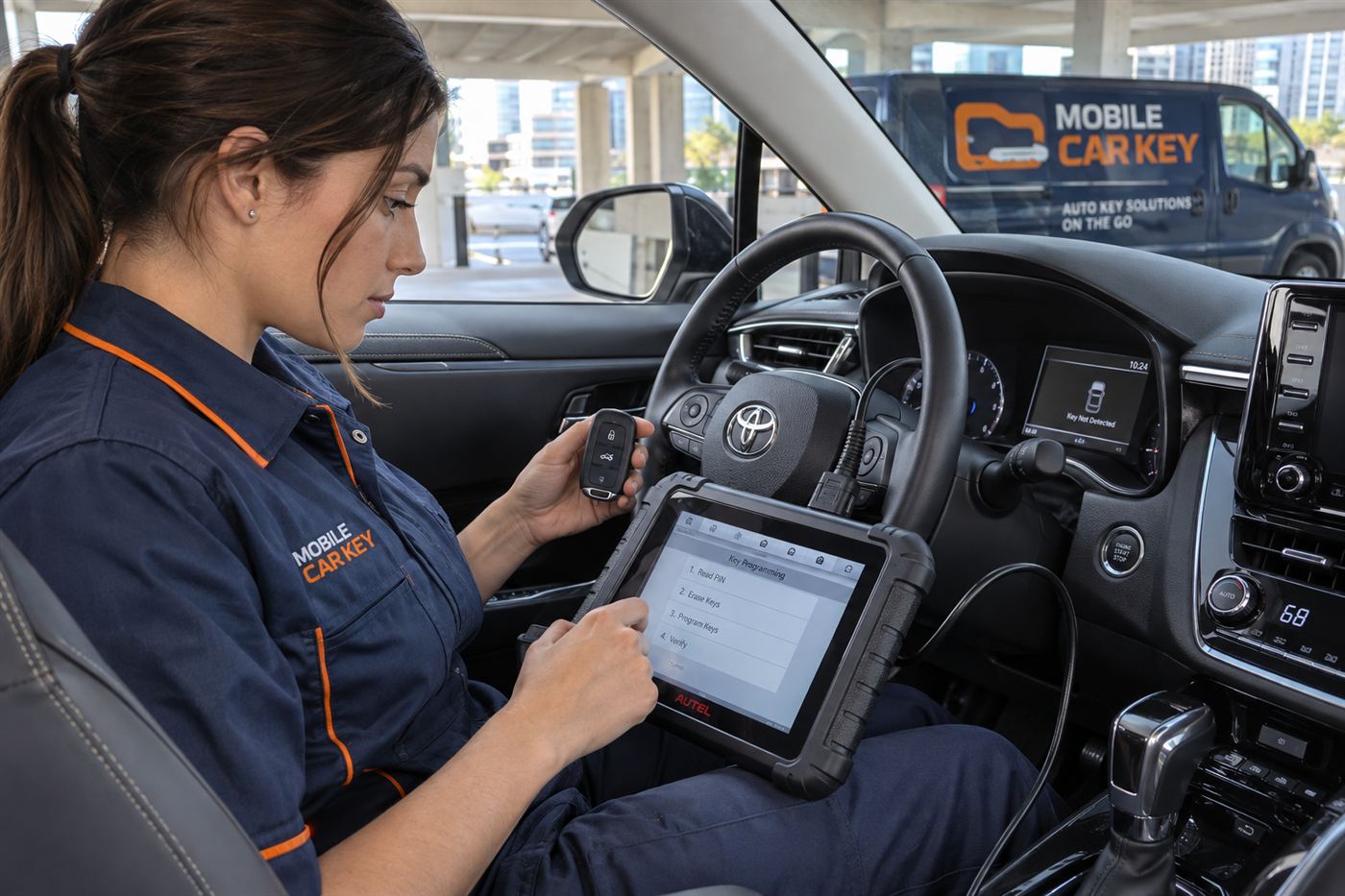
Vehicle-specific questions first
Modern automotive keys can involve a blade, a chip, remote functions, proximity features and the vehicle's own modules.
How the request flows
Share the year, make, model, location and whether a working key remains.
Replacement, programming, lockout, duplication or ignition: we sort out which.
Availability, capability, documentation and terms are confirmed before dispatch.
A technician comes to the vehicle, checks ownership, and does the work.
Across the United States
Pick your state to see how mobile car key service works where you drive.
See all statesA mobile workshop
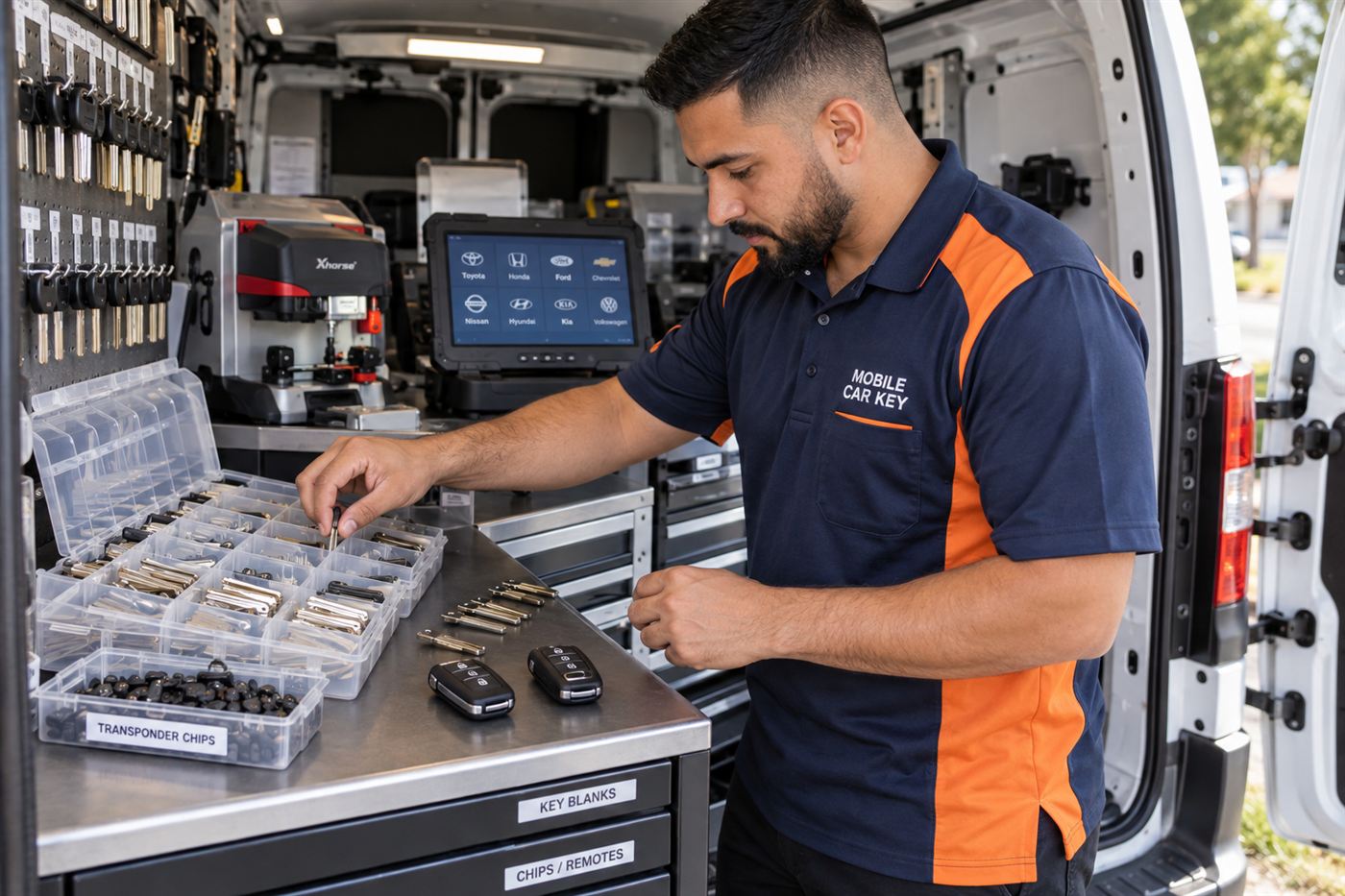
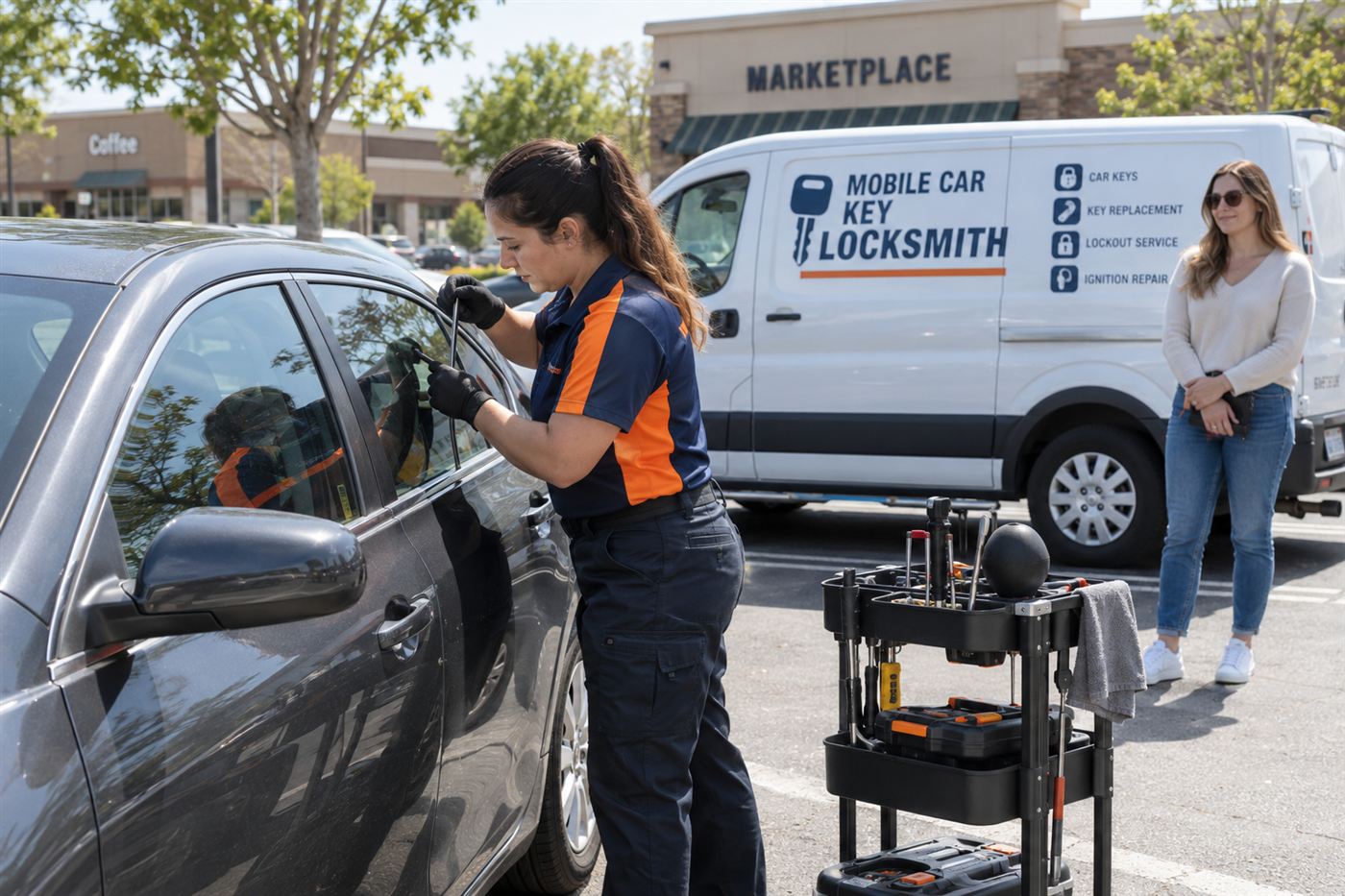
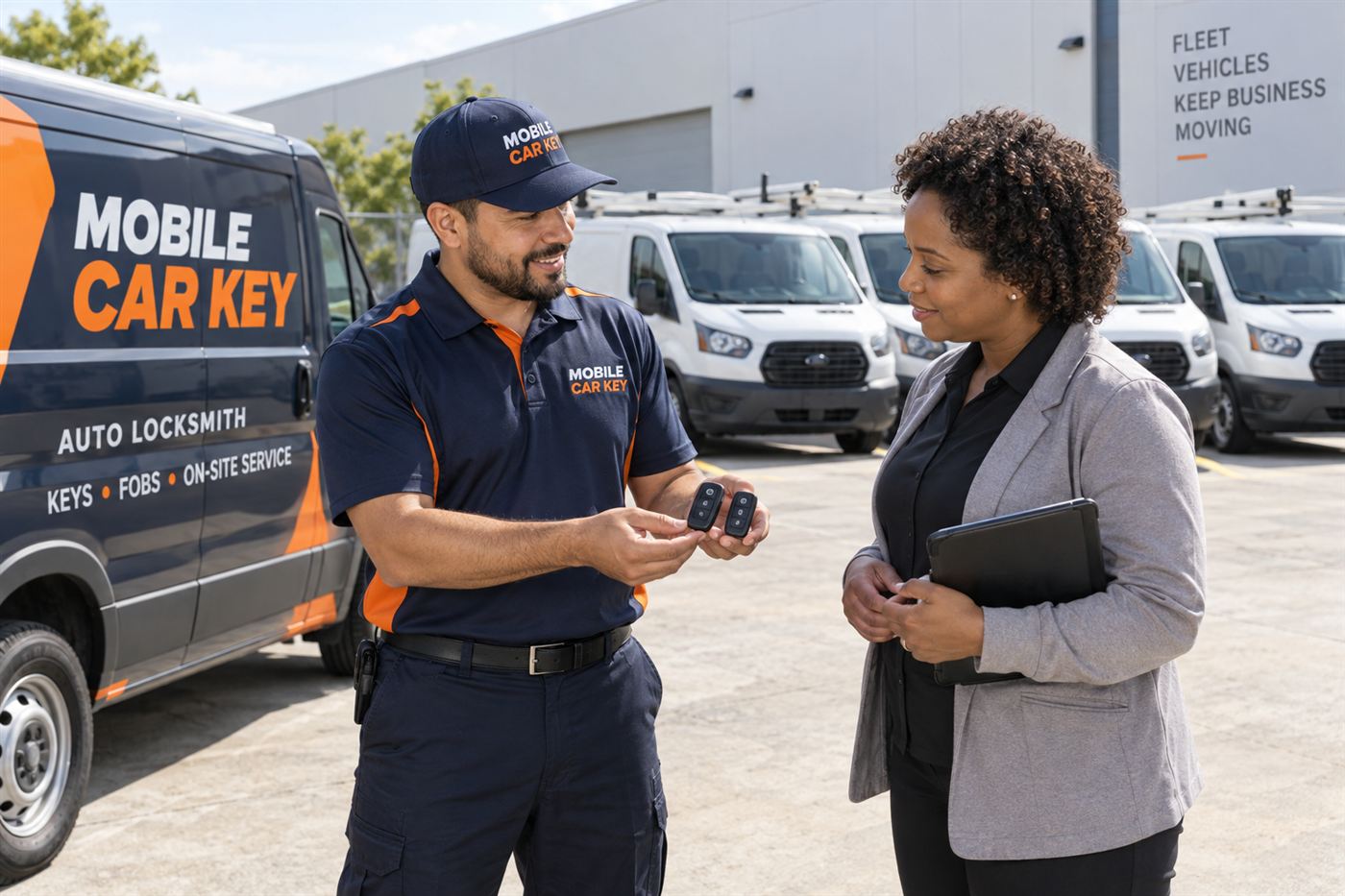
Mobile car key service means the work comes to the vehicle. Instead of towing a car to a shop, or finding a way to reach a dealership with no key in your pocket, a technician travels to the place where the car is parked and does the work there. That might be a driveway, an office lot, a shopping center, a hospital garage, a hotel, or the shoulder of a road.
Mobile Car Key Locksmith is an automotive service only. The work is limited to car keys, transponder keys, remote and proximity fobs, ignition keys, and getting into a locked vehicle. There is no side business in other kinds of locks here, and that focus matters. Vehicle keys are electronic devices as much as metal ones, and the tools, software and habits that go with them are specific.
The service covers the entire United States. Coverage is confirmed for your exact location and vehicle before a technician is sent, so you know where things stand before anything is scheduled.
Most requests fall into a few familiar groups. Knowing which group your situation belongs to helps you describe it clearly on the first call, and it helps the person on the other end ask the right follow-up questions.
The process is meant to be calm and predictable, even when the reason you are calling is not. You call or send a callback request. The service asks about the vehicle: the year, make and model, where it is parked, and what happened to the key. Those details decide which tools and key blanks are needed.
Availability, coverage and terms are confirmed before dispatch. That sequence is deliberate. You should know whether a technician can reach your location, and what the arrangement looks like, before the trip begins rather than after.
Once you agree to go ahead, a technician is sent to the vehicle. On site, ownership or authorization is checked, the work is carried out, and the result is tested. A new key is not finished when it turns in the ignition; it is finished when it starts the car, locks and unlocks it, and works the way a key should.
The technician confirms the vehicle matches what you described, asks to see proof of ownership or authorization, and then starts. Depending on the job, that can mean cutting a key, reading information from the car, programming a new key into its memory, or opening the vehicle without harming it.
At the end the technician tests every function you expect: the key in the lock, the engine start, and the buttons on any remote. You are encouraged to try everything before the visit ends.
The people who call about car keys are rarely having a good day. Many have been standing next to a locked car for a while, or have spent an hour retracing steps through a parking structure. A few common situations come up again and again.
A commuter drops keys through a gap in a parking garage. A parent loads groceries and the fob ends up on the wrong side of the glass. A traveler steps out of a rental car at an airport and cannot find the only key. A small business owner finds that an employee left and took a work van key along. A buyer picks up a used car at a fair price and then learns it has only one key, and that one is cracked.
The service is for ordinary drivers, families, commuters, travelers and small fleets. The question is always the same: the vehicle needs a key or access, and the owner needs someone who can handle that at the car.
Each of these drivers needs a different thing, but they share a worry: what happens if the car cannot be moved. That worry is why a service that arrives at the vehicle is useful. It lets people stay with the car, keep an eye on belongings, and keep the rest of the day from falling apart.
Cars, pickups, SUVs, minivans and many work vans use keys that can be replaced or programmed by a mobile technician. Some are simple cut keys. Many have a transponder chip. Others use a remote head, a flip key, a smart key for push-button start, or a key card. The key type tells you much more about the job than the badge on the grille does.
No honest service can promise that every vehicle from every maker is supported in every situation. Many are, and most common vehicles are within reach of a mobile technician. Limits depend on the vehicle, the key system and the tools and access available for that model.
Newer vehicles from some makes may need dealer-level tools or manufacturer access. When that is the case, it is better to hear it up front. A clear answer on the first call saves you a wasted trip, and it can point you toward the dealer when that is the sensible route.
When you describe your vehicle on the first call, mention anything unusual. An imported model, a vehicle that has been modified, a car with an aftermarket alarm, or one that already had an ignition replaced can all change which approach makes sense. Details that seem minor to you can matter a great deal to the person planning the job.
Coverage is national, but cars are local. A key problem in Phoenix, in Buffalo or on a road in rural Montana is solved by a technician who can actually reach that spot. When you send a request, the service looks at your location and the vehicle and works out whether it can match you with a technician near the car.
That is why the first conversation asks where you are parked. A downtown garage, a suburban cul-de-sac and a remote highway pullout are different jobs, and they affect what can be arranged.
You can browse service areas across the United States to see how coverage is organized, with a page for every state and the District of Columbia. Those pages talk about the driving conditions drivers face in each place, from winter cold to summer heat, and what that means for keys and fobs.
Rural areas deserve a plain word. Distances between towns are long in many parts of the country, and a technician may need to travel farther to reach a remote vehicle. That does not make help impossible, but it can change what is arranged. Telling the service your location honestly, and being flexible about meeting at a nearby town if the car can be moved, can open options.
A little preparation makes the call shorter and the job smoother. None of it is difficult, and you can gather most of it while you wait for a callback. If you are stressed, write it on your phone so you do not have to remember it under pressure.
Do not share card numbers, passwords or account logins in a first message. A callback request needs vehicle and location details, not financial ones. A reputable service will tell you how payment works when terms are confirmed.
A dealership is sometimes the right place for a key, and a full comparison is in the guide on a mobile locksmith or a dealership for a car key. The honest short version is that each has strengths.
The practical problem with a dealership is the vehicle itself. If every key is gone, the car may not start, and moving it means a tow or a flatbed. You also have to fit the visit into the shop's schedule and your own. A mobile technician removes the transport step, because the work happens where the car already sits.
Convenience is not the only reason, but it is a real one. A person with children, a work deadline, or a long drive ahead may value staying with the car and getting it sorted in place. For some newer models the dealer remains necessary, and a mobile service will say so rather than pretend otherwise.
It also helps to think about what the visit leaves you with. A mobile technician works on the car in front of you, and you can watch the work, ask questions, and test the result on the spot. Ask whatever you want to know about the key, the programming, and what is left behind in the car's memory.
A key is access to a valuable vehicle, and access to whatever is inside it. A reputable service asks for proof that you own or are authorized to use the vehicle. That request is not an insult. It is the same protection that keeps a stranger from walking into a shop and asking for a key to your car.
In general terms, that means showing documents that connect you to the vehicle, such as a registration or title, and an ID that matches the name. If you are driving a vehicle for someone else, such as a family member or an employer, the service may ask for confirmation from the owner.
If the paperwork is not with you, the ownership proof guide explains common ways people handle it. The goal is a path that protects the owner and still lets you get moving.
Rental cars, car shares and company vehicles are special cases, because the person holding the key is not the owner. In those cases the owner or fleet manager is usually the right first call, and a locksmith may need the owner's permission before doing anything.
Losing a key is annoying. Losing a key that someone else may have found is a different matter. If you do not know where the key went, or you think it may have been taken, it is worth thinking about what a stranger could do with it.
Many modern keys carry a chip that the car recognizes. When new keys are registered to a vehicle, the old ones can often be removed from the car's memory, so a lost key stops working for starting the engine. Whether that is possible depends on the vehicle and the system, and it is worth asking about during the call.
A physical key can still open the door if it has not been disabled, so the question is worth raising early. A technician can explain what can be done for your particular vehicle.
Anyone who has dealt with an all-keys-lost situation knows the difference between having one key and having two. With a working key in hand, adding a spare is usually a simpler job. With no key at all, the work is more involved, and the car must be identified and a new key created from nothing.
That is why spare planning is worth a few minutes. Keep one spare somewhere separate from the main key, and consider a second for a family member. Keep it out of the vehicle, since a spare inside a locked car does not help you.
The spare key guide covers where to keep spares and how many are reasonable. If your car came with one key, the right moment to fix that is before anything goes wrong, not after.
A spare made while you still have a working key is also a chance to check the condition of the original. If the main key is worn smooth, a fresh cut from the code can be better than a copy of a copy. Mention it, and the technician can advise which approach suits the vehicle.
Keys fail for ordinary reasons. A key ring carries a dozen other keys that grind against the ignition. Cold weather makes plastic brittle and batteries weak. Summer heat bakes fobs on a dashboard. Water gets into a pocket through a wash cycle and a fob never recovers.
A worn key can also wear the ignition cylinder in the car, which can make the next key feel sticky or refuse to turn. If you notice that a key needs wiggling, that is worth mentioning when you call.
Many fob problems are only a battery. The dead key fob battery guide explains how to tell a weak battery from a fob that needs to be programmed again, so you can try the simple fix first and call only if it does not work.
Cold snaps are a common trigger. A fob that worked fine in autumn can seem dead on the first freezing morning, and a lock can stiffen with ice. A warm pocket and a fresh battery solve many of these problems without any call at all, so try the simple checks first.
A growing share of vehicles use a smart key that never needs to touch the ignition. The car senses the fob nearby and allows the engine to start with a button. It is convenient, and it also changes what a replacement involves, because the fob and the car communicate electronically.
Smart keys often carry a hidden emergency blade, and many cars have a spot where you can hold a dead fob to start the engine. Knowing where that spot is on your own car is useful long before you need it.
Replacement and programming for smart keys depends on the make and model. Some can be handled by a mobile technician, and some newer systems need manufacturer access. The guide to push to start keys explained goes into the details in plain language.
One more point about smart keys: relay theft, where thieves capture and extend a fob's signal to open a parked car. Storing a smart key away from the entrance of your residence and using a signal-blocking pouch are common precautions. The remote and proximity fobs page discusses this alongside battery care.
A lockout is the most common reason for a call and also the most urgent in the wrong conditions. A driver standing beside a car in the sun, or in the cold, or in a poorly lit lot at night, feels it at once.
A trained technician uses methods designed not to damage the vehicle. Which method fits depends on the car and where the keys are. There is more on this on the vehicle lockouts page and in the safety guidance at locked out of your car safely.
If a child, a pet or a person with a medical problem is in the vehicle, treat it as an emergency and call 911 before anything else. Do not wait for a callback.
Before calling, check the obvious. Try every door and the trunk, since one may have been left unlocked. If you have a spare, consider whether someone can bring it to you. Those steps cost little, and if they fail you have lost nothing by trying.
Nothing on this website is a service agreement. The pages are educational, and they exist to help you understand your options. Availability, coverage and terms for any job are confirmed with you before a technician is sent.
That includes whether a technician can reach your location, what the job is expected to involve, and how payment will work. Having that conversation up front removes surprises, and the decision to proceed stays with you.
The how the service works page walks through each step in order, including what can delay a job. Reading it before you call is optional, but it can make the conversation easier.
It is also fair to ask questions. How will the technician confirm identity? What happens if the job turns out to need different tools than expected? Is there anything about the vehicle that could change the plan? A service that welcomes those questions is easier to trust.
Begin with a callback request or a phone call. Share the vehicle details, your location, and a short description of what happened. If you can, have the vehicle identification number and your documents nearby.
If you are not sure which service you need, that is fine. Describing the situation honestly is enough, and the person you speak with can sort out whether it is a replacement, an all-keys-lost job, a programming job or a lockout. The car key services page also lays out how the options relate.
The contact page explains what to include in a request and what to leave out. For common questions, the questions about mobile car key service page collects answers in one place.
A mobile car key technician comes to your vehicle and works on it where it sits. Depending on the situation, that can mean cutting a new key, programming a key or fob to the car, removing lost keys from the vehicle's memory, or opening a locked car. The work is tested before the visit ends.
Yes, a reputable service asks for proof that you own or are authorized to use the vehicle. In general terms that means a registration or title along with an ID that matches. This protects owners from someone else trying to obtain a key to their car.
Many cars can, but no one can honestly promise every vehicle. Limits depend on the make, the model and the key system. Newer vehicles from some makes may need dealer-level tools or manufacturer access, and a good service will tell you that at the start.
It can still be solved. The vehicle is identified, ownership is checked, and new keys are created and registered to the car. This is more involved than adding a spare when you still have a key. The page on all car keys lost explains the steps.
It depends on the vehicle. On many cars, registering new keys lets the old ones be removed from the car's memory, so the lost key no longer starts the engine. Ask about this during the call, especially if you think the key was taken rather than misplaced.
Call 911 first. A child or pet inside a closed vehicle can be in danger within a short span, particularly in heat. Emergency responders can act right away. A key technician is the second call, not the first, in any situation where a person is at risk.
Coverage and availability are confirmed before dispatch. When you call, you describe your location and the vehicle, and the service tells you whether it can match you with a technician near the car. You are not committed until you agree to the terms discussed.
No. The pages are educational and describe how car key service generally works. They do not create a service agreement. Availability, coverage and terms for a specific job are confirmed with you directly before a technician is sent to the vehicle.
Know what to share when you call
Have the year, make, model, current location, ownership information, and details about any remaining key or fob ready.