
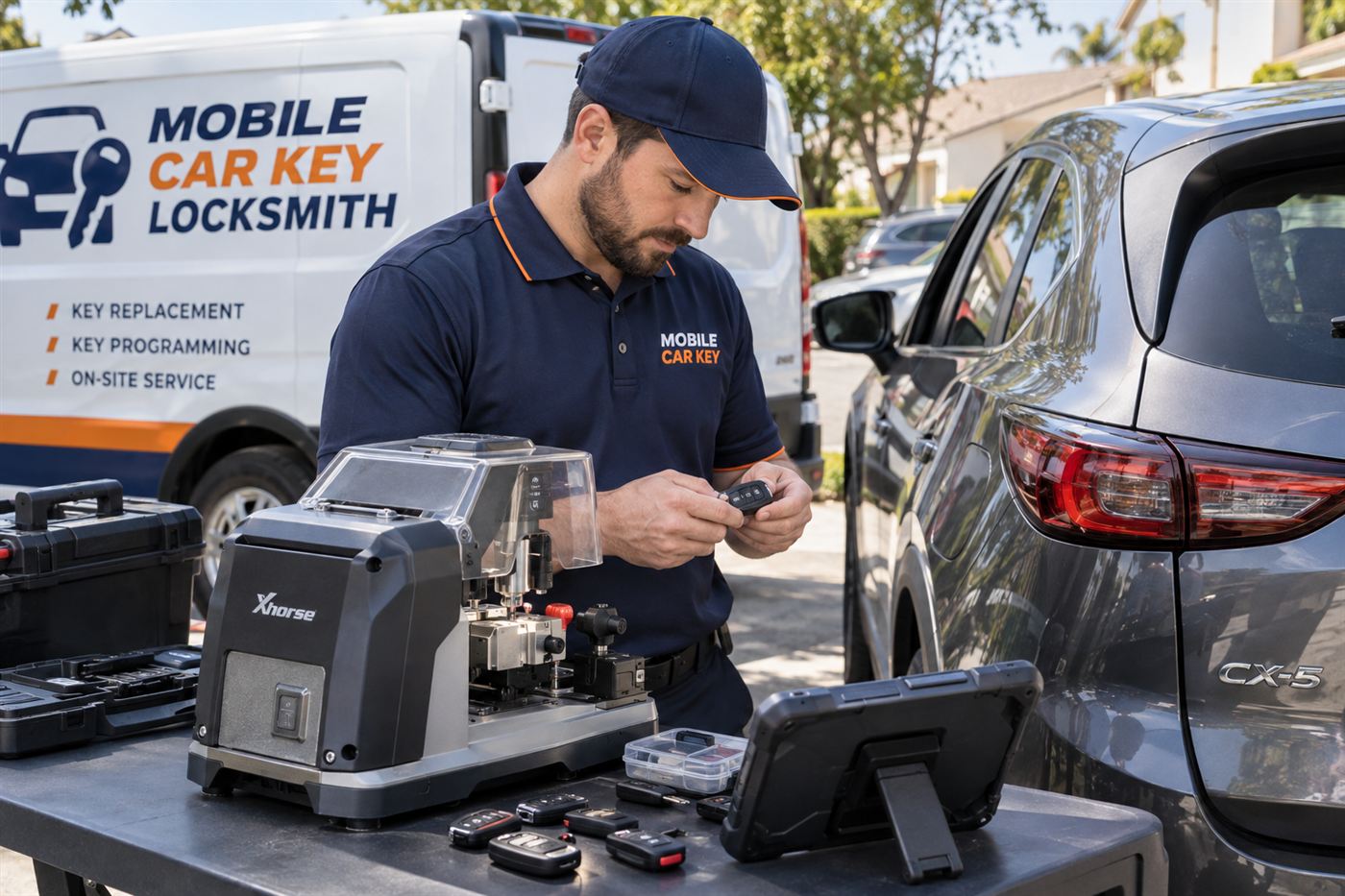
What replacement means
Car key replacement is the work of producing a new key that opens your vehicle and starts it, when the key you had has been lost, broken, worn out or damaged. The word sounds simple, but it covers a spectrum, from cutting a plain metal blade to creating and registering an encrypted smart key.
What separates the easy jobs from the involved ones is mostly information. If a technician can identify your vehicle exactly, and has a working key or the vehicle's key code to work from, the path is clear. If the information is missing, more steps are needed.
This page assumes at least some path to a new key exists. If every key has vanished, the closely related page on all car keys lost describes that more involved situation.
Many people arrive at this page thinking a key is a key. In practice, two drivers with the same make of car can need quite different work, because one car has a simple chipless key and the other has a smart key that talks to the vehicle by radio. Learning which of these you have is the first useful step, and the rest of this page follows from it.
It also helps to think about timing. Replacing a key you still have in worn form is a calm project. Replacing one you lost an hour before an important appointment is a rush. The work is similar, but the experience is very different, and planning ahead is the quiet lesson that runs through the whole subject.
The kinds of keys on the road
The first thing to settle is what kind of key your car uses. The badge on the trunk does not decide it. Year, trim and even the factory where the car was built can change the answer.
Looking at the key in your hand, or at a photo of it, usually makes the answer plain. The shape of the head, the presence of buttons and the thickness of the plastic all offer clues.
If you cannot tell what you have, look for markings. Some keys carry a stamped logo, a code or a letter that points to the key family. A thick plastic head usually means a chip. Visible buttons mean a remote. A key with no blade at all means a smart key. A technician can make the same judgement from a photo, which is why a clear picture helps.
Plain metal keys
Older vehicles often use a purely mechanical key with no chip. These are the simplest to replace, because cutting the blade correctly is the whole job. They are becoming rare, but they still turn up on older cars and some work trucks.
Transponder keys
A transponder key looks like a plain key, often with a thicker plastic head that hides a chip. The car will not start unless the chip is recognized. Replacement therefore involves cutting the blade and also giving the chip an identity the car accepts.
Remote head keys and flip keys
These add buttons for locking, unlocking and often opening the trunk. A flip key folds the blade into the body of the fob. Replacement involves the blade, the chip and the remote functions, and each may need separate attention.
Smart keys and key cards
Push-to-start vehicles use a proximity fob, sometimes with an emergency blade hidden inside. A few vehicles use a card instead. These are generally programmed to the car and may involve more specialized tools. See remote and proximity fobs for more.
Why keys fail
Keys fail because they are used hundreds of times a year under hard conditions. They are dropped on pavement, sat on, run through washing machines, left on dashboards in summer sun, and hung on heavy rings that pull on the ignition.
The metal blade wears slowly. The grooves smooth out, and eventually the key begins to stick or turn only with a wiggle. A worn key can also scrape the tumblers inside the lock and ignition, so the damage spreads to the car.
Plastic cracks, especially in cold weather. Once the casing splits, the chip inside can fall out or be crushed. Batteries in remote keys die, and moisture can corrode the contacts. A good habit is to replace a key that shows wear before it fails completely.
Habits make a surprising difference. A key used mostly for short trips and kept in a quiet pocket can last decades, while one carried on a ring with a dozen others, dragged through a workday and hung from the ignition may wear out in a few years.
Weather adds its own layer. Cold makes plastic brittle and weakens batteries. Heat warps cases and can damage the chip. Moisture corrodes contacts. None of this is dramatic, but over time it adds up, and it explains why so many key problems appear on the first very cold morning or the first scorching afternoon of the year.
- Blade worn smooth or bent.
- Head cracked or split open.
- Buttons that no longer respond or stick down.
- Key that turns only with extra force.
- Fob that has been through water or extreme heat.
Lost, broken or damaged: three different starting points
A lost key means the key itself is out of reach. If you have another working key, the replacement is mainly a matter of making a copy and giving it the right electronic identity. If you have none, you are in all-keys-lost territory.
A broken key usually leaves pieces behind. Those pieces can help, because the blade and the head can show the key type and sometimes the cuts. A key broken inside the ignition or a lock is a separate step, since the remnant must come out before anything else happens.
A damaged key may still work, which tempts people to keep using it. The trouble is that a key in poor shape can fail at the worst moment. Replacing it on your own schedule costs less stress than replacing it during an emergency.
There is also the stolen key, a case that is neither lost nor broken. If you think someone took the key, the question of disabling it matters most. Tell the service at the start, because it changes the order of the work: new keys are created, and then the stolen one is removed from the car's memory where the system allows.
Whatever the cause, resist the urge to keep driving on a key you know is failing. A key that works today and fails tomorrow often chooses a bad moment, and a snapped key in a worn ignition is harder to fix than a replaced one.
What a technician needs from you
The technician starts with the vehicle. The year, make and model identify the family of key systems. The vehicle identification number narrows it further and lets the key be matched to the exact car.
Next comes proof of ownership or authorization. A reputable service asks for this on every job, and the request is a safeguard rather than an obstacle. In general terms it means a registration or title and an ID that matches. The ownership proof guide explains what to do if your paperwork is not with you.
Last, the technician needs to know what you have. A working key, a broken key, key fragments or nothing at all each lead to a slightly different plan.
Do not worry if you are missing something. Describe what you have and what you do not, and the service will explain the options. Registration and title documents are often in the glove box of the very car you are locked out of, and that is a common problem with a workable answer.
Keep your own ID handy and make sure the name matches the ownership documents. Small mismatches, such as a recent move or a name change, are worth mentioning early so they do not cause a delay on site.
- Year, make, model and, if you have it, the trim or engine.
- The vehicle identification number.
- Where the car is parked.
- How many keys you had and how many are left.
- Photos of any remaining key, if you can take them.
How a new key is made
Making a car key has two halves: the physical half and the electronic half. They are done separately and tested together.
The physical half is cutting the blade. A technician may cut by code, which means using the vehicle's key code to cut a blade without any existing key. Or the cut may follow an existing key, or be derived by reading the lock. Whichever method is used, the blade must match the lock closely enough to turn smoothly.
The electronic half is giving the key an identity the car accepts. For a chip key, that means programming or cloning. For a remote, the buttons also need to be linked to the car. The result is tested in the lock, in the ignition, and with every button the key offers.
Quality in this stage shows up later. A blade cut a hair off will turn stiffly, wear the ignition and fail sooner. A technician who takes care with the cut and checks it against the lock is protecting both the key and the car.
On the electronic side, quality means confirming that the car accepts the key reliably, not just once. A properly programmed key keeps working through cold starts, battery changes in the car and ordinary use.
Cutting by code
Every vehicle has a key code, tied to its identification number and held in secure records. With the code and proof of ownership, a blade can be cut without ever seeing the old key. The code is not the whole story, because the chip must still be dealt with, but it solves the metal half.
Cloning versus programming
Cloning copies the identity of an existing chip onto a new one. Programming introduces a brand-new key to the car so the car adds it to its list. Which route applies depends on the vehicle and the chip, and the transponder key duplication page explains the difference.
Matching the key to the car
On most vehicles from recent decades, a key that turns the lock is only half a key. The car's immobilizer expects a coded signal from the chip, and it refuses to run the engine without it. Matching means telling the car that this new key is allowed.
The usual way is to connect a diagnostic tool to the car's data port, which lets the technician add the new key to the memory. Some vehicles have a procedure that can be done from inside the cabin with the keys. Others require manufacturer-level access.
During programming, the technician often also removes keys that should no longer work. That is how a lost key is turned from a liability into a dead piece of metal, where the vehicle supports it.
Some cars add a short waiting period or a security step to the programming sequence. That is by design, and it is not a sign that something has gone wrong. A technician who knows the vehicle will expect it and explain it.
Occasionally a car does not accept a new key at first attempt. The cause may be an unusual module, a low car battery, or a key blank that does not quite fit the system. A good technician checks these points, and may switch blanks or tools to complete the job.
Spare keys and replacement together
When a key is being replaced, it is the easiest time to think about spares. The technician is already at the car, the tool is connected, and the extra step is smaller than a separate visit later.
A common pattern is to replace the damaged key and add one more. The second becomes a spare kept somewhere secure and apart from the main key. If you use a flip key or smart key, consider whether you want a plain emergency key as well.
The guide to why every car needs a spare key explains where to keep spares and how many are reasonable.
Consider how you drive. If several people share the car, each might reasonably hold a key. If you take long trips, a spare kept in a separate bag from the main key is inexpensive protection. If you rarely leave town, a spare kept with a trusted relative may be enough.
Whatever you choose, avoid hiding a spare on the vehicle. Magnetic boxes under bumpers are well known to thieves, and they can fall off. A spare is only useful if it is secure and also within reach when you need it.
What affects the job
Replacement is not one-size-fits-all. A handful of factors explain most of the difference between one job and another.
Key type matters most. A cut-only key is a different task from a smart key. Next is how many keys are left. After that comes the vehicle itself: age, make, model and the security system. Some systems are well supported by mobile tools, and some require manufacturer access that not every technician has.
Finally, location and conditions play a part. A job in a covered lot on a mild day is simple. A job on a roadside in the rain is harder to carry out and test properly.
Preparation reduces variables. When you give a full description of the vehicle and the key, the technician can bring the right blanks and tools. When details are missing, the first visit may only identify the car, and a second trip may be needed.
If something changes on site, such as discovering that the vehicle has a different key system than described, a reputable service explains the change before proceeding. The decision to continue stays with you.
- Type of key and how many functions it has.
- Number of existing keys.
- Make, model, year and key system.
- Need for dealer-level tools or manufacturer access.
- Access to the vehicle and the conditions where it is parked.
Newer vehicles and dealer-level limits
Newer vehicles from some makes may need dealer-level tools or manufacturer access to add or replace keys. A mobile technician may not be able to reach those systems, and honest services say so at the start.
If your vehicle is in this group, you may be directed to the dealer, or to a technician with the right access. Hearing that before a trip is made saves everyone time.
The question of which route suits you is explored in the guide to a mobile locksmith or a dealership for a car key.
The practical effect is that the first question to ask is whether your specific vehicle can be handled. Provide the year, make and model, and let the service answer honestly. If the answer is no, the time you spend finding that out is short, and the dealer route can begin without delay.
Broken keys in the ignition or door
Sometimes the key breaks off in the lock. It is a common problem, and it deserves care. Do not try to dig out the piece with a knife, a pin or glue. Those attempts can push the fragment deeper and damage the lock.
A technician can extract the remaining piece using thin tools designed for the purpose, then cut or program a new key. If the ignition is worn or damaged, the technician can tell you whether it is still reliable.
Keep the broken pieces. They can show the key type and sometimes the cuts, which helps the replacement.
After extraction, look at the ignition itself. If the key had been sticking for a while, the cylinder may be worn. A new key in a worn ignition can fail early, so it is worth asking whether the cylinder needs attention.
Door locks are similar. A key that snaps in a door lock can usually be extracted and replaced without harming the lock. Avoid using the door until the fragment is out, because pushing a key in again may drive the piece further.
Testing the finished key
A key is not done when it turns once. A proper job includes testing every function. The new key should unlock and lock the doors, open the trunk if it has that button, turn the ignition smoothly, and start the engine. For a fob, every button gets tried.
Test it more than once. Start the engine, turn it off, and start it again. If the key has remote functions, try them from a short distance as well.
If something is not right, say so while the technician is still there. It is much easier to correct a fault on the spot than after a long trip.
Ask the technician to explain what was done. Which method was used to cut the key? How was it programmed? Were any lost keys removed from the car? You have a right to understand the work on your own vehicle, and a good technician is happy to explain it.
How a replacement request works
The path is simple. You call or send a callback request. The service asks about the vehicle, the location and what happened to the key. Availability, coverage and terms are confirmed before dispatch. A technician comes to the vehicle, checks ownership, makes the key, programs it and tests it.
The how the service works page describes each step. Nothing on this page creates a service agreement, because the details of any job are confirmed with you first.
If anyone is in danger, such as a child or pet in a hot car, call 911 first.
Before you call, decide how you can be reached. A phone that rings in an area with poor reception wastes time for both sides. If you are at a remote spot, tell the service about nearby landmarks. A clear location is half the work of arranging help.
Looking after the new key
Once you have a new key, treat it better than the last one. Keep the key ring light. A heavy ring hanging from the ignition puts steady strain on the cylinder, and it wears both the key and the car.
Keep fobs away from water and heat. A dashboard in summer sun is hard on plastic and batteries. Replace the battery on a schedule rather than waiting for failure.
Finally, add a spare if you have not already. The strongest protection against a key emergency is a second working key stored where you can reach it.
Keep a note of what you have. A simple list of how many keys the car has, who holds them, and where the spares are stored saves trouble later. For a family, it is worth agreeing on a single place for the main set.
Common questions
Can a new key be made if I have no original?
Often yes. With the vehicle identified, proof of ownership shown, and the key code or lock information available, a technician can cut a blade and program a new key. It involves more steps than copying an existing key, and the details depend on the vehicle and its security system.
Does replacement mean copying my old key?
Not always. A copy follows an existing key, but a replacement may be cut from the vehicle's key code and then programmed to the car. For a chip key, a copy of the blade alone will not start the engine, so the electronic identity must also be set up.
Will the new key work with my remote buttons?
It can, if the key has remote functions and they are programmed to the car. Remote head keys and flip keys need the buttons linked as well as the chip. Test every button before the technician leaves so any fault can be corrected on the spot.
What if my key broke inside the ignition?
Do not dig at it. The fragment can be removed with thin tools made for that, and then a new key can be made. Keep the pieces because they can help identify the key. If the ignition itself is damaged, the technician can advise on what that means.
Can the lost key still start my car?
On many vehicles, programming new keys lets the lost key be removed from the car's memory, so it can no longer start the engine. This depends on the vehicle and system, so ask about it, especially if you think the key was stolen.
Do all vehicles allow mobile key replacement?
Many do, but not all. Newer vehicles from some makes may need dealer-level tools or manufacturer access. A good service will tell you early if your make or model falls into that group, so you can choose the right route without wasting a trip.
Why must I prove ownership?
A key gives access to a vehicle, so a reputable service asks for proof that you own it or are authorized to use it. This usually means a registration or title and a matching ID. It protects owners and is a normal part of the process.
How do I avoid needing a replacement again?
Keep a tested spare in a separate place, keep your key ring light, protect fobs from water and heat, and replace remote batteries on a schedule. If a key sticks or looks worn, replace it before it breaks. A little care makes the next emergency much less likely.