
What programming means
Programming is the process of making a car and a key or fob recognize each other. Every modern fob carries electronic identity. The car keeps a list of identities it accepts. Programming adds a new identity to that list, or re-links an existing one that has dropped out.
Without programming, a fob is just a plastic case with a circuit board. It may transmit a signal, but the car has no reason to listen to it. That is why a new fob out of the package, or a fob bought online, so often does nothing at first.
Programming is not copying the metal key. It is a separate electronic step that works alongside cutting. The page on car key replacement covers the cutting side, and this page focuses on the electronic one.
A useful way to picture it is a guest list at the door of a building. The car is the doorman, and each key is a guest. Cutting a blade gets a guest to the door, but the doorman still checks the list. Programming writes the guest onto the list, and removing a key crosses a name off it. That mental picture explains most of what follows on this page.
It also explains why a fob taken from a different car often fails: it is on another car's list, and the new doorman has never heard of it.
What a key fob actually contains
Opening a fob reveals more than most people expect. There is a small circuit board, a battery, a radio transmitter for the buttons, and usually a separate chip or antenna that identifies the key to the immobilizer. In a smart key there is also a receiver that listens for the car.
Those parts do different jobs. The buttons send a coded radio signal when pressed. The immobilizer chip answers the car when the key is in the ignition or nearby. A smart key keeps both systems active, since the car checks it constantly.
Understanding that there are two layers helps with troubleshooting. A fob can lose one function and keep the other, and the fix depends on which one failed.
Frequencies matter as well. Remote systems transmit on specific radio frequencies, and cars listen for the one they were built to use. A fob that looks identical but uses another frequency will never be heard, no matter how carefully it is programmed.
Chip types differ too. Different generations of chip exist, and a car expects its own kind. These small invisible differences are the reason a technician asks for year, make and model instead of just a photo of the fob.
Buttons versus the chip
This is the single most useful idea on this page. The buttons on a fob and the chip inside the key are separate systems. They can fail separately, and they are programmed separately.
If the buttons stop working but the key still starts the car, the chip is fine and the problem lies with the remote side: the battery, the button contacts, or the remote's link to the car. If the buttons work but the engine will not start, the chip is the issue.
Some people are surprised to learn that a car can start without any working buttons. The ignition only needs the chip. Likewise, the buttons can work perfectly and not start the car if the chip is unrecognized. Telling the service which symptom you have makes diagnosis much quicker.
Panic buttons, trunk releases, remote start and sliding door controls are all part of the remote side. Some vehicles let you program each separately, and some set them as a group. If one button fails while the others work, a worn contact under that button is a likelier cause than a programming problem.
Wear is common on the lock and unlock buttons, since they are used most. A rubber pad that has flattened or a contact that has worn through can often be revived by a new case or a repaired board.
A simple test
If the key turns the ignition and the engine starts, the chip is working. If the doors will not respond to the buttons, you are looking at the remote side. Reverse it for the other case. You can usually work this out in a minute without any tools.
On-board programming
Some vehicles allow a fob to be programmed without any special equipment. The process uses a sequence of actions inside the cabin: turning the ignition on and off, pressing buttons in a set order, opening and closing doors, or holding a key in a particular position.
This is called on-board or self programming. It exists on a limited range of vehicles, and typically for the remote buttons rather than for the chip. The steps vary by make and model, and they are easy to get wrong if the sequence is slightly off.
A technician knows the procedure for a vehicle and can complete it reliably. Even where on-board programming exists, the car may require that an existing key is already working, so it does not help in an all-keys-lost situation.
Not every driver has the manual that describes the sequence, and online guides are mixed in quality. A sequence meant for one model year may fail on the next, and there is no harm in stopping to ask for help instead of guessing.
Where on-board programming does apply, it can be a convenient route for adding a spare remote when a working key already exists. Keep every working key with you during the process, since some cars clear the memory and need all keys to be presented together.
Tool-based programming
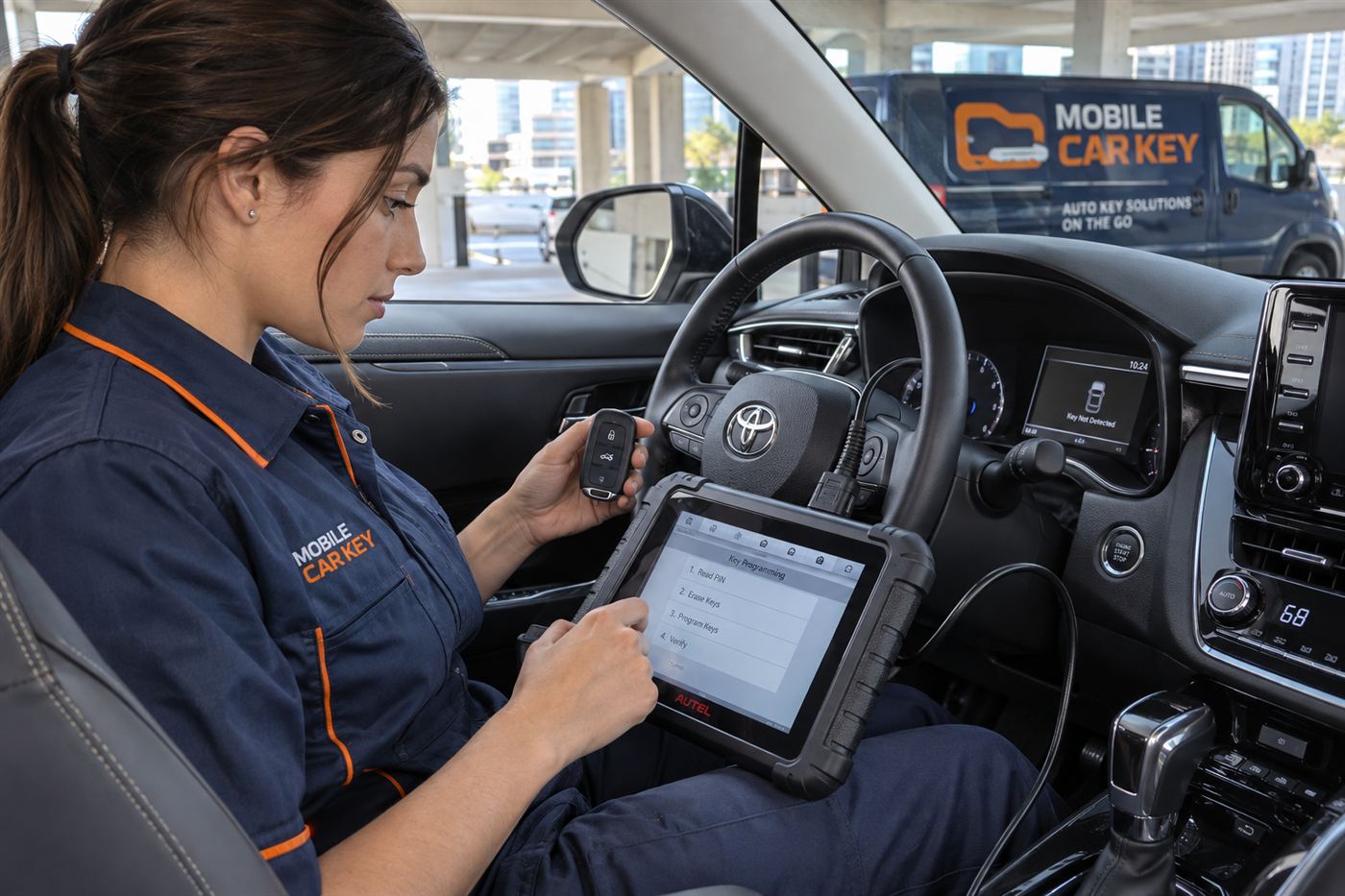
Most chip keys and many fobs are programmed with a diagnostic tool connected to the car. The tool plugs into the vehicle's data port, communicates with the immobilizer and the body control module, and writes the new key into memory.
This route can add keys, remove keys, and sometimes read information needed to make a key. It also lets the technician confirm that the work took by checking the key list afterward.
The tool needs the right software and the right level of access for the vehicle. Some makes are broadly supported. Others need manufacturer-specific access. The transponder key duplication page explains how chips and immobilizers fit in.
The technician's tool also helps with diagnosis. Reading the key list shows how many keys the car has, and whether a particular key is recognized. It can reveal a low car battery, a communication fault, or a module that is not responding, any of which can look like a bad fob from the outside.
Stable power matters during programming. A weak car battery can interrupt a sequence and leave a module in an odd state. Technicians often use a power support unit to keep voltage steady, which is another reason not to try complicated procedures with a dying battery.
Newer vehicles and dealer-level limits
Newer vehicles from some makes may need dealer-level tools or manufacturer access to program a new key or fob. Security has tightened over the years, and some systems now require authorization that is only available through the manufacturer's channels.
A mobile technician may or may not have access to those channels for a given make. A trustworthy service tells you early, rather than leaving you to discover it after a trip. If your vehicle falls into that group, you may be directed to the dealer.
The guide on a mobile locksmith or a dealership for a car key covers the choice in plain terms.
There is a bright side. Where a mobile technician does have access, the work can be done at the car, with no tow and no waiting for a shop appointment. The key is to ask the right question at the start: can you program a fob for my exact year, make and model? Then listen to the answer.
Battery problems that look like programming problems
Weak batteries cause a surprising share of fob trouble. Symptoms include shorter range, buttons that need several presses, a dashboard message about low key battery, or a smart key that is sometimes recognized and sometimes not.
Replacing a fob battery is simple on many models, but there are traps. The battery type must match. Polarity matters. Some fobs hold a tiny spring contact that bends easily. And handling the circuit board with oily fingers can affect contacts.
After a battery change, most fobs work again without programming. Some need a reset. If the fob does nothing after a fresh battery, programming becomes a more likely cause. The dead key fob battery and reset guide describes the steps.
Which battery is it? Most fobs use a small coin cell with a number printed on it, and the number should be matched exactly. Pry the case open gently with the right tool, note which side faces up, and avoid touching the flat faces of the new battery with bare fingers.
After the change, wait a moment and test the buttons. If a smart key is involved, hold it near the start button or the marked spot and see whether the car responds.
- Shorter range than before.
- Buttons that need to be pressed several times.
- A low key battery message on the dashboard.
- A smart key that works only when held close.
- A fob that stopped altogether after sitting for a long time.
Reset and re-sync
Sometimes a fob that worked yesterday stops today, with no battery issue. The fob may have lost sync with the car. This can happen after a battery swap, a dead car battery, a jump start, or a long period without use.
Re-syncing is a lighter step than full programming. It may involve a short sequence of actions, such as pressing a button while the key is in the ignition. On some cars the fob re-learns itself after being used once in the ignition.
If you try a reset and nothing happens, do not repeat it endlessly. Repeated failed attempts can cause some systems to lock out for a while. Stop, note what you tried, and ask for help.
Jump starts and dead car batteries deserve a note. When a car loses power, some systems forget parts of their configuration. A fob that worked on Monday may need a re-sync on Wednesday after a battery replacement in the car.
If the problem began right after work on the car, such as a new battery, a repair, or a software update, mention that to the service. It is a strong clue, and it points toward re-sync instead of a failing fob.
Programming a replacement fob
A new fob needs to be the right one. Fobs look similar across years but use different frequencies and chip types. A fob that is physically identical may not be compatible. This is why the vehicle details are asked for at the start.
Buying a fob online and expecting it to work out of the box is a common source of frustration. Some will program easily, some are not the right type, and some are locked to another vehicle and cannot be reused. A technician can confirm compatibility before you spend money on a part.
If you bring your own fob, tell the service in advance. They can tell you whether it can be used and what the job would involve. Where a fob is the wrong type, supplying a correct one often saves time.
Check the labels. Many fobs have a part number or an identification code printed inside the case or on the back. Matching that against what the vehicle needs is one of the surest ways to buy the right part. A technician can tell you which numbers matter for your car.
Low-cost generic fobs vary in quality. Some are well made, and some fail within months. If you plan to program a fob you bought, ask beforehand whether the service is comfortable working with it.
When a fob cannot be reused
Not every fob can be given a second life. A used fob taken from another car may be locked to its original vehicle. Some chips can be written only once. Others are cloned or tied to a specific identification number and cannot be reset.
Physical damage ends many fobs. A fob that has been through water, crushed, or cracked open may have a failed board. Broken contacts and corroded batteries compartments are common.
If a fob cannot be reused, the answer is a new one. That is not a failure of the technician. It reflects how the part was built, and a clear explanation helps you decide how to proceed.
Do not throw away a failed fob right away. Even a damaged one can show the technician which model it was, the frequency and the part number. It can be useful for reference when ordering the replacement, and it may even supply a working blade.
- Locked to another vehicle and unable to be reset.
- A chip that supports only a single write.
- Water damage, cracks or corrosion on the board.
- The wrong frequency or chip type for your vehicle.
- A model that needs manufacturer access to accept new keys.
Smart keys and push-to-start programming
Smart keys are programmed a little differently. They communicate with the car through short-range radio and need to be registered with the vehicle's body control system. Many also have a hidden emergency blade that is cut separately.
A technician typically uses a diagnostic tool to add the smart key, then tests that the car recognizes it inside the cabin and allows starting by button. Range checks are common: the car should detect the key at each door, the trunk and inside.
Smart keys are among the most likely to need dealer-level tools on newer models. The page on remote and proximity fobs explains each type in more detail, including relay theft and battery care.
Convenience features such as walk-away locking, remote windows and proximity trunk release are tied to the smart key. When a replacement is programmed, these settings may need to be checked and re-enabled, since a new key can arrive with defaults that differ from what you are used to.
Mention any features you rely on. It is simpler to check them while the technician is present than to find one missing later.
How many keys can be programmed
Cars generally hold a limited number of keys in memory. The limit varies by make and model. Reaching the limit means that adding another key may require removing an old one first.
This matters for used cars. Previous owners may have programmed several keys, and some of them may still be out there. If you buy a used car, it is worth asking whether old keys can be removed from memory so only the keys you hold will work.
For families and small fleets, plan how many keys you want in circulation. Each additional key is another thing to track, so a balance between convenience and control makes sense.
Fleet owners face this problem most. A van that has gone through several drivers and several programmed keys can reach its limit. Clearing the list and re-registering only the current keys keeps control in the hands of the business, and it is a sensible step whenever a driver leaves.
Testing after programming
Every function should be tested before the visit ends. The doors should lock and unlock, the trunk should open if the fob has that button, and any panic or remote-start buttons should respond. The engine should start and run, and then start again after being shut off.
Test from a few distances if the fob has remote buttons. Walk away from the car and try the buttons from a short way off, so you are not surprised later when range is poor.
If a function does not work, mention it while the technician is still there. Many faults are simple to correct when the tool is still connected and the vehicle is nearby.
Check also that the car locks behind you when you walk away, if that feature is on, and that it does not lock with the key inside. Smart key systems are designed with safeguards, but it is better to see them work before you rely on them.
Looking after your fobs
Fobs live hard lives, but a few habits extend them. Keep them away from heat on dashboards and from moisture. Do not hang a heavy ring of keys from a fob. Replace batteries on a regular schedule, not after the failure.
Keep a spare battery in the glove box if your fob uses a common type. Know where the emergency blade is on a smart key, and where to hold a dead fob to start the car. Those small bits of knowledge turn a bad morning into a minor delay.
If you have only one working fob, treat that as a project. A second one, programmed early, is much easier to arrange than a replacement after a loss.
Pay attention to warnings. A dashboard message about low key battery is the car asking for help, and ignoring it leads to the worst-timed failures. Replacing a battery costs little, and doing it on a calm afternoon beats doing it in a rain-soaked lot.
How a programming request works
You call or send a callback request, and describe the vehicle and the problem. The service asks about the fob, whether it is new or old, and whether the car still starts. Availability, coverage and terms are confirmed before dispatch.
A technician comes to the vehicle, checks ownership or authorization, does the programming, and tests it. The page on how the service works sets out each step in order.
Nothing on this page creates a service agreement. If anyone is in danger, such as a child or pet in a hot car, call 911 first.
Have the fob with you, along with any other keys. If you bought a fob separately, keep the packaging, since part numbers on it can help. And keep your documents ready. Ownership is checked on site, and a missing document is the most common reason a visit is delayed.
Common questions
What does programming a key fob mean?
It means adding the fob's electronic identity to the car's memory, so the car recognizes and accepts it. A fob that has not been programmed may look fine and still do nothing. Programming is separate from cutting the metal blade, and it is done with a procedure or a diagnostic tool.
Can I program a fob myself?
On some vehicles, a sequence of actions inside the cabin can program the remote buttons. Many fobs and nearly all chip keys need a diagnostic tool. If you try and it fails, stop after a couple of attempts, because repeated failures can lock some systems for a while.
Why does my fob unlock the doors but not start the car?
The buttons and the chip are separate systems. Working buttons mean the remote side is fine, while a no-start suggests the immobilizer chip is not recognized. The chip may need to be programmed or replaced, or the fob may be the wrong type for your vehicle.
Will a new battery fix a dead fob?
Often, yes. A weak battery causes shorter range and unreliable buttons. After a fresh battery, many fobs work again at once, and some need a reset. If a fresh battery changes nothing, programming or a damaged board becomes the more likely cause.
Can a used fob from another car be programmed to mine?
Sometimes, but not always. Some are locked to their original vehicle and cannot be reset. Others are the wrong frequency or chip type. A technician can check compatibility before you rely on a used fob, which can save a wasted purchase.
How many fobs can a car hold?
It varies by make and model, but there is generally a limit. If the memory is full, an old key may need to be removed to add a new one. This is worth knowing for used cars, where previous owners may have programmed several keys.
Do all vehicles allow mobile fob programming?
Many do, but no one can honestly promise all. Newer vehicles from some makes may need dealer-level tools or manufacturer access. A good service will say so early, and the dealer may then be the sensible route for your vehicle.
Does this page create a service agreement?
No. It is educational. Availability, coverage and terms for a specific job are confirmed with you before a technician is sent to the vehicle, and ownership or authorization is checked on site before any programming begins.