
Describe the failure before you fix it
A fob that has stopped working can mean several different things. Perhaps none of the buttons do anything. Perhaps only one button has stopped. Perhaps it works from close range and not from a distance. Perhaps it unlocks the doors but will not start the engine. Each pattern points to a different cause.
Four patterns come up again and again. The first is total silence: no light on the fob and no response from the car. The second is a fob that lights up but gets no answer from the vehicle. The third is a fob that works at close range only. The fourth is a fob that locks and unlocks but will not start the engine. Knowing which of the four you have narrows the list of suspects considerably.
Take thirty seconds to notice exactly what happens. Does the small light on the fob blink when you press a button? Does the car make any sound, flash its lights or click its locks? Does the dashboard show a message about the key? Those observations are worth more than guessing.
Write the pattern down in plain words. It will help you move through the checklist and it will give a technician a head start if you end up calling.
Rung one: the battery
The coin sized battery inside a fob is the most common reason for sudden silence. These batteries do not die with a warning. They weaken gradually, so the reach shrinks first, then the buttons need several presses, and finally nothing works at all.
Many fobs open with a small slot on the side or back. Check the number printed on the battery, usually a code with letters and digits, and match it exactly. Insert the new battery with the positive side facing the same way as the old one. Press the buttons while standing close to the vehicle.
If the fob works again, you are done, though it is wise to replace the battery in any other fobs you own at about the same time, since they are the same age. The dead fob battery guide covers battery types and care.
Not every fob battery is a coin cell
A few fobs use rechargeable cells that charge when the key is inserted into the ignition. If the car has not been driven with that key for a long time, the cell may be flat. Others have batteries soldered to the board. If you cannot find a way to open the fob, ask rather than prying.
Rung two: distance, angle and obstacles
Before opening anything, walk right up to the driver door and press the button again with the fob held near the handle. A weak battery or a crowded radio environment can make a fob work only at arm's length.
Large parking structures, shopping centers, hospitals, airports and areas near broadcast towers can fill the air with signals that overwhelm a small fob. Nothing is wrong with the fob in such a place. Moving the car or yourself a short distance can restore normal operation.
Also notice how you are holding the fob. A fob buried under a thick bag, a phone or other metal items may have its signal partly blocked. Hold it in your open hand pointing at the car and try again.
Rung three: the car side of the conversation
A fob needs a listening car. If the vehicle battery is weak, the receiver in the car may not wake up properly. Notice whether the interior lights are dim, whether the dome light fades slowly, and whether the car sounds weak when you turn it on with the key blade.
A fault in the car can also stop remote signals, for instance a blown fuse for the body control system, a failed door lock actuator or a receiver that has lost power. If your second fob works but the first does not, the problem is likely in the first fob. If both fobs fail together, the car deserves the blame.
That comparison is among the most useful tests in the whole checklist. Always try your spare before concluding anything. If you do not have one, make a note to ask a technician about getting one soon, since a spare is also the most useful test tool you can own.
Rung four: interference and rare surprises
A few unusual sources can cause a working fob to misbehave. Stronger radio transmitters nearby, some LED lighting, electric vehicle chargers and battery chargers inside the cabin can interfere with the signal. Aftermarket devices plugged into the car, such as dash cameras, trackers or remote starters, may also compete for the receiver.
If the problem began right after you installed a device or after a repair, mention it to the technician. It may be a simple matter of removing the device or relocating it.
Magnets and heavy impacts rarely harm a fob but can crack solder joints inside. A drop on concrete followed by a dead fob usually points to a mechanical break rather than a battery issue.
A few scenarios that explain odd behavior
A driver who works near a large radio facility finds the fob dead in the office lot but perfectly fine at the grocery store. The fob is not failing; the lot is noisy. A driver who recently added a plug in tracker finds that remote locking works only when the device is unplugged. The tracker is the culprit.
A driver who keeps the fob in a pocket with a phone and a metal card holder finds that the buttons work only when the fob is pulled out. The pocket is partly shielding the signal. None of these require a technician, but each is easy to mistake for a broken fob if you do not look at the surroundings first.
Rung five: the fob has lost its connection to the car
Sometimes the fob and the battery are fine, yet the car no longer responds. The fob's code has fallen out of step with what the car expects. This can happen after the car battery has been disconnected or replaced, after repairs to the body control system, or after pressing the buttons many times out of reach of the vehicle.
Some vehicles allow a resynchronization by a sequence in the owner manual, such as turning the ignition on and off in a pattern and pressing a button on the fob. If the manual lists one, follow it exactly.
If no onboard procedure exists, or it does not work, programming with a diagnostic tool is the usual answer. The page on key fob programming describes the general idea of how a fob is paired with a vehicle.
When the chip still works
A fob that no longer locks and unlocks the doors may still start the engine, because the chip and the remote are separate systems. If the car starts normally with the fob in its usual place, the immobilizer part is healthy and the trouble lies in the remote part.
Getting in and starting the car while it is dead
Nearly every fob has a mechanical backup. Look for a small release button or latch that frees a metal blade. The blade fits the driver door lock, sometimes hidden behind a cap on the door handle that can be pried off gently.
Once inside, a car with a blade ignition starts the usual way if the chip is working. A push button car may need the fob held against a marked spot on the steering column or console so the car can read the chip at very short range. Your owner manual shows the spot.
If a door opens with the blade and the alarm sounds, starting the engine with a recognized key normally silences it. The related page on a car that will not start with the key in hand covers the case where everything seems fine and the engine still refuses.
What a mobile technician brings to this problem
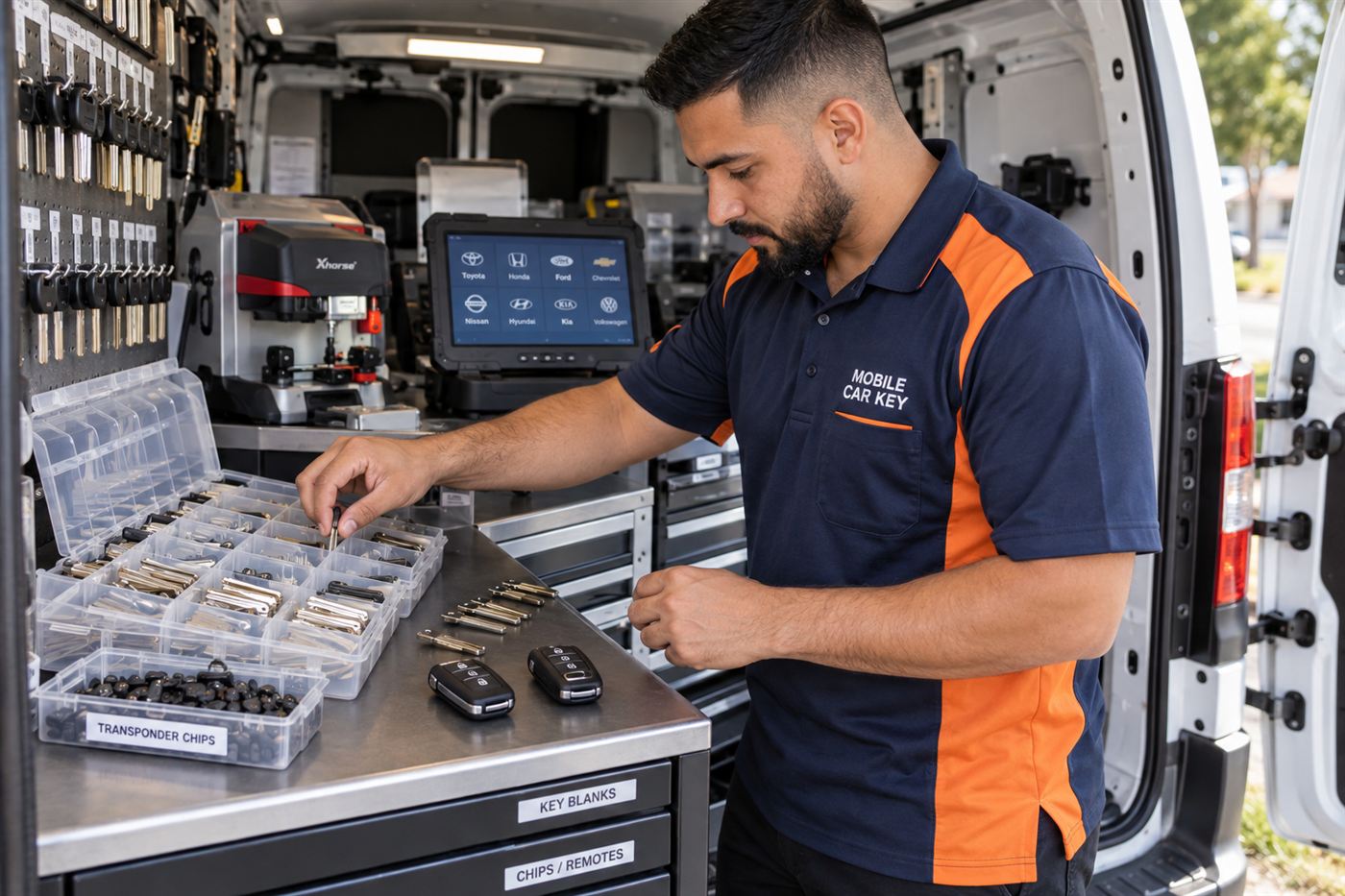
A mobile automotive technician arrives with a diagnostic tool that can read the fob's signal, test the car's receiver, and show whether the key is recognized. These checks tell early on whether the fob, the battery, or the car is at fault, without replacing parts by guesswork.
If the battery was the problem, it is replaced and tested. If the fob is out of sync, it is reprogrammed to the vehicle. If the circuit board has failed, a replacement fob is matched and programmed on site where the vehicle supports it.
A careful technician also looks at the bigger picture. A fob that fails on a vehicle with a weak battery or a loose terminal is only part of the story, and a replacement fob on such a car may seem to fail too. Checking the vehicle's own power and receiver before cutting or programming anything saves repeat visits and unnecessary parts.
Before leaving, the technician tests every function: lock, unlock, trunk release, panic button where fitted, and remote start where fitted. Testing the engine start is part of the same routine, so you know the chip, the remote and the car agree with each other.
Some vehicles require dealer level tools or manufacturer access for certain steps, and limits depend on the vehicle. That is why availability is confirmed before dispatch.
When a replacement is the sensible choice
A fob with a cracked board, worn button contacts, a missing case or old water damage often costs more attention than it deserves. Repeatedly changing the battery in a fob that still fails is a sign. So is a fob that works only when pressed in a certain way.
A replacement should be the correct type for the car. Fobs that look similar can differ in frequency, chip or button layout. A technician checks that the replacement fits the vehicle before programming. Buying an unknown fob online and hoping it works is a common source of frustration, because many of them cannot be programmed to the car at all.
If the fob is also the last key you have, the situation is closer to a lost keys job, which has its own considerations.
Ownership proof for programming
Programming a key or fob lets someone start the vehicle, so a reputable service asks to see that the vehicle is yours or that you are authorized to use it. Typical proof is a photo ID alongside the registration or title.
It may feel odd to be asked for papers when you are standing beside the car holding a fob that used to work. The question is not about you in particular. It is a routine step that keeps vehicles from being opened or started by people who do not have the right to do so, and it applies to every customer in the same way.
If you are dealing with a car that belongs to a family member, a friend or an employer, the technician may ask for their permission in some form. A clear message from the owner, together with the registration, usually settles the matter. Mention this when you call so the right details are arranged before the visit.
The requirement is about protecting owners. If you rent the car, tell the service so that the right authorization is arranged with the rental company. If you drive a company vehicle, ask your fleet contact for written permission in advance.
More detail is in the ownership proof guide.
What to share when you contact the service
A short description helps the service decide how to help you. The items below cover most of what is asked.
Nothing here forms a service agreement. Availability, coverage and terms are confirmed before anyone is sent.
- Year, make and model, and whether the car has a push button start.
- Exactly what the fob does or does not do, including the light on the fob.
- Whether you changed the battery and what type you used.
- Whether a second fob exists and whether it works.
- Where the car is parked and whether you can get inside.
- Whether anything changed recently, such as a battery replacement, repair or new device.
Keeping a fob healthy
Replace the battery before it fails. Many owners do so every couple of years as a habit. Keep the fob out of back pockets where it gets bent, away from water, and off the dashboard where summer heat bakes the plastic.
Avoid hanging heavy items on the fob ring. A weight that swings from the key presses on the case and the internal board. A light ring with just the essentials lasts longer.
Avoid cleaning a fob with harsh chemicals, and wipe sweat and skin oils off the buttons now and then. A worn rubber pad can stop pressing the contact beneath it, which looks like a dead button. A replacement pad or shell is a smaller job than a whole new fob, and a technician can tell which you need.
Keep a spare in a known place and test it from time to time. A spare that has sat for years with a dead battery is no help on the day you need it. The spare key guide has practical ideas.
Where this page fits among related situations
A dead fob is often the first sign of a larger issue. If the fob got wet, read about a key fob that got wet. If the battery keeps dying again soon after replacement, read about a fob battery that keeps dying. If the car says the key cannot be found, read about a smart key that says key not detected.
The full path from your call to a working fob is described in how it works, and the situations hub gathers every page like this one.
This information is educational only. Terms and availability are confirmed before a technician is dispatched.
Common questions
How do I know whether the fob or the car is the problem?
Try a second fob if you have one. If the spare works, the first fob is the problem. If neither works, suspect the car, for example a weak battery or a receiver fault. You can also check whether the light on the fob blinks when you press a button, which shows that the fob itself still has power.
I replaced the battery and it still does not work. What now?
Confirm the battery type and direction, and check that the contacts are clean. If it still fails, the fob may be out of sync with the car or its board may be damaged. Look in the owner manual for a resynchronization routine. If none exists or it fails, the fob likely needs diagnostic testing and programming.
Can a fob lose its programming?
It can fall out of step with the vehicle, particularly after the car battery is disconnected, replaced or fully drained, or after repairs to the body control system. A technician can usually pair it again with a diagnostic tool, as long as the fob's hardware is healthy and the vehicle allows it.
Why does my fob work only when I stand right next to the car?
That is a classic sign of a weak fob battery, though heavy radio interference can cause it too. Try a new battery first. If the problem appears only in certain places, such as large parking structures or near airports, the surroundings may be to blame and moving the car a short distance can help.
Is it a good idea to buy a replacement fob online?
It can go wrong. Fobs that look the same can have different frequencies or chips, and some cannot be programmed to your vehicle at all. A technician can confirm the correct type for your car before programming it, which avoids paying for a part that will not work. Ask first, then buy.
Can I drive my car if the fob stops working while I am driving?
On most vehicles with a push button start, the engine keeps running if the fob stops being detected, though the dashboard warns you. Do not shut the engine off until you have reached a place where you can use the backup start method. Pull over only when it is appropriate and follow your owner manual.