
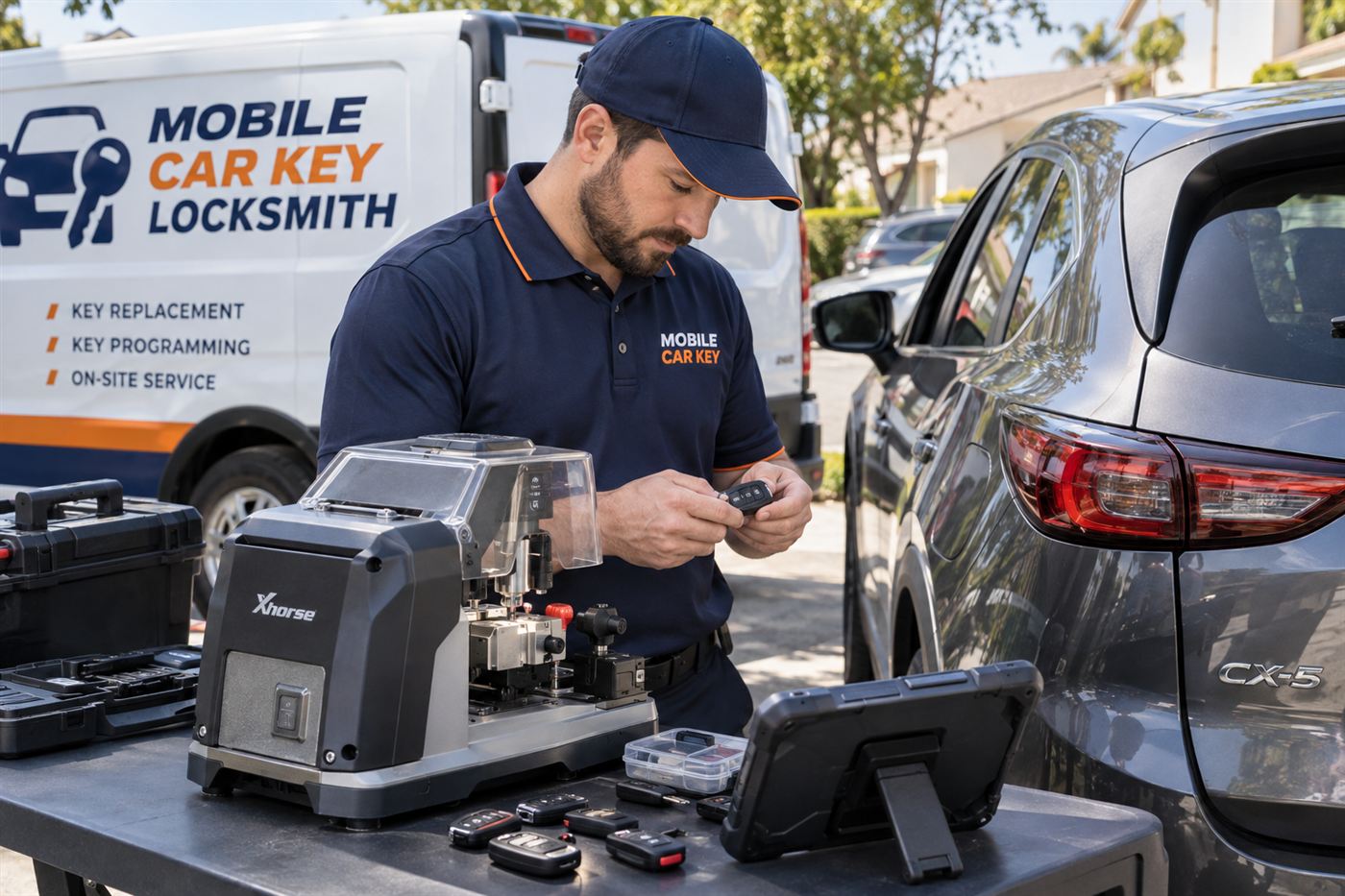
A valley full of smart keys
The San Jose area has a reputation for early adoption. Residents tend to buy newer vehicles, including hybrids and electric cars, and many of them use proximity fobs, phone-based features or keys that look more like small electronic devices than traditional metal keys. That gives drivers convenience, but it also means that a lost or dead key can be more complicated than a simple trip to a hardware store.
Mobile automotive key service sends a technician to the vehicle, which avoids a tow and a ride across a spread-out region. Whether a given job can be done at your exact spot depends on the vehicle, the location, access and current availability. Those points are confirmed with you before anyone is dispatched.
This page looks at the settings and habits typical of the region, from office park garages to weekend trips into the mountains, and offers practical guidance for each.
Proximity fobs, push buttons and what happens when they fail
A proximity fob lets the car sense the key nearby, so you can unlock the doors by touching a handle and start the engine by pressing a button. It is a clever system, but it depends on a working battery in the fob, a healthy battery in the car and a clear signal between them. When any of those links fails, the car may show a message such as key not detected or refuse to start.
Many vehicles have a backup method. There is often a mechanical blade hidden inside the fob for opening the door, and a spot on the steering column, console or start button where you can hold the fob so the car can read it at very short range. Your owner's manual explains the details for your model.
The page on a smart key that says key not detected walks through the common causes and what to try before calling for help. If the backup method fails, the fob may be damaged or have lost its programming.
Battery care is the simplest defense. Most fobs use a small coin cell that lasts a year or two, depending on use. Some cars warn you on the dash when the fob battery is low, and others give no warning until the fob stops working. If you cannot remember the last time you changed it, do it now. The model number is printed on the cell, and buying a spare is easy.
Be gentle when opening a fob case. Many are held together by small clips, and prying with the wrong tool can crack the plastic or damage the circuit board. If you are not sure, look for the small slot designed for a coin or the mechanical key, and consult the manual.
Office parks, campuses and parking structures
Much of the valley's daily life takes place on campuses and in office parks with large parking structures. Employees park for a full workday, sometimes on upper levels far from the entrance. A fob that gets left in a jacket or a bag in a conference room is a classic problem. Another is the fob that stays in the car when someone steps out to take a call.
Security staff at larger campuses can usually tell you where a technician may park and whether a permit or escort is needed. Ask your facilities or security office early, since they often have a procedure for outside service providers. Give the structure name, level and nearest elevator when you call.
Open offices and shared desks add a twist. A fob dropped into a shared bag, a coat room or a meeting room tray can wander. Before you decide it is lost, check with building staff, reception and your colleagues. A short message to the team channel often turns up a missing fob.
Remote work has changed parking patterns too. Employees who come to the office a few days a week may find a car has sat for several days and the battery is weaker than they expected. A fob that was fine last week can fail after a long idle stretch, especially in cold or hot weather.
If you work for a company that provides a fleet or pool vehicle, the service will need confirmation from the employer or registered owner. The fleet key guide explains how organizations can prepare for that.
Commuting on crowded highways
Highway traffic here can be heavy for long stretches of the day, and drivers spend many hours behind the wheel. A key problem on the way to or from work can derail a schedule. If you are on a highway shoulder, your first job is to get yourself and your passengers away from traffic. Move to an exit, a frontage road or a parking lot if you can.
If anyone is in danger or injured, call 911 first. A key service is for the vehicle, not for an emergency involving people. Once you are in a calmer spot, describe the exit, the direction you were traveling and nearby landmarks.
Rush hour changes what is practical. Roads that move smoothly at midday can crawl in the morning and evening, and a technician must consider traffic as well as distance. If your car is in a lot off a busy highway, the entrance may back up with other drivers. Tell the service about any long lines, construction or detours near your spot.
If you keep a change of clothes, water and a phone charger in your car, a key problem becomes less miserable. These simple items turn a stranded wait into a manageable pause. Keep them in your bag as well as the car, since the car may be the thing you cannot enter.
Commuters who rely on carpools should agree on who holds which key. A shared vehicle with a single fob invites trouble, especially if the fob rides in a different bag from day to day.
Electric and hybrid vehicles
Many drivers in the region use electric and hybrid vehicles. These cars often rely on smart keys, and some also let owners use a phone or a card as a key. If your vehicle supports multiple key methods, a lost fob may not leave you stuck, but you may still need a physical replacement for backup.
Some of these vehicles need dealer-level tools or manufacturer access for programming a new key. A reputable service will tell you early if your vehicle falls into that category, and will not promise something it cannot deliver. Limits depend on the make, model and year.
If your vehicle can be unlocked with a phone, tap-card or app, treat those methods as helpful extras, not replacements for a physical key. Phones die, apps need updates and accounts can be locked out. A physical key stored in a reliable place gives you a way in when technology lets you down.
Tell the service which kind of vehicle you have when you call. A hybrid with a 12 volt battery that has weakened, a fully electric car with a card key and a plug-in with a conventional fob each present a different picture. The more precise your description, the better the service can say what is workable.
If the vehicle has a low-voltage battery that has weakened, the car may act as though the key is the problem when it is not. A technician can help sort out the difference, though a battery replacement may require a separate service.
Shopping centers, restaurants and Santana Row style districts
The valley has lively outdoor shopping districts and restaurant streets where parking structures are tucked behind the storefronts. People park, wander for hours and return to find a fob missing. A common reason is that the fob fell out in a restaurant booth or ended up in a shopping bag handed to a friend.
Before assuming the worst, call the venues you visited. Staff often collect lost items and may be holding your key. If you need to arrange help for the car, give the garage name and level.
Outdoor districts also mean weather exposure. A fob left on a patio table or in a jacket pocket may get wet in a sudden shower or lost when you shift your coat. Use an inside zip pocket, and check it when you stand up from a table. Waiters and hosts often find a fob under a table at closing time, so call before you leave the area.
Evening events and holiday shopping crowd these districts. Mention any closures or heavy traffic when you call, since they affect where a technician can stop.
Weekend trips to the mountains and the coast
Within a short drive of the valley are redwood forests, beaches and ski areas. Hikers, surfers and campers drive out on weekends, and key trouble follows. A fob that gets wet in the surf, a key dropped on a trail or a car locked at a remote trailhead with the key inside are all typical stories.
Remote areas have limited cell coverage and long distances between services. If you lose a key at a trailhead, give the road, the lot name and landmarks. Mention how far the nearest town is. Availability in remote spots depends on distance, and the service will tell you honestly what is possible.
Winter weekends in the mountains add cold. A fob that sits in a freezing car can lose range, and a lock cylinder can stiffen. Warm the fob in your hand, use the mechanical blade if needed and avoid forcing a frozen door. In snow or ice conditions, the roadside may be unsuitable for any vehicle work, and waiting until you reach a safer place may be the right choice.
Coastal fog and damp air can cause similar trouble. A fob that gets damp repeatedly may develop corrosion. Keep it in a dry pocket and wipe it with a clean cloth if it gets wet.
The key fob that got wet page explains how to treat a soaked fob. Short version: do not bake it or press buttons repeatedly, and let it dry in open air.
Airports, rental cars and visiting business travelers
The valley hosts a steady stream of visiting business travelers who land at the regional airports, pick up rental cars and drive to meetings. A rental car's key is the company's property, and the company sets the rules for replacement. If a key goes missing, call the rental agency first and read your agreement.
If you left your own car at the airport for a trip, a dead battery or a depleted fob can greet you on return. Try the physical key blade and the backup spot for the fob. If neither works, give the service the terminal, lot or garage and level.
Business travelers often have tight schedules. Say so, but be realistic: a technician cannot promise an arrival time, and the service will confirm what is possible before dispatch.
Understanding the key you hold
Keys range from simple cut blades to complex smart fobs. A transponder key has a chip that the vehicle must recognize before the engine starts. A remote key head adds buttons for lock and unlock functions. A proximity fob lets the car detect the key nearby.
Many keys and fobs can be handled by a mobile technician, but limits depend on the make, model and year. Some newer vehicles from certain makes require dealer-level tools or manufacturer access.
The immobilizer guide explains why a copied key may open a door but fail to start the engine, and what programming does to fix that.
Keeping an eye on the key's health
A key rarely fails without a warning. You may notice that the fob needs more than one press to lock or unlock the car, that the range has shrunk, that the car sometimes fails to detect the key or that buttons feel sticky. These are signs worth acting on while the key still works.
The right moment to make a spare is while an original key is available. Copying a working key is a simpler task than starting from nothing, and it avoids the stress of an all-keys-lost situation. If you buy a used car, ask how many keys came with it and test each one.
Keep a short record: year, make, model, number of keys and where each is stored. A note in your phone is enough. Having that information ready means fewer questions have to be answered on the spot.
Finally, treat a heavy keychain as a risk. A large bundle hanging from a smart key or an ignition cylinder adds weight and wear, and the fob itself can be damaged by repeated drops. A light ring with only the keys you need is gentler on the equipment and easier to keep track of.
Proving ownership
A responsible locksmith will not open a car or create a key for a stranger. Expect to show photo identification and a document linking you to the vehicle, such as a registration, title or rental agreement.
A common problem is that the registration is in the glove box of the car you cannot open. Photograph it and store the image on your phone. If you do not own the car, have the registered owner available by phone.
If documents are missing, say so. The service may help you work out how to get a copy before work begins.
How to describe your situation
Lead with the problem: lost key, broken key, locked out, dead fob, key not detected or stuck ignition. Then give the year, make and model, the exact location and any access details. If a key is visible inside, say so. If the engine is running, say that too.
Mention earlier attempts and unusual features, such as an aftermarket alarm or a recent battery change.
After the call, the service confirms availability, coverage and terms before dispatch, sends a technician, checks ownership on site, does the work and tests it.
Nearby cities and more reading
The Bay Area is a connected region, and your situation may span several cities. The Los Angeles page covers a freeway-driven basin to the south, and the San Diego page covers a coastal city with a naval presence. The California state page gives the wider view, and the city hub lists every metropolitan page.
Each page is written for its own area, so the examples differ.
If you travel between cities, always tell the service where the vehicle actually is.
A calm plan for right now
Move to a secure spot out of traffic. Check pockets and bags. Try the backup start method for your fob. Call anyone who might hold a spare. Write down your location with as much detail as possible. Photograph your ID and registration if you can reach them.
Decide what you need: an opened door, a replacement key, a reprogrammed fob or a broken key removed. If you are unsure, say so. Be skeptical of anyone who offers to fix the problem on the spot without checking ownership.
This page is educational. It does not create a service agreement and does not promise help at a specific time or place. Availability, coverage and terms are confirmed with you before dispatch. If anyone is in danger, call 911 first.
Common questions
My car says the key is not detected. What now?
Try the backup method in your manual, usually holding the fob against the start button or a marked spot. Replace the fob battery if it is weak. If the message continues, the fob may be damaged or out of sync, and a technician can assess it.
Can a lost smart key be replaced?
Often, but limits depend on the make, model and year. Some newer vehicles, including some electric models, need dealer-level tools or manufacturer access. The service will tell you early what applies to your vehicle before anything is committed.
Does a rental car follow different rules?
Yes. The rental company owns the car and sets the process. Call them first and read your agreement. A third-party service may not be allowed to program a key for a vehicle you do not own.
Can I get help in an office park garage?
Often yes, but the structure's rules apply. Check with security or facilities, and give the structure name, level and nearest elevator. Company vehicles need confirmation from the employer or owner.
Is a phone key enough as a backup?
Not always. Phone keys depend on a charged phone and a working app, and some situations need a physical key. Keep a physical spare in a reliable place and test it periodically.
Can service reach mountain or coastal trailheads?
Sometimes, depending on distance and availability. Give the road, lot name and landmarks, and a backup way to reach you. The service will say honestly what is possible, and terms are confirmed before dispatch.