
What kind of key does my Hyundai have?
It is a fair first question, and the honest answer is that it depends on the model and the year. Hyundai has used a range of styles over time, and a single model name can switch from one style to another between generations.
Broadly, drivers meet a traditional blade key with a chip in the head, a flip or fold out key where the blade tucks into the fob, a remote head key with buttons, and a smart key that goes with a push button ignition. Newer vehicles may also offer a phone based digital key as an extra, though a physical fob generally remains part of the package.
The way to be certain is to look. A keyhole in the ignition suggests a blade or flip key. A round start button suggests a smart key. A blade that swings out of the fob is a flip key. Take a photograph of the key and the dash, because a technician can often tell you a great deal from a clear picture. This is general information, not a service agreement, and availability and terms are confirmed before dispatch.
Why did my Hyundai key stop working?
Keys do not usually stop working without a reason, even if the reason is not obvious. The most common causes fall into a few buckets. The battery in the fob has weakened. The key was dropped, soaked or crushed. The chip inside the key head has been damaged. The key and the car have lost their pairing. Or the car itself has a fault in a receiver or an immobilizer module.
The battery is by far the easiest to check and the most likely. Fob batteries last a long time, but they do not last forever, and drivers frequently forget they exist. If your fob has been through several years of use, a new battery is a reasonable first step.
If a new battery does not help, try a spare key. A working spare points to the first key as the problem. If both keys fail, the car deserves a closer look. Mention these tests when you call, because they help the technician decide what to bring.
How a Hyundai smart key behaves
A smart key lets you unlock the doors by pressing a button on the handle, and start the engine by pressing a button with your foot on the brake. The car and fob talk by short range radio, and the car decides whether the fob is close enough.
Because the system depends on radio signals, certain things can interfere. A phone pressed against the fob in a pocket, a metal key ring, a charging cable or even a strong radio source nearby can occasionally confuse the car. If the fob stops being detected, try moving other objects away from it.
A dash message about the key not being found is common when the fob battery is weak. Many Hyundai owner manuals describe a fallback: hold the fob against the start button, then press it, so the car can read the fob at very close range. The exact location and method vary by model, so check the manual for your vehicle.
Heat and cold change behavior too. A fob left on a sunny dash all afternoon can run warm and drain its battery faster, and a fob in a freezing pocket may report a shorter range. These are normal quirks, but they sometimes look like failures. If your trouble appears only at the temperature extremes, tell the technician.
The hidden emergency key
Most smart fobs carry a small mechanical blade released by a catch on the side or back. On some Hyundais, the keyhole on the driver door hides behind a small cover that you pry off gently with the blade tip. Knowing where this is before you need it can turn a stressful moment into a calm one.
Panic and alarm behavior
Using the emergency blade in the door may trigger the alarm on some vehicles. Starting the car with a recognized fob usually silences it. Do not worry if the horn sounds; it is part of the system working as designed.
I lost my only Hyundai key. Now what?
Take a breath, then retrace your steps. Check the obvious places first, including the car seats, coat pockets, bag linings and the place you last paid for something. Keys do turn up. If you are confident the key is gone, move on to getting a replacement.
A mobile technician will ask for the year, model and trim, how the car starts, where it is parked and proof that you own or are authorized to use it. With those details and a confirmed visit, the technician comes to the vehicle, prepares a new key or fob, matches it to the car and tests it.
A thoughtful technician will also talk about removing the lost key from the car's memory, so that a stranger holding it cannot use it. If the old key was lost near the car, this matters. Some newer Hyundais may need dealer level tools or manufacturer access, and you will be told honestly if yours is one of them. The all keys lost page walks through the full process.
Hyundai flip keys that snap or loosen
The flip key is clever, but it has moving parts. Over time, the hinge can loosen, the blade can wobble and the case can crack. A key that flops around in your pocket is a key that is wearing out.
If the blade snaps off from the fob, keep both pieces. A technician may be able to reuse the electronics inside the fob and install a new blade, which can be more convenient than replacing the entire unit. If the circuit board is also damaged, a replacement fob may be required.
Avoid using a flip key to pry, scrape or open packages. It sounds obvious, yet many snapped blades come from exactly this kind of use. If you carry the key on a heavy ring, move it to a lighter one. The car key replacement page explains how replacement keys are generally handled.
Digital keys and phone based access
Some newer Hyundais let a phone act as a key, sometimes with the option to share access with other people. It is a convenient feature, and it changes the problem if something goes wrong. A phone that dies, a phone that is stolen or a service outage can leave you without access.
The physical fob remains valuable as a backup. Keep it somewhere other than the car, and do not leave the only copy in the center console. If you rely on a phone key, think about what you would do if the battery were flat at an airport parking structure or a trailhead.
If you lose a phone that holds a digital key, your first calls should be to the phone carrier and the manufacturer's service to disable the device. For the vehicle itself, a technician can help you with physical keys. How much can be done depends on the model and year, and the technician will explain what is possible.
Immobilizers and security conversations
Hyundai and Kia drew a lot of public attention in recent years over theft of certain older models that lacked an engine immobilizer. In response, the companies and other parties introduced updates and measures. If you own a vehicle that falls into that group, you may have heard about steering wheel locks and software updates.
What does that mean for keys? In practical terms, vehicles that have immobilizers depend on the chip in the key. Vehicles that do not have immobilizers behave differently, and they can be started with a mechanical key alone. If you are not sure which type you have, a technician can ask the right questions based on the model and year.
The advice here is general: if your vehicle is among those with a history of theft concerns, ask the dealer about available updates, keep valuables out of sight, and keep your keys secure. Do not assume a locksmith can retrofit security features, and do not trust anyone who promises that.
Family cars, SUVs and daily use
Hyundai's SUVs and family cars serve as the main vehicle in many households. They are driven by several people, loaded with children and groceries, and parked in school lots and supermarket garages. Fobs get dropped, thrown in diaper bags and tucked into backpacks.
A common failure pattern is the fob that goes through the wash. If it happens, remove the battery immediately, dry the fob thoroughly in open air and avoid applying heat. A fob that never recovers needs replacement, and the sooner you start the process, the less likely you are to be stranded.
A less obvious pattern is the fob left in a coat that gets donated or dropped off. When a fob disappears this way, treat it as a lost key. Have it removed from the vehicle memory, and consider that a stranger may hold something that works. See the spare key guide for ways to plan ahead.
Teen drivers, shared cars and handoffs
When several people share a Hyundai, the key becomes a shared responsibility. A teenager new to driving may not have a habit yet of knowing where the fob is. A grandparent borrowing the car may not know how a push button works. A spouse who borrows the keys may lock them in the trunk.
A little structure prevents most problems. Decide where the fob lives when it is not in use, and keep it there. Teach new drivers how to use the emergency blade and where the fallback start spot is. Keep a spare in a place everyone knows about but nobody in the car can lose.
If a teenager loses a fob at a school, an amusement park or a friend's place, do not panic. Check the usual spots, call anyone who was there and then consider the key lost if it does not appear. Removing a lost fob from the car's memory is a sensible safeguard. The how it works page describes what the process looks like from the first message to the finished key.
Locked out of a Hyundai
A lockout is when the key still exists but cannot be reached. It may be in the ignition, on a seat or in a bag in the trunk. The first rule is to look inside the car: is anyone trapped?
If a child or a pet is inside a closed vehicle, call 911 first. Heat inside a car rises rapidly, even when the day seems mild, and rescue crews are trained to act. A locksmith is not the first call in that case.
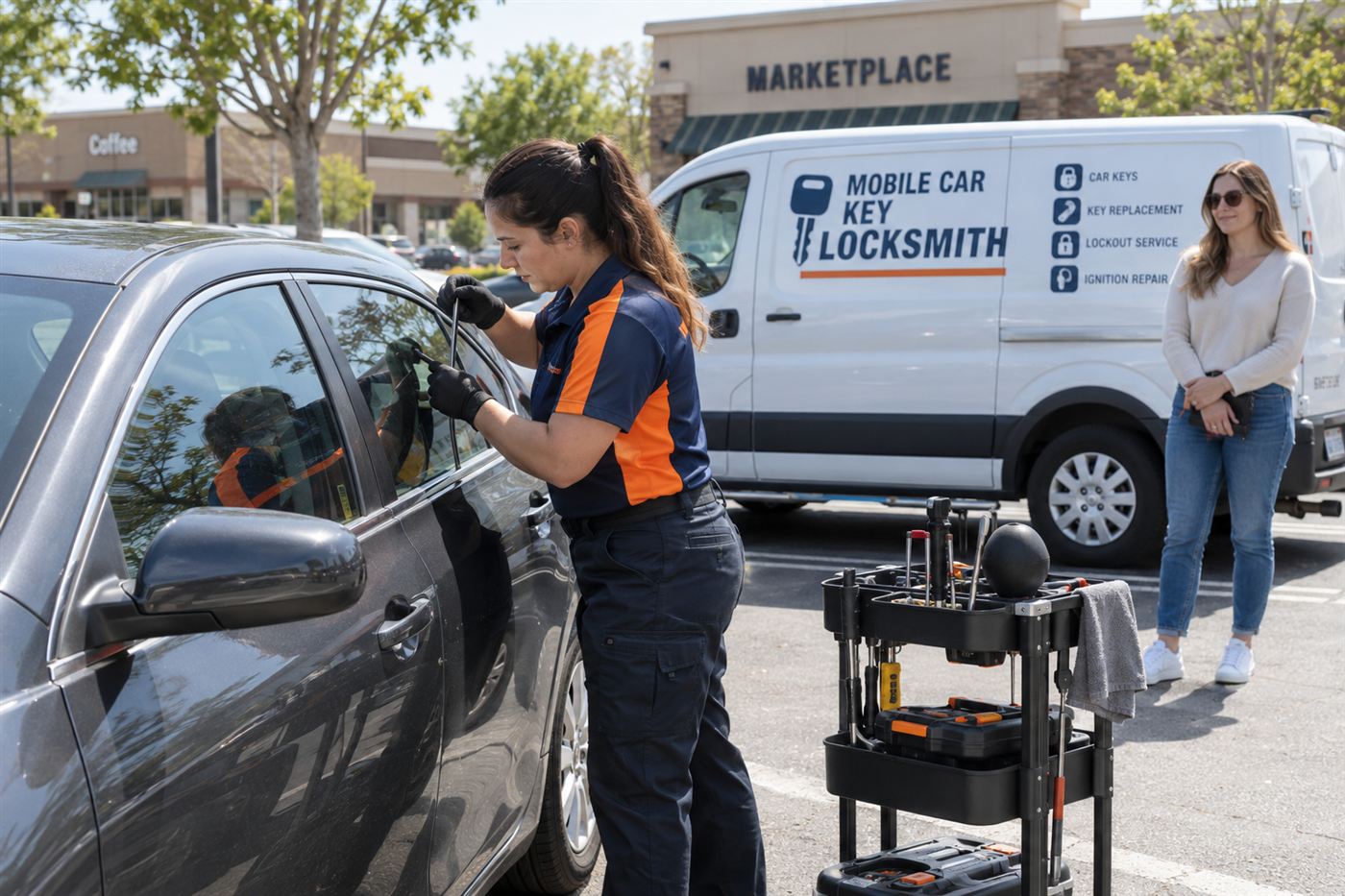
If everyone is secure, a technician can open the vehicle with tools designed for the purpose. Avoid forcing the door, using a hanger or wedging the window, since modern doors contain wiring and airbag components. See the lockouts page for details and for what to avoid.
Hybrid and electric Hyundais
Hyundai sells hybrid and electric models alongside its gas cars, and the key experience changes slightly. The vehicle starts silently, and the dash may show a ready indicator instead of a rumble. Drivers new to these vehicles occasionally think a car is dead when it is simply waiting.
The small twelve volt battery that runs the electronics is separate from the large traction battery, and a weak small battery can cause odd key behavior, such as doors not responding or the fob not being detected. If your electric Hyundai acts strangely, it is worth mentioning the model type to the technician.
Charging stops introduce another habit. Many drivers leave a fob in a pocket or bag at a public charger while they wait. It is wise to keep track of the fob, since a fob dropped near a charging station is easy to lose. If you travel with an electric vehicle, carry the spare fob somewhere other than the car and check that the battery in each is fresh before a long trip.
Information to gather before you call
A clear picture of the situation helps the technician decide what to bring. Collect these items:
- Year, model and trim of the Hyundai, and whether it is gas, hybrid or electric.
- Whether the key is a blade, a flip key or a smart key with a push button.
- Whether you use a phone key as well as a fob.
- What the dash says or shows when you try to start the car.
- How many working keys you still have, and the state of each.
- Your location, including a parking level or nearest cross street.
- Registration, title, lease paperwork or photo identification.
Proving the Hyundai is yours
Technicians check ownership because the skills involved can be misused. If a service made keys for anyone who asked, it would be easy to steal a car. A check protects you and the next person.
The usual evidence is a registration and a photo identification that match. If the car is leased, bring the lease or a letter from the leasing company. If it belongs to a family member or an employer, written permission and a copy of the registration may be needed. The details depend on the situation and are explained when the visit is confirmed.
Store a picture of your registration on your phone. It costs nothing and can save an awkward conversation later.
Getting a spare and exploring other brands
A spare key made while a working one exists is much simpler than a key made from nothing. Consider where it will live: with a trusted relative, in a work drawer or in a lockbox you control. Avoid hiding it on the vehicle.
Hyundai is part of a group that also includes Kia and Genesis. The Kia car keys page and the Genesis car keys page treat those brands individually, since procedures and parts can differ. For a look at another large brand, the Honda car keys page is a good comparison, and the car keys by make hub lists the rest.
Common questions
Can a Hyundai smart key be programmed on site?
In many cases yes, once ownership is confirmed. The technician needs the year, model and trim and may need access to the vehicle. Some newer models may need dealer level tools or manufacturer access, and you will be told honestly before dispatch if yours does. Availability and terms are confirmed first. Keep your ownership documents handy, since they are checked before any key is made.
My Hyundai says the key is not detected. What should I try?
Move other objects away from the fob, replace its battery and hold the fob against the start button as your owner manual describes. Try a spare if you have one. If the message persists with a fresh battery, the fob may have lost its pairing or been damaged, and a technician can help. Every vehicle is a little different, which is why the first conversation matters.
What happens to my old Hyundai keys when a new one is made?
It depends on the situation. If you lost a key, it is wise to have the lost key removed from the car so it no longer works. If you are adding a spare, existing keys usually continue to function. Tell the service which case applies so the correct steps are planned. Details like these are confirmed with you before any visit is arranged.
Does my Hyundai have an engine immobilizer?
Many do, particularly in more recent years, but some older models did not. Check your owner manual or ask a dealer. A technician can also ask about the year and model to understand how the key interacts with the vehicle. Do not assume, since the difference affects what a key job involves. Share the year, model and how the car starts, and you will get a clearer picture.
Can I rely on my phone as the only Hyundai key?
It is risky. Phones lose charge, get lost and fail. Keep a physical fob as a backup, stored away from the car, and know how to use the emergency blade on it. If you lose the phone, disable it through your carrier right away and contact a technician about a physical key. Limits depend on the vehicle, so ask before you assume either way.
Is a broken flip key blade repairable?
Sometimes. If the electronics inside the fob are intact, a new blade may be fitted. If the board is damaged, a replacement fob is needed. Keep every piece of the broken key and describe the damage to the technician, who can tell you which route is realistic for your model. Keep your ownership documents handy, since they are checked before any key is made.