
Ford is a lineup, not a single key
It helps to start with an honest admission: there is no such thing as one Ford key. The brand sells small crossovers, family sedans, sport coupes, three row SUVs, vans and full size pickups that tow trailers and haul work crews. Each has been refreshed several times, and the key hardware has changed along the way.
For the driver, that means two Fords parked next to each other may need completely different handling. A technician cannot assume anything from the oval badge. The first useful facts are the model, the year and the way the engine starts.
Pickups in particular tend to be used by people who cannot afford downtime. A contractor with a stuck truck and a job site waiting does not want a lecture on electronics. The goal of this page is to give you enough background to describe your Ford accurately, so a mobile technician can say what is possible and what is not before anyone drives to your location.
The passive anti theft system in plain language
Many Ford vehicles use a passive anti theft system, often abbreviated PATS, in which the key head holds a transponder chip. When you turn the key, the car reads the chip. If the code matches, the engine is allowed to run. If it does not, the engine may crank briefly and then stop, or it may not crank at all.
The word passive matters. Nothing has to be armed or switched on by the driver. The protection is always working in the background, which is excellent for security and annoying when a key goes bad. A blade cut at a hardware kiosk can turn the lock and still fail to start the car, because the chip has not been matched.
This is why a duplicate cut from a worn key sometimes surprises owners. It looks identical and opens the door, but the dash light blinks and the engine will not catch. The fix is programming, not cutting, and it is something a mobile technician can often do at your vehicle. For the general idea, see the key fob programming page.
The keypad on the driver door
A feature many Ford owners forget exists is the numeric keypad on the door pillar or door handle found on many models. If you set up or know the entry code, you can unlock the car without any key at all. That has helped plenty of people who stepped out to pump gas and locked the key inside.
It is worth checking whether your Ford has one. Look beside the driver window or on the pillar between the front and rear doors. If the pad is there, check your owner manual or the paperwork from the original owner for the factory code, which in some cases is printed on a card that came with the vehicle.
The keypad does not start the engine, and it does not replace the transponder key. It is a door convenience. But it can turn a lockout from a major event into a small one, and it can give you access to the glove box where registration lives. Remember that ownership proof is part of any key job.
Turn key, flip key and push button
The key styles you may find on a Ford fall into several groups. Older trucks and work vehicles often use a plain metal key with a thick plastic head and a chip. Mid range vehicles frequently add remote buttons to that head. Some use a flip style where the blade folds away. And a growing number use an intelligent access system with a push button.
With intelligent access, the fob stays in your pocket. A sensor on the door handle detects it, and a button starts the engine. Inside, there is usually a cup holder pocket, a console slot or a specific spot to place a weak fob so the car can read it at very close range. The location varies by model, so check the manual rather than guessing.
If you drive a Ford and cannot tell which system you have, look for an ignition slot beside the steering column. No slot and a round start button usually means push button. A keyhole means a turn key system, even if the key also has remote buttons.
Why the remote may work while the engine will not
On a chip key, the remote buttons and the immobilizer chip are separate functions that happen to share a case. The remote can keep working with a damaged chip, and the chip can keep working with a dead remote battery. A symptom in one function does not prove the other is healthy.
Emergency blade on a smart fob
Most smart fobs conceal a small mechanical blade. Releasing it lets you open the driver door manually. The lock cylinder on some vehicles is hidden under a small cap on the door handle, so you may need to pop that cap gently before you can see the keyhole.
MyKey and restricted driver settings
Some Ford models offer a feature called MyKey that lets an owner program certain keys with limits, such as a capped top speed, a lower maximum audio volume or earlier seat belt reminders. Parents sometimes use it for a teenager's key. Fleet managers occasionally use it for drivers who share a vehicle.
If your Ford has this feature and a restricted key is the only one you can find, the vehicle may behave in unexpected ways. A new key may come up unrestricted, or the technician may need to know about the setting so that it can be handled properly. Tell the service if you have ever set limits on a key.
It also means a lost restricted key is a real security issue, not only a convenience problem, since the settings live in the key and the vehicle. Removing the lost key from the car memory is a sensible step in that case.
Pickup trucks and work crews
Trucks tend to live a rough life. Keys ride on heavy rings with tool tags and gate cards. They get crushed in tailgates, dropped in mud and left on top of work benches. A contractor who loses a truck key might also lose the tool box key, the trailer key and the gate fob, all on one ring.
If you manage several Fords for a business, the situation multiplies. Who has which key? Who is allowed to request a new one? A written record helps, and so does a policy that every extra key is logged. The fleet key guide goes into detail on tracking and spare planning.
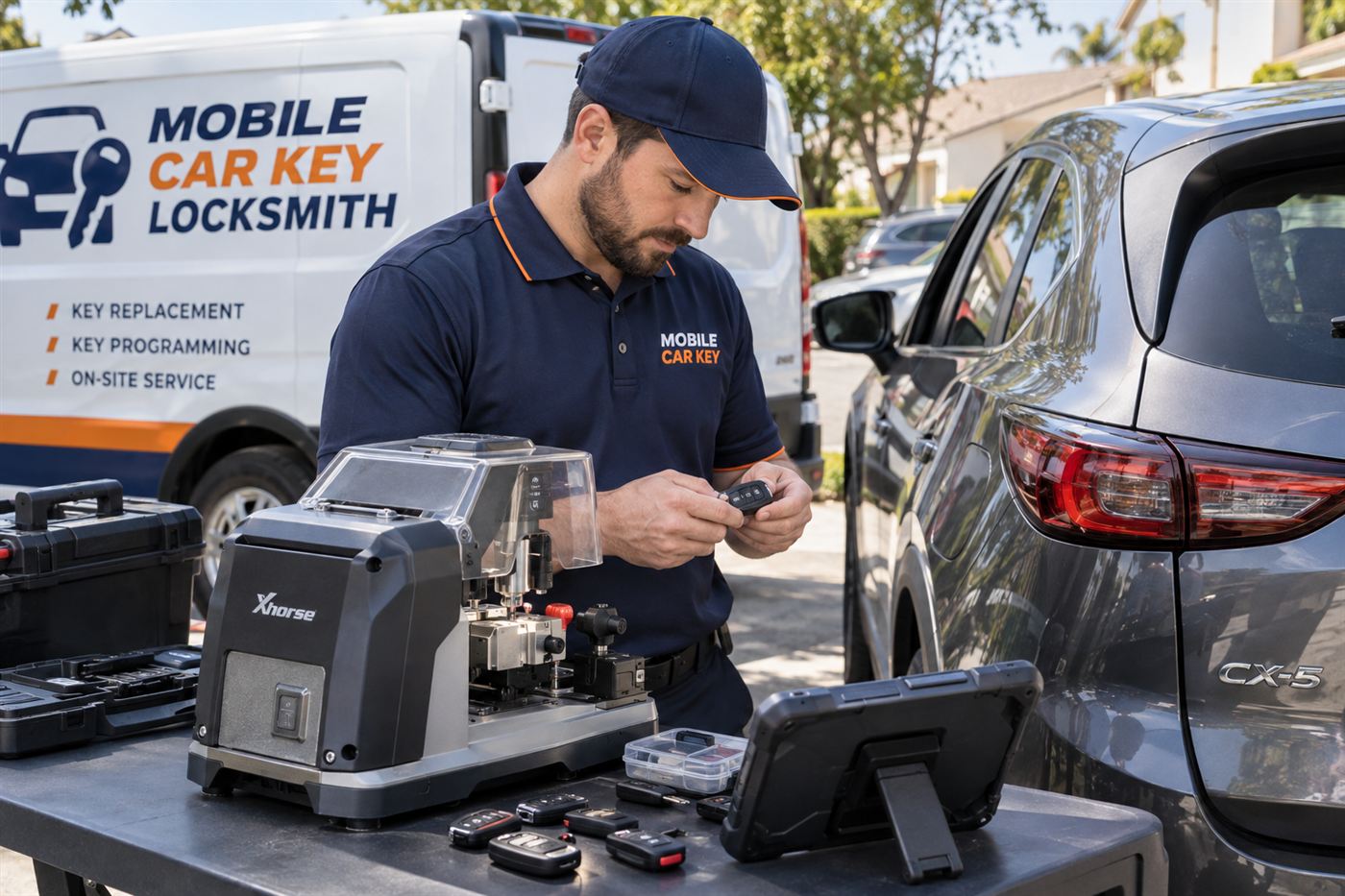
Mobile service is particularly suited to work trucks, since moving a vehicle that will not start is costly and slow. A technician who comes to the job site or the yard can handle the key and let the crew continue. Confirmation of availability, location and terms still comes first.
When a Ford key snaps or the ignition sticks
Heavy rings put constant weight on an ignition cylinder. Over years, that load can wear the cylinder and the key. A sticky ignition, a key that needs wiggling and a steering lock that grabs are all signs of wear. Eventually the key may snap in the lock or refuse to turn.
If a piece is left in the cylinder, stop. Pulling with pliers can push the fragment further in or ruin the wafers. A technician can extract it and cut a new key to code, if the code is available, or by impression from the cylinder.
The sensible advice for a heavy ring is to remove it. Keep only the Ford key on the ring that enters the ignition, and hang the rest elsewhere. This one habit slows cylinder wear. A fuller explanation is in the car key replacement guide.
Ford cars, crossovers and family vehicles
Not every Ford is a truck. Many drivers have a sedan, hatchback, crossover or three row SUV that doubles as the household vehicle. These tend to carry the more modern key styles, including intelligent access with push button.
The family car has special risks: a toddler who loves to press fob buttons, a teenager who borrows it and misplaces the fob, a parent who locks the fob in the trunk while loading luggage. A trunk lockout is a classic Ford owner headache when the fob rides in a bag. Always check that your fob is in your pocket before closing the lid on bags and strollers.
If a fob is locked in the vehicle, treat that as a lockout rather than a key replacement. The lockouts page covers the options, and any case with a child or pet inside a closed vehicle is a 911 call first.
Mustang, sport models and enthusiast Fords
Ford sells vehicles that people love enough to modify, show and drive on weekends. A sports coupe may be a second or third vehicle, kept in a garage, started rarely and charged with a battery tender. When the fob battery in a rarely used car dies during a long storage period, the owner often discovers it at the worst moment, at a car show or on a first warm day of spring.
Enthusiast cars are also more likely to carry aftermarket parts such as alarm systems, remote starters, performance tuners and tracking devices. Any of these can interact with the key system. Tell the technician about modifications, even ones that seem unrelated, so the visit is planned properly.
If a fob is buried in a project car that is partly disassembled, say so. Door panels removed, a dash out for wiring work or a dead battery in the car all change what the technician has to bring. It is much better to explain that on the call than to discover it at the curb.
Newer Fords, hybrids and electric models
Ford has added hybrid and electric vehicles to the lineup, and these use modern electronics for access and start. The vehicle may sit silent when ready, and a fob warning message is the usual sign of trouble rather than an engine that will not crank. Some newer models may also let a phone act as a key, which is convenient but does not replace a physical fob when the phone battery dies.
With newer vehicles, key programming may involve more secure steps. Some models may need dealer level tools or manufacturer access, and a technician will tell you honestly if yours is one of them. Never assume a newer vehicle is out of reach, and never assume it is simple. Ask.
If you rely on a phone as a key, keep a physical fob as a backup somewhere other than the vehicle. A dead phone in an empty parking lot at night is an easy way to turn a small inconvenience into an ordeal. The remote and proximity key page explains how these electronic keys differ from the older kind.
What to prepare for the call
A little preparation makes the whole process smoother. Collect this before you reach out:
- Model, year and trim, plus whether it is a gas, hybrid or electric Ford.
- Whether the truck or car has a door keypad and if you remember the code.
- What your key looks like, and whether the blade folds or is fixed.
- Any MyKey or aftermarket remote start settings.
- Your exact location, including a landmark if you are on a job site.
- Registration or title and a photo identification.
Ownership proof and your Ford
Ford keys are sometimes the target of theft, so a reputable service asks for proof of ownership or authorization before making one. That is a protection for you. A truck with expensive tools in the bed is exactly what a thief would want a key to.
The usual documents are a registration, a title, a lease agreement or a loan document, along with identification that matches. If the Ford belongs to a business, a letter from the company or an employee card plus the registration in the company name can serve. The exact requirement depends on the situation and is explained when availability and terms are confirmed.
Taking a photo of your registration and storing a scan elsewhere is easy insurance. The ownership proof guide describes common acceptable proof.
Spare keys for a Ford
The cost of waiting for an emergency is not only money. It is time, stress and sometimes lost income. A spare made while you still hold a working key is the simplest approach, and many Ford owners are surprised by how straightforward it can be.
Store the spare somewhere separate from the main key and protected from weather. A drawer at a trusted friend's place, a locked office cabinet or a combination lockbox all work. Avoid the classic spots under the bumper or behind the license plate.
If you only have one fob for a push button Ford, adding a second one is worth doing soon. The spare key guide explains how to decide on the number of spares. You can also compare with another domestic brand on the Chevrolet car keys page.
Where to go next
If your Ford issue involves a lost fob and no spare, begin with the all keys lost page. If you simply want to compare brands, the car keys by make hub has them all. And if you drive a Lincoln, a brand owned by the same company, the Lincoln car keys page gives that brand its own treatment.
Ford vehicles are everywhere, which is both comforting and a reminder to be specific. The more precisely you describe your truck or car, the more accurately a technician can tell you what to expect.
Common questions
What does the passive anti theft system do on a Ford?
It stops the engine from running unless the transponder chip in your key matches the car. The check happens automatically each time you start the vehicle. That is why a key that was only cut, without matching the chip, can open the door yet fail to start the engine. Programming is the step that fixes it. Every vehicle is a little different, which is why the first conversation matters.
Can I still get into my Ford if I know the door keypad code?
On models that have a keypad, entering the code usually unlocks the doors even without the key. It does not start the engine, which still needs a recognized key or fob. The keypad can be a lifesaver for a lockout, so it is worth locating your code and storing it somewhere you can reach. Details like these are confirmed with you before any visit is arranged.
My Ford key turns the lock but the truck will not start. What now?
This often points to the immobilizer chip not being recognized, or to a copy that was cut but never programmed. Try your other key if you have one. Watch the dash for a security light. If the spare also fails, the problem may be in the vehicle, and a technician can help diagnose it. Share the year, model and how the car starts, and you will get a clearer picture.
Will a new key remove the old one from my Ford's memory?
That depends on how the job is done. When keys are lost, a technician can often remove missing keys from the car so they stop working. When you are just adding a spare, existing keys normally continue working. Say which situation applies so the right steps are planned. Limits depend on the vehicle, so ask before you assume either way.
Is a mobile technician able to work on a Ford at my job site?
In many cases yes, as long as the vehicle can be reached and the details are confirmed ahead of time. Availability, coverage and terms are settled before dispatch. Give the exact location, the vehicle details and your documents, and the technician can tell you what is realistic for your Ford. Keep your ownership documents handy, since they are checked before any key is made.
What if my Ford has a restricted key set with MyKey?
Tell the technician when you call. A restricted key stored in the vehicle can affect how new keys behave, and the settings may need to be handled during the visit. If the restricted key was lost, it is also reasonable to ask that it be removed from the car memory for security. Every vehicle is a little different, which is why the first conversation matters.