
Safety first, before anything else
If a child, a pet or any person is inside the vehicle and in distress, stop reading and call 911. Emergency responders are trained and equipped for these cases, and every minute matters, especially in warm weather. Do not wait for a locksmith. A locksmith is not an emergency service.
Cars heat up much faster than most people expect. On a warm day the cabin can reach dangerous temperatures well before it feels uncomfortable to an adult standing outside. Infants and animals are far more vulnerable than grown people. If you see a child or pet alone in a closed vehicle, call 911 as well.
Cold is also a risk. A person locked out of their car in freezing weather, in a remote place or at night, may be in danger even without anyone inside the vehicle. If you feel threatened or unwell, call emergency services first and tell them where you are.
- Child or pet inside a closed car: call 911 immediately.
- Extreme heat or cold and you are exposed: seek shelter and call for help.
- You feel unsafe in a dark or isolated spot: move to a lit, public place and call 911 if needed.
- Engine still running with keys inside: mention this on the call, because it affects how the technician approaches the vehicle.
How lockouts happen
Lockouts rarely come from carelessness. They happen when attention is split: a phone call, a child fussing in the back seat, a bag of groceries in both hands. The door shuts, the lock clicks, and the keys are on the seat or in the ignition.
Some cars lock themselves. A vehicle with automatic locking may lock as soon as you walk away with a key in your pocket, or lock when you drive above a certain speed. Others lock when the trunk closes with a fob inside, trapping it. A few older cars have a lock button that can be pressed while the door is open and then closed.
A different kind of lockout occurs when the key is in your hand but will not work. A dead fob battery, a broken key, a frozen lock or a damaged door mechanism can all leave you outside a car you have the key for.
Keys inside the car
This is the classic case. The technician needs to open the door without damaging it so you can retrieve your keys.
Keys with you but the car will not open
Here the issue is a failed fob, a worn lock or a frozen mechanism. The fix may involve a battery, a lock repair or a replacement key rather than simply opening the door.
Keys lost entirely
If the keys are not in the car and cannot be found, the lockout becomes a key replacement job. See car key replacement and all car keys lost for how that works.
What a mobile technician can do
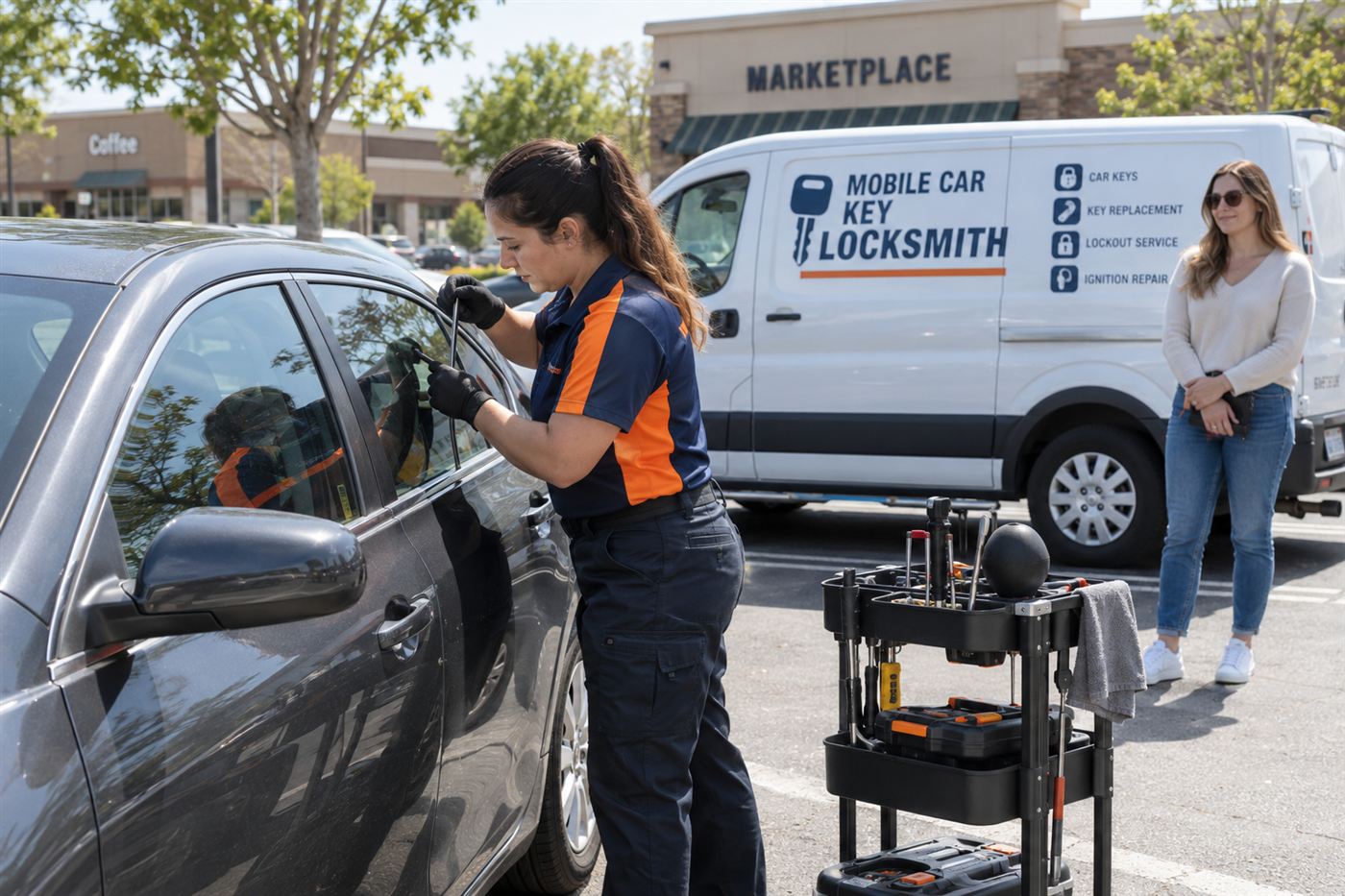
A trained technician opens most locked vehicles without damage by using specialized tools designed for the purpose. These tools reach through the door seal or window gap to operate the interior handle, press the unlock button or lift the lock post, depending on the vehicle design.
The goal is to leave the car exactly as it was found. Methods are chosen to avoid scratching paint, tearing weatherstripping or interfering with side airbags and window electronics. A technician selects the method that suits your particular vehicle.
Some vehicles are more demanding than others. Frameless windows, tight door seals and certain security systems all change the approach. A technician will tell you honestly if a car has unusual features that complicate the work, and may suggest alternatives.
- Opens the door without keys in most situations.
- Chooses tools to suit the door, window and lock design.
- Protects paint, seals and trim during the process.
- Tests the lock and handle after the job to confirm everything works.
Damage-avoidance methods in general terms
Older methods of opening a car sometimes involved forcing a slim strip down the window and hooking the lock rod. That approach can scratch glass and damage the door's internal wiring. Modern practice avoids it wherever possible.
Today, technicians typically use an inflatable wedge that gently opens a small gap at the top of the door frame. A long, thin reach tool is then guided through the gap to press the unlock button or pull the handle. The wedge is cushioned and spreads force over a wide area, so it will not mark paint when used properly.
Another approach is to pick the lock itself. This works on vehicles that still have a mechanical door cylinder, though many modern cars use cylinders designed to resist it. In some cases the car's electronics offer a diagnostic route to unlock the door without touching the frame at all.
The wedge and reach tool
This method is the most widely used. It depends on the door's flexibility and on careful placement, so a technician takes time to observe how the door sits before starting.
Lock picking
When a car has a traditional door lock, a technician can sometimes manipulate it directly. It takes skill, and results depend on the lock design.
Electronic assistance
Certain vehicles allow an unlock command through a diagnostic connection. Access to the connection can itself be the obstacle, so this route is used only where it suits the car.
Information that helps on the first call
Clear answers on the first call let the service confirm what is possible before anyone is dispatched. Expect questions about the vehicle: year, make and model. The way a car's doors, windows and locks are built affects the method, so these details matter.
You will also be asked where the car is and what has happened. Tell the person on the phone whether the keys are inside, whether the engine is running, whether anyone is inside and whether the car is in a garage, a parking structure, a driveway or on the roadside. Each of these details shapes the plan.
Finally, you will be asked about ownership. A reputable service asks for proof that you own or are authorized to use the vehicle. The technician checks this on site, so keep identification within reach and have registration details ready if you can.
- Year, make and model of the vehicle.
- Exact location, including a parking level or nearby landmark if relevant.
- Whether keys are inside, the engine is running, or anyone is in the car.
- Whether the trunk or only a door needs to be opened.
Proof of ownership at a lockout
People are sometimes surprised that a locksmith asks them to prove the car is theirs. The reason is simple: a technician who opens any car for anyone who asks would be helping thieves. Checking is part of doing the job responsibly.
The check does not need to be complicated. A driver's license that matches the registration is often enough, together with a glance at the vehicle and what is in it. If your documents are inside the locked car, tell the service so. There are usually other ways to confirm who you are and your connection to the vehicle.
If you are borrowing a vehicle, being authorized by the owner can also be established, though it may take a call to the owner. Our guide on proving you own the car explains the typical options in more detail.
If your license is inside the car
Explain this early. Other forms of identification, or contact with the registered owner, may satisfy the requirement. The technician decides what is acceptable.
If the car belongs to someone else
A friend, relative, employer or rental company who owns the car may need to give permission. A technician will not open a vehicle without being satisfied that the request is legitimate.
Door cases and trunk cases
Most lockouts involve a front door, but trunks and rear doors can be locked too. A hatchback may have a rear glass that remains shut while the doors are open. A sedan trunk can close with the key fob inside, and many cars will not let the trunk open from outside without that fob.
The method for a trunk is different from the method for a door. A trunk has no window gap, and its latch may be electric. A technician may open a rear door first, fold down the back seat and reach the trunk from inside. If the rear seat does not fold, other routes are considered.
If only the trunk is locked and the keys are in the cabin, a driver can usually retrieve the keys and open the trunk normally. If the keys are in the trunk and the cabin is locked, both parts of the car must be opened in sequence.
- Front and rear doors are opened with door-gap methods.
- Trunk lockouts often use the cabin and fold-down seats as the route.
- Keys locked in the trunk usually need the cabin opened first.
- Some cars have manual trunk release levers or panels that a technician knows how to find.
Keys locked inside with the engine running
A running engine with the keys inside is a distinct situation. The car may be in a state where doors have locked automatically for safety, and moving a person around a running vehicle needs care. The technician will want to know if the car is in park and if the parking brake is set.
The risk of theft is also real. Do not leave the area if you can avoid it. If you must step away, ask someone to keep an eye on the vehicle, and tell the service where the car is so there is no confusion on arrival.
Running engines also use fuel, so it is worth turning off the lights if you can and not worrying about the engine itself. Once the door is open you can switch the car off and retrieve your keys.
Weather, heat and cold
Weather changes both the urgency and the method. In hot climates the cabin becomes uncomfortable and dangerous within a short time, and finding shade for yourself becomes an immediate need. In freezing weather, door seals stiffen and locks freeze, and a flexible wedge works differently on a cold door frame.
Snow and ice can hide the vehicle and make footing unsafe for a technician. If your car is parked under heavy snow, clearing the area around the door helps. A frozen lock is not the same as a lock that has failed, and a technician will often recognize the difference.
Heavy rain, wind and darkness all make the work harder but not impossible. Mention any exposure on the call, and the service will plan accordingly.
Hot weather
Move into shade, drink water, and keep an eye on any person or animal inside. If someone inside is struggling, do not wait.
Cold weather
Find a warm place to wait if you can, and avoid pouring hot water on frozen glass, which can crack it.
Parking structures, driveways and roadside
Where the car sits changes the job. In a parking structure, tight spaces next to other cars may limit room to open the door, and signal strength for phone calls can be weak. Mention your level and a nearby column or sign so the technician can find you.
In a driveway or a quiet street, access is usually simple. Mention if there is a gate or code needed to reach you. On a roadside or a highway shoulder, safety becomes the central concern. Stay away from traffic, keep passengers out of the car, and consider calling emergency services if the location is dangerous.
A rural road or trailhead adds distance. Coverage and availability depend on where the vehicle is, and these are confirmed before dispatch. See service areas across the United States to understand how matching works.
When opening the door is not the answer
Sometimes a lockout is a symptom of a different problem. If the fob has stopped working, opening the door may only lead to another stranding when the car fails to start. If the key is broken in the lock, extraction is a different job. If the door's mechanism is damaged, it may need repair.
A good technician looks beyond the immediate task. After opening the door, they check that the lock works, the fob responds and the car starts normally. If the key is worn, they may suggest a spare while you still have one, and may explain the options in terms of your vehicle.
Our guide on locked out of your car safely adds a checklist for the minutes before help arrives.
- Fob battery weak: replace it or consider a spare key.
- Key broken in the lock: extraction is separate work.
- Door mechanism damaged: the lock may need repair after opening.
- Key lost: replacement becomes part of the conversation.
What to avoid while you wait
Waiting for help tempts people to try their own fixes. Resist the urge to force the door, smash a window or push a coat hanger down the glass. These actions can break a window regulator, damage the paint or set off the alarm, and they can cost much more than they save.
Do not ask strangers to help open the car. You may be in a public place and well-meaning bystanders may mean well, but a person who is skilled enough to open your car with no effort may be exactly the person you should be careful about.
Do not leave a child or pet in the car to seek help. If someone is inside, call 911 and stay beside the vehicle.
Check the other doors
It sounds obvious, but many lockouts end when someone tries every handle and the trunk. A door that was left unlocked is the simplest answer.
Check your phone and apps
Some makes offer a smartphone app or a roadside assistance program that can unlock the car remotely. If you have one, try it before you call for a technician.
Smart keys, push-to-start and lockouts
Modern cars with proximity keys add a twist. The car locks itself when the fob moves away, and some will refuse to lock if the fob is inside, while others will lock anyway and leave you outside with the fob on the seat. A few models beep to warn you, but the warning is easy to miss in a noisy parking lot.
Opening these cars follows the same principles as any other, but the technician has to be careful around door electronics and sensors. Unlocking the door through the interior handle or button is usually the cleanest approach. Pulling hard on a handle linkage can cause trouble that costs more than the lockout.
If the fob is inside and the car is a push-button start, the technician may also remind you not to close the door again with the fob in the cabin. Carry the fob in your pocket or bag, not on the seat, as a habit.
- Keep the fob on your person rather than in a cup holder or on the dash.
- Learn how your car signals that the fob is inside when you close the door.
- Know where your hidden emergency blade is stored and how it opens the door.
- Check whether your make offers an app that can unlock the car remotely.
Preventing the next lockout
Most lockouts are avoidable with a few small habits. The most reliable is the simplest: before you shut a door, touch your pocket or bag and confirm the keys are with you. It takes a second and it becomes automatic after a few weeks.
A spare key helps in a different way. A spare kept by a trusted relative, a neighbor or in a secure hiding spot away from the car lets you recover without waiting for help. Avoid magnetic boxes under the bumper, which thieves know to check.
If you often get locked out because the car locks itself, check your vehicle settings. Many cars allow you to turn off automatic locking or to change when it happens. A short look in the manual or the infotainment menu may solve the problem for good.
A spare with a trusted person
Giving a spare to someone you trust gives you a second route. If you travel, consider leaving one with a person near your usual parking spot, and replace weak batteries in the spare from time to time.
A simple routine at the door
Say the list in your head: phone, wallet, keys. It sounds silly, but it works. Lockouts often follow distraction, and a routine interrupts the pattern.
What happens after the door is open
Once the door opens, you can take your keys and check that everything is as it was. The technician may test the lock and handle from both sides to make sure the mechanism still works smoothly. If something is not right, they will tell you.
This is also a good moment to think about the cause. If you have a single key, consider a spare. If the fob battery is weak, replace it. If the lock is worn, ask about it. Little repairs at this stage can prevent the next lockout.
Payment and paperwork are handled in general terms as part of the process described on how the service works. Availability and terms are confirmed before dispatch, and this page is educational and does not create a service agreement.
Common questions
What should I do if my child or pet is locked in the car?
Call 911 immediately. Do not wait for a locksmith, because heat can become dangerous within minutes and emergency responders are trained for exactly this. Stay beside the vehicle and give the dispatcher your exact location. A mobile technician is not an emergency service, and this situation always comes first.
Will opening my car damage the door or paint?
A trained technician uses damage-avoidance methods, typically an inflatable wedge and a thin reach tool, to open the door without marking paint or seals. Results depend on the vehicle, and some cars with unusual designs are harder to open. The technician will explain any risk before starting.
What information do I need to give on the first call?
Expect to give the year, make and model, your location, and what happened. Mention whether the keys are inside, the engine is running, anyone is inside, and whether the car is in a garage, driveway or roadside. These details let the service confirm availability and coverage before dispatch.
Why do I have to prove the car is mine?
A technician who opens cars for anyone would be helping thieves. A reputable service asks for proof that you own or are authorized to use the vehicle. Identification matched to registration is often enough. If your documents are locked inside, say so early because there are usually other ways to confirm.
Can you open a trunk if the keys are inside?
Often yes, though the method differs from a door. A technician may open a rear door, fold down the seat and reach the trunk from the cabin. If the keys are in the trunk and the cabin is also locked, both parts are opened in sequence. The approach depends on the vehicle.
My key is with me but the car will not unlock. Is that a lockout?
It can be, though the cause differs. A dead fob battery, a worn key, a frozen lock or a damaged door mechanism can all leave you outside with a key in hand. The fix may be a new battery, a repair or a replacement key rather than simply opening the door.
Should I try to open the car myself while I wait?
Avoid it. Forcing a door, pushing a hanger down the glass or breaking a window can damage the regulator, the paint and the wiring, and often costs more than professional help. Try every handle and the trunk, check for a smartphone unlock app, and then wait safely.
Do lockouts work the same way for newer cars?
Many newer cars can be opened without damage, but some designs are more demanding, including frameless windows and tight seals. A few vehicles may require special approaches. Limits depend on the vehicle, which is why the make, model and year are among the first things you will be asked.