
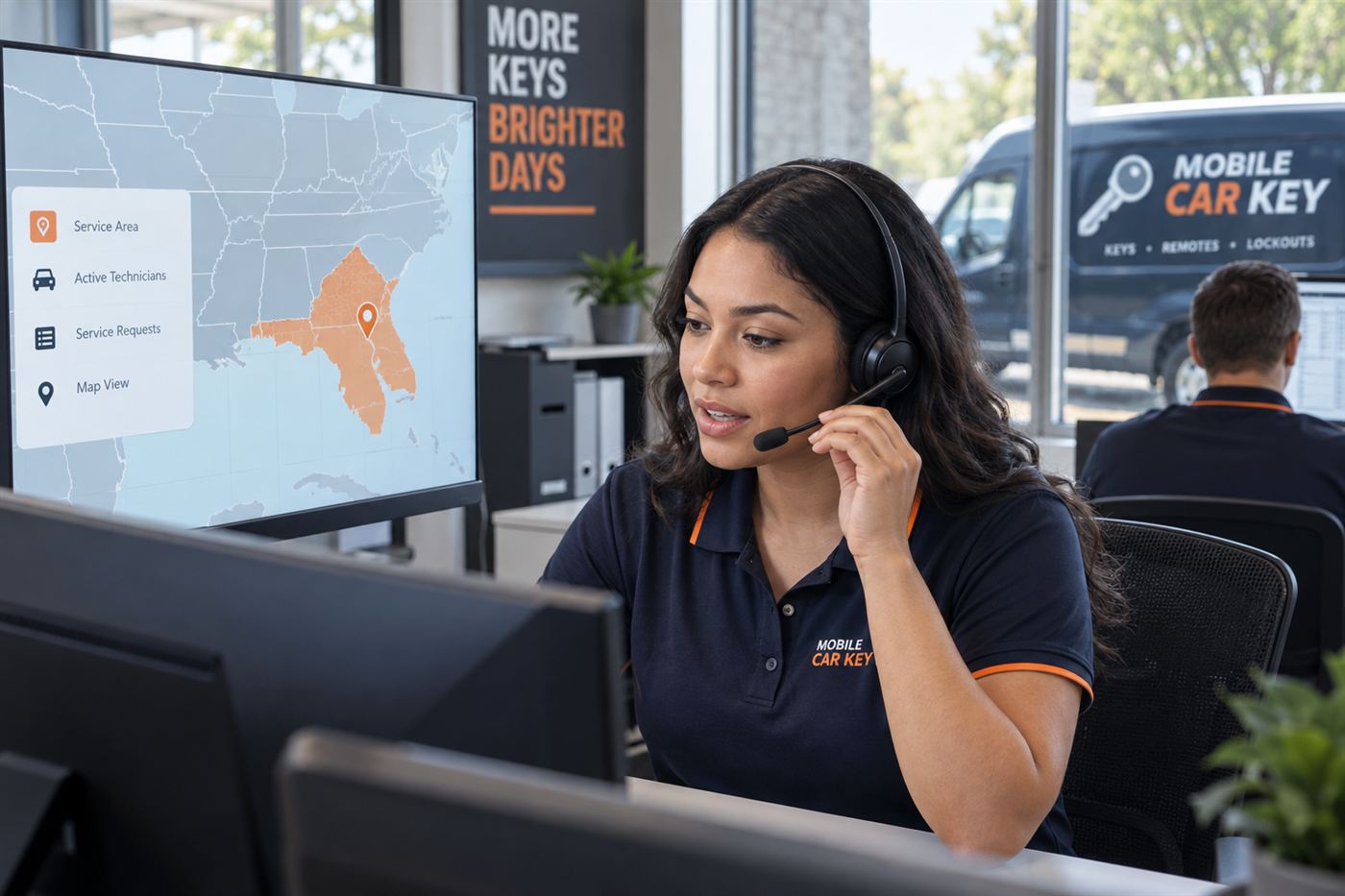
Ways to reach the service
There are two ways to begin. You can call the number shown on the site, or you can send a callback request and wait for a person to contact you. Both lead to the same conversation, so choose whichever suits your situation. A call is natural when you are standing beside the vehicle with a charged phone, while a callback request works better if you are in a place where talking is difficult.
Whichever you choose, the goal of the first conversation is the same: to understand the vehicle, the location and what happened, so that the right kind of help can be arranged.
Safety comes before any key
Some situations are emergencies, not inconveniences. A child or animal locked inside a closed vehicle can be in serious danger in a short time, whether the weather is hot or cold. In that case, call 911 immediately. Emergency responders are trained for exactly this, and they take priority over any locksmith service.
The same applies if you feel unsafe where you are standing, for example on a dark road or beside a busy lane. Move to a protected place if you can, and ask for emergency help if you need it. Once you are secure, the key problem can wait a little while, and a calm request will be easier to manage.
What to share about the vehicle
The most helpful details are the year, make and model of the vehicle. These decide which kind of key it uses, which equipment is needed and whether the job is likely to be straightforward. If you do not know the exact year, a range or a description such as a recent model is still useful, and the service can often work out the rest.
It also helps to say whether the vehicle starts with a turned key or a push button, and how many working keys remain. If you have a spare key, say so, because that can change the job from creating a key from nothing to adding a key to the car's memory.
- Year, make and model of the vehicle
- Turn key or push button start
- How many working keys remain, if any
- Whether the vehicle is locked, unlocked or running
What to share about the location
Be as specific about the place as you can. A street address, a parking lot name, a level in a parking structure or a nearby intersection all help a technician find you. In rural areas, a road name with a nearby landmark, mile marker or exit is often better than a vague description.
Mention anything that affects access, such as a gated lot, a private road, a garage with a height limit or a locked entrance. Technicians come to the vehicle, and good directions are one of the most practical contributions you can make. If the vehicle is in a public place, note whether it is likely to stay there.
Describing what happened
A short, honest description of the problem saves time. Say whether the key is lost, broken, locked inside the vehicle, or simply no longer working. Mention any warning messages on the dashboard, any recent battery changes, and whether the key worked yesterday. These small clues often point to the cause.
If something unusual happened, such as a fob getting wet or a key being bent, mention it. There is no need to explain it perfectly. The person you speak with will ask follow up questions, and your honest answers help the service decide whether this is a simple matter or one that needs more preparation.
What not to share
A legitimate service does not need your bank card number, your password, your social security number or your account credentials in order to begin a conversation. If anyone asks for those details at the first contact, stop and reconsider. You can discuss the vehicle and the problem without sharing anything sensitive.
Ownership documents are different, and they are requested on site, where a technician can compare them with the vehicle in front of them. Do not send photographs of identification through channels you do not trust. When in doubt, ask how and when documents will be checked, and wait until you are comfortable with the answer.
Preparing proof of ownership
Before the technician arrives, gather what you can. Typically that means a government issued photo identification and something tying you to the vehicle, such as a registration, title or insurance document. If the paperwork is locked inside the car, a copy on your phone or help from someone at your residence may solve the problem.
The guide on proving you own the car explains the process in detail. Having documents ready is the single easiest way to prevent delay, because the check cannot be skipped. It protects you, as much as it protects anyone else, from someone else obtaining a key to your car.
What happens after you reach out
After your call or request, a person gathers the details above and explains what the work would involve. If the vehicle is one the service can handle, the next step is confirming availability, coverage and terms. If it needs equipment or access that only a dealer has, you will be told so honestly.
You can read the full sequence on the page about how the service works. In short, you are never asked to commit before you understand the situation. The conversation is meant to be calm and clear, even if the reason you are calling is not.
Availability is confirmed before dispatch
Mobile service depends on real conditions: where you are, where technicians are, the weather and the demand at that moment. For this reason, availability, coverage and terms are always confirmed before a technician is sent. You hear what is possible in your situation, and you decide whether to go ahead.
The service does not promise arrival times on this page, because honest timing depends on those same conditions. Coverage reaches every part of the country, and the service areas page explains how requests are matched to a technician near the vehicle. Rural distances and bad weather can change the picture, and you will be told when they do.
When the technician arrives
On site, the technician first confirms the vehicle and checks your documents. Then the work begins, whether that is opening a locked door, cutting a key or programming a fob. A careful technician explains what is being done and tests every function before finishing, including the ignition, the door locks and any remote buttons.
You are welcome to ask questions as the work proceeds. If the technician finds that the vehicle needs something different from what was discussed, they should tell you before continuing. A clear conversation on site is part of the service, not an extra, and it is how surprises are avoided.
If your vehicle needs a dealer
Some newer vehicles, from certain manufacturers, need dealer level tools or manufacturer access to register a new key. This is not a failure of the service. It is a limit of the equipment that exists for that vehicle. When it applies, the honest answer is that a dealer visit may be necessary, and you will be told.
The guide on a mobile locksmith or a dealership describes how the two options compare. Knowing the limits in advance helps you choose sensibly, and it is better to hear the truth in the first conversation than to wait for a technician who cannot complete the job.
Planning ahead instead of waiting for trouble
You do not have to be stranded to get in touch. Many people reach out to add a spare key, replace a worn fob or ask whether their vehicle can be handled. Doing it early is calmer, and it costs you nothing to ask a question.
If you are still choosing what you need, the page on car key services describes the types of work, and the questions page answers more than forty common concerns. Whenever you are ready, a call or a callback request starts the conversation, and nothing in that conversation forms an agreement until the terms are confirmed.
A short preparation routine before you ask for a callback
A few steps taken before you reach out make the first conversation far smoother. None of them are difficult, and most can be done while you wait for a ride or stand beside the vehicle. Think of it as gathering a small packet of facts so that you are not searching your memory while someone is asking questions.
Start by finding a secure place to stand, then check that your phone has enough charge to receive a return contact. Look at the vehicle once more and note anything you can see without forcing a door, such as a spare key on a hook indoors, a fob in a coat pocket or a dashboard light that is showing.
Check the obvious places once more
Before requesting help, retrace your steps. Many lost key problems end in a coat, a bag, a cup holder or a seat crease. If you have been out for the day, think about each stop. A second look costs very little and sometimes ends the problem before it begins.
If the key is truly gone, that is useful information too. Say so plainly, and mention where you think it was last seen, because that affects whether you should worry about someone else finding it.
Look for a spare before you assume the worst
Ask whoever shares the vehicle whether a second key exists, and where it is kept. A spare in a drawer indoors, with a family member or with a friend changes the job. It may mean that a replacement can be made from a working example, and it may even solve the lockout without any programming at all.
If a spare exists but is far away, say that as well. The conversation can then weigh the distance against other options, and you stay in charge of the decision.
Describing the vehicle in words a technician can use
Not everyone knows the exact name of their trim level or the year printed in the paperwork, and that is fine. What helps is a description that lets the person on the other end picture the vehicle. Think in terms of what is visible: the badge on the back, the shape of the body, and the way the key looks when you hold it.
The key itself is a strong clue. A blade with a thick plastic head suggests a transponder. A flat fob with buttons suggests a remote. A slim card or a fob with no visible blade suggests a proximity system that works while it stays in your pocket. You do not need to name the technology, only describe what you see.
- The badge or name on the back of the vehicle
- Body style, such as sedan, hatchback, pickup or van
- Color, which helps if you are in a crowded lot
- Whether the key has a metal blade, buttons or both
- Whether the vehicle was bought new, used or through a rental or fleet
Giving a location that someone can actually find
A good location description answers one question: if a stranger drove toward this point, where would they stop and look? Be concrete. Say which side of the road you are on, which direction the vehicle faces and what you can see around you, such as a store sign, a bridge or a tall building.
Parking structures deserve special care. Give the level, the section letter or number, and the nearest elevator or exit. Large venues, hospitals, airports and campuses often have several lots with similar names, so say which entrance you used. If your phone can share a map pin, mention that you can do so, and the person you speak with will tell you whether it is useful.
Rural roads and long distances
Out of town, road names can repeat and mile markers matter more than street numbers. Note the nearest town, the last exit you passed and any crossroad you can read. If reception is weak, a short message with these details may reach the service when a call would drop.
Be honest about whether the vehicle can stay where it is. A car parked on a narrow shoulder is a different situation from one in a quiet lot, and the answer may affect how the visit is arranged.
When you are not with the vehicle
Sometimes the person asking is not the person standing at the car, for example a parent helping a student or a manager arranging help for an employee. That is common. Just say so, and make sure someone who can show proof of authorization will be at the vehicle when the technician arrives.
What happens in the hours and days after you send the request
After you send a request, a person reviews what you wrote and gets in touch using the contact method you chose. They may begin by repeating back the vehicle and location to make sure nothing was misunderstood. This is normal care, not suspicion, and it prevents a technician from being sent to the wrong place.
Next come a few follow up questions. You may be asked about the key type, the remaining keys, the condition of the vehicle and how the problem began. Answer as plainly as you can. If you do not know something, say so, because a clear gap is easier to handle than a guess.
Only after these questions does the conversation turn to availability, coverage and terms. You hear what is possible and what is not. If you decide to go ahead, the visit is arranged. If you decide to wait, compare options or consult a dealer, the conversation simply ends without pressure.
If you do not hear back
Messages can fail for ordinary reasons, such as a full inbox, a blocked number or weak reception. If you have not heard back when you expected to, check that your phone can receive calls from unknown numbers and look in any spam folder. Then try the other route, calling if you wrote and writing if you called.
Keep your phone nearby and your ringer on while you wait. A missed return call is the most common reason a simple request takes longer than it needs to.
Questions a technician is likely to ask on site
The on site conversation is short but specific. The technician already has the details you shared, so the questions are mostly confirmations. They want to be sure that the vehicle in front of them matches the description, that you are the person you said you were and that the work being done is the work you asked for.
Expect to be asked to show identification, and to show something that connects you to the vehicle. Expect questions about how many keys you want and whether you want a spare added while the equipment is out. Expect a plain explanation of what will be done, including anything that may change the plan.
- Can you show identification that matches your paperwork
- Can you show registration, title, insurance or a rental agreement
- How many keys do you want made or programmed
- Are there any keys that must stop working, such as a lost one
- Has anyone else worked on the key system recently
- Is there anything on the vehicle that does not work normally
Honest reasons a request cannot be completed
Not every request ends in a finished key, and a service that says otherwise should be questioned. Understanding the usual reasons in advance helps you react calmly if one of them applies to you. In most cases the cause is outside anyone's control and is better discovered early than on the roadside.
The most common reason is ownership that cannot be shown. If the paperwork is missing, belongs to someone else or does not match the person present, a reputable technician will not proceed. That rule protects the real owner, and it applies to everyone equally.
A second reason is vehicle limits. Some newer vehicles from certain manufacturers need dealer level tools or manufacturer access that a mobile service cannot reach. A third is physical condition, such as a damaged ignition or a failed electronic module that must be repaired before any key will work. A fourth is practical, such as a location that is unsafe, closed to outsiders or simply too far for coverage on that occasion.
What a good service does when it has to say no
It says so early, explains the reason in plain terms and points you toward the next step, whether that is a dealer, a repair shop or gathering missing documents. If you want to compare routes, the guide on a mobile locksmith or a dealership lays out how they differ.
A clear no is not a failed visit. It saves you from paying attention to a promise that could not be kept.
Different starting points, different first conversations
The details you share depend on what went wrong, and the first conversation changes accordingly. A person who has locked a key inside the vehicle needs a very different plan from one who has lost every key, and both differ from someone whose fob has simply stopped responding. Naming your starting point early helps the service ask the right questions.
If the key is inside and the doors are shut, the situation is usually about access, and the page on vehicle lockouts explains how that kind of work is approached. If no key remains at all, the page on all car keys lost describes what is different. If you have one working key and want another, the page on car key replacement is the better place to start.
A dying fob battery, a cracked shell or a worn blade are smaller problems that people often wait too long to address. Mention them even if the vehicle still starts, because early attention can prevent a stranded morning later.
Emergencies and personal security in more detail
Key trouble is stressful, but it is almost never an emergency by itself. The emergencies are the things around it: heat, cold, darkness, traffic and people who cannot get out. Decide first whether any of these apply, and handle them before you think about the key.
If a child, a person with a medical condition or an animal is inside a closed vehicle, call 911. Do not wait for a callback. If you feel threatened by someone nearby, move toward people and light and ask for emergency help. If your vehicle is stopped in a travel lane or on a narrow shoulder, stay clear of traffic and let emergency services guide you.
When everyone is out of danger, the request can proceed at a calmer pace. Say in your first message whether the vehicle is in an exposed place, whether you have shelter and whether anyone else is with you. That information helps the service understand how carefully to plan the visit. See also the guide on staying secure when locked out.
Protecting your key and your privacy afterward
Once the work is finished, a few habits keep the problem from coming back. Test every key before the technician leaves, including the remote buttons and the ignition or push button. Ask whether any older key was removed from the vehicle's memory, and whether any worn parts deserve attention soon.
Keep new keys apart from each other. A spare stored in the same bag as the primary key does nothing on the day the bag is lost. Consider a simple tag that does not include your name or address, and store the extra key somewhere secure but reachable by a trusted person.
Treat the details you shared during the request as private too. You are not obliged to repeat your identification to anyone who contacts you afterward unprompted. If you later receive a message that seems out of place, go back to the contact method you started with rather than answering a stranger.
A short checklist to keep in your phone
Everything above can be reduced to a list you can read in half a minute. Save it as a note so that it is ready on the day you need it, and update it when your vehicle or your keys change.
- Everyone is out of danger, and 911 has been called if anyone is in danger
- I am standing somewhere secure, with my phone charged
- I know the year, make and model, or can describe the vehicle
- I can describe my exact location, with a landmark or level
- I know how many working keys remain and where any spare is
- I can describe what happened in two or three plain sentences
- My identification and vehicle paperwork are ready, or I know where to get them
- I understand that availability and terms are confirmed before dispatch
- I have not shared any card number, password or account details
Common questions
Should I call or send a callback request?
Either works. A call suits you if you are beside the vehicle and can talk. A callback request is useful if you cannot speak freely, have poor reception or want to gather details first. Both lead to the same conversation, where the vehicle, location and situation are discussed and availability and terms are confirmed before dispatch.
What should I have ready before I make contact?
Have the year, make and model of the vehicle, the exact location, a short description of the problem, and a count of working keys. It also helps to gather your photo identification and any vehicle paperwork you can reach. These details shorten the first conversation and keep ownership checks from delaying the job.
Does a callback request commit me to anything?
No. A callback request starts a conversation, nothing more. The service explains the work, and availability, coverage and terms are confirmed before dispatch. You decide whether to continue once you hear the facts. If your vehicle needs a dealer, the service should say so honestly instead of sending a technician who cannot finish the work.
Why am I asked about my location so carefully?
Technicians travel to the vehicle, so an accurate location is essential. A precise place also allows the service to check availability and coverage near you. Rural roads, large parking structures and gated lots all benefit from extra detail, such as a landmark, a level number or an access note about how to reach the vehicle.
Can I send documents when I first make contact?
Ownership is normally checked on site, where a technician can compare documents with the vehicle in front of them. You do not need to send sensitive items at the start. If you are unsure how documents will be handled, ask before sharing them, and avoid sending identification through any channel you do not trust.
What if a child or pet is locked in my car?
Call 911 immediately. Emergency responders are trained to open the vehicle and they take priority over any key service. Do not wait for a locksmith. Once everyone is out of danger, you can arrange key service to deal with the lost or locked in key, and the service will help you from there.