
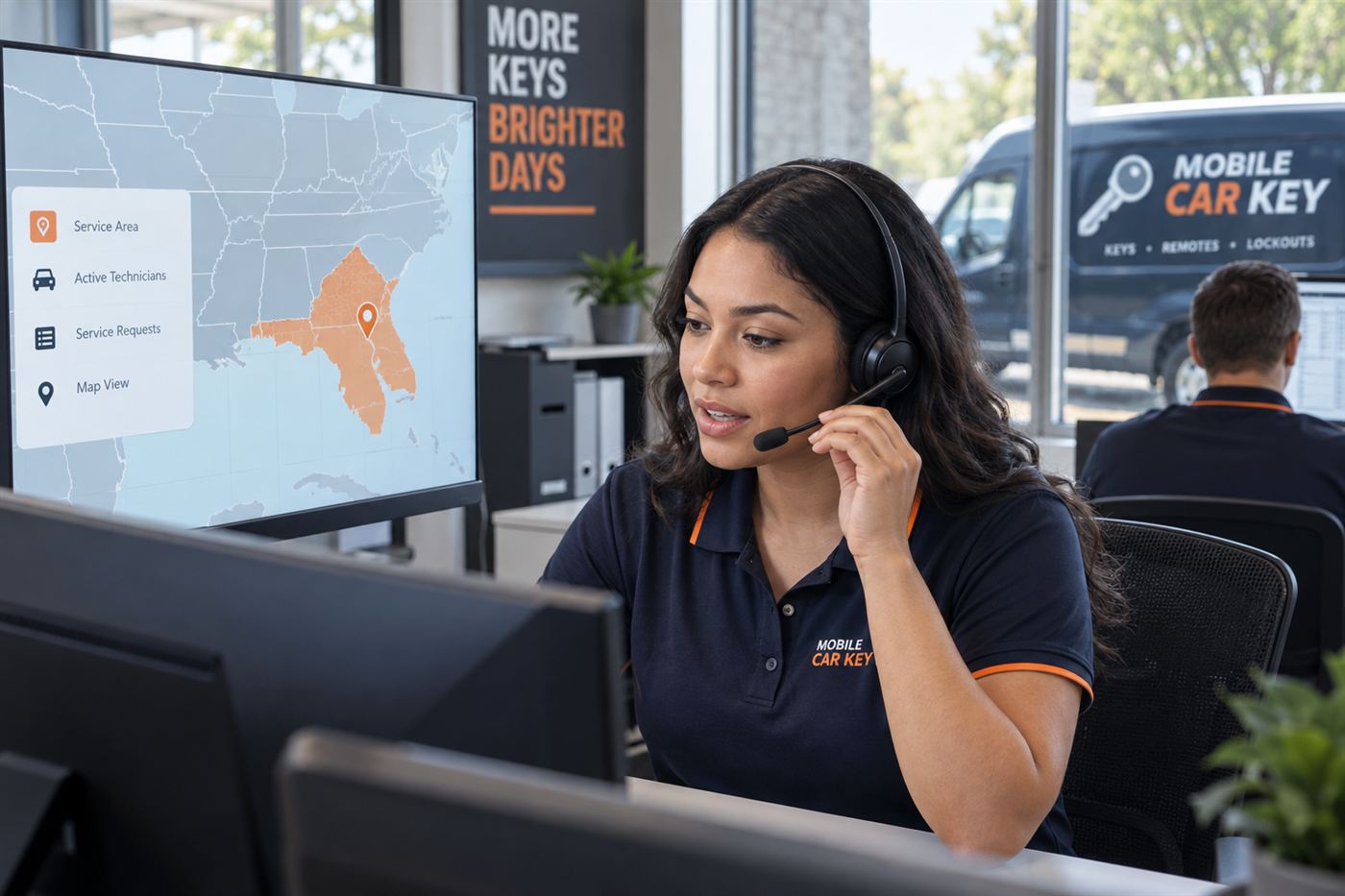
What coverage across the country really means
Coverage across the whole country sounds simple, but the practical meaning is worth stating clearly. It does not mean a technician is waiting on every street corner. It means the service is organized so a request from nearly anywhere in the country can be matched with a technician who works near the vehicle.
The technician comes to the car. That is the point of mobile service: you do not move the vehicle, arrange a tow or find a ride to a shop. The work happens at the roadside, in a parking lot, at a workplace or wherever the car is parked.
Because geography varies so much, what happens next depends on where the vehicle is. A request from a downtown parking structure in a major city looks different from one on a rural highway, and the service treats them differently while following the same overall steps.
- All fifty states and the District of Columbia are covered by the service.
- Requests are matched to a technician near the vehicle.
- Availability for your exact location is confirmed before dispatch.
- What is possible still depends on your vehicle.
How a request is matched to a technician
When you call or send a callback request, the first questions are about the vehicle and the location. The location tells the service which technicians work in the area. The vehicle tells it which tools and keys are needed. Matching means finding a technician who can reach you and who can do the job on your car.
A technician who covers a given area may have particular strengths. One may handle lockouts and standard transponder keys. Another may have tools for specific makes. The match considers both distance and capability, because a technician who is close but lacks the right equipment is not helpful.
Once a match is found, the service confirms the details with you before sending anyone. If no suitable match exists for your vehicle in your location, you should hear that plainly rather than being promised something that cannot be delivered.
Distance and capability together
A match is a balance. Closer is usually better, but only if the technician can do the work. Sometimes a slightly longer trip is justified because the technician carries the right equipment for your make.
Why exact location matters
A town name is not enough. Parking structures, large campuses, gated communities and rural roads all need detail. A cross street, a level or a mile marker helps the service match accurately.
What is confirmed before dispatch
The service does not send a technician until a handful of points are confirmed. This protects you from a wasted wait and protects the technician from a wasted trip.
First is coverage: can a technician reach the vehicle's location? Second is capability: can the job be done on this vehicle with mobile equipment? Third is terms: what are the conditions of the service, including how payment is handled? Fourth is readiness: will someone be at the car with identification and, where needed, ownership papers?
Only when these points are settled does dispatch begin. This page is educational. Nothing here creates a service agreement, and what is available depends on your vehicle and your location.
- Coverage: a technician can reach the vehicle.
- Capability: the job is possible on your make and model.
- Terms: conditions and payment handling are explained.
- Readiness: someone with identification will be at the car.
The regions of the country
The United States covers a vast area, and the driving conditions that cause key problems differ from region to region. Thinking in regions helps explain why requests look different in different places.
The Northeast is dense, with older cities, compact parking and heavy use of public transit alongside cars. The Southeast combines growing metropolitan areas, tourist destinations and humid heat. The Midwest has large agricultural stretches, major industrial cities and harsh winters. The Southwest and Mountain West bring desert heat, long distances and high elevations. The Pacific coast has large cities, freeways and a mix of coastal and mountain driving. Alaska and Hawaii stand apart, with unique geography and distances.
Northeast
Cities such as Boston, New York and Philadelphia mean tight streets, street parking and garages. Cold winters affect fob batteries and locks, and commuter rail stations often have long-term parking lots where cars sit for days.
Southeast
Places such as Atlanta, Miami and Charlotte combine large metropolitan areas with tourism and rental cars. Heat and humidity are hard on key fobs and rubber buttons.
Midwest
Chicago, Detroit and Minneapolis anchor a region of long winters and wide open highways. Frozen locks and cold-weakened batteries are common concerns, and distances between towns can be large.
Southwest and Mountain West
Phoenix, Las Vegas, Denver and Salt Lake City show how heat, altitude and distance shape service. Dashboard heat can damage plastic keys, and remote trailheads add to the challenge of reaching a vehicle.
Pacific coast, Alaska and Hawaii
Los Angeles, Seattle and Portland have dense urban cores and long freeways. Alaska and Hawaii are special cases because of remote locations and island geography, and coverage is confirmed with extra care.
Big cities and dense urban areas
In large cities, the challenge is rarely distance. It is access and precision. Vehicles sit in underground garages, on busy one-way streets, in multi-level parking structures and in lots behind security gates. A technician may need a gate code, a level number or a call to building security.
Traffic and parking rules also play a role. A technician needs a place to stand and work, and some city streets leave little room. Mention if you are in a no-parking zone or on a narrow street, and be prepared to explain where the technician can safely work.
Dense areas often have more technicians, which can help availability. But a larger market also means more variety in vehicles, and unusual or newer models may still need special tools. The vehicle questions apply as much in a city as anywhere else.
- Give the level, section or nearby landmark in a parking structure.
- Mention gates, codes or security desks that affect access.
- Note whether the street allows stopping or working at the curb.
- Keep your phone reachable, since signal can be weak underground.
Suburbs and mid-sized towns
Suburbs and mid-sized towns are where most drivers live, and many key requests come from ordinary places: a supermarket lot, a school pickup line, a workplace parking area. Access is usually simple, and distances are moderate.
The challenge in suburbs is often timing around daily routines. A driver who needs help during a work shift, a school pickup or a medical appointment may have limited flexibility. Telling the service about your constraints helps them plan.
Shopping centers and office parks add detail. Large lots can make it hard to explain where you are. A nearby store name or a numbered light pole helps the technician find the car.
Rural roads and long distances
Rural areas are where distance becomes the main factor. A technician may live far from the vehicle, and travel across a large county or between small towns affects availability. This is confirmed before dispatch, not left to chance.
Cell signal can also be limited. If you are in an area with weak coverage, find the spot with the strongest signal for a call, share your location as precisely as possible and keep your phone charged. Note the nearest mile marker, road name or landmark.
Rural drivers often face particular key issues too. Work trucks, farm vehicles and older cars are common, and key styles can vary widely. Describe your vehicle carefully, since older models may be simpler or may have unusual keys.
Planning ahead in remote places
If you regularly drive in areas with limited coverage, a spare key kept in a secure place, and a charged phone, can save a long wait. Think about where help would reach you.
Honest answers about distance
If a vehicle is too far for practical service, you should hear that early. Sometimes the right answer is a different route, such as a roadside program or a dealership.
Travelers, tourists and rental cars
Many calls come from people who are not near where they live. A traveler on a road trip, a tourist at an airport or someone on a business trip with a rental car faces extra constraints: unfamiliar streets, no spare key at hand and sometimes a vehicle that belongs to someone else.
If the car is a rental, the rental company owns it. The company is often the first call, because it may have its own roadside program or replacement process. A locksmith may not be able to help without the owner's permission. Our guide on lost keys on a rental car or car share explains the order of steps.
If it is your own car but you are far from where you live, the same ownership check applies. Carry a photo of your registration on your phone, and keep identification on you.
Weather and seasons across the country
Weather shapes key problems in ways that vary by region and season. In hot climates, heat softens plastic, wears out batteries and makes lockouts more urgent. In cold climates, frozen locks, brittle plastic and weak batteries cause failures. Wet regions bring corrosion to fobs that get soaked.
Storms add another layer. Heavy snow, ice, flooding or wildfire smoke can affect road access and technician travel. If conditions are dangerous, be patient and put safety first. Availability can change with the weather, and coverage is confirmed with current conditions in mind.
During extreme weather, if you are stranded and unsafe, call 911 first. Emergency services come before everything else.
- Hot climates: heat damages cases and drains batteries.
- Cold climates: frozen locks and brittle plastic are common.
- Humid and wet regions: moisture corrodes fobs.
- Storms and disasters: access may be limited and safety comes first.
What to have ready wherever you are
Preparation is the same in every state. Know the year, make and model of your vehicle. Keep your identification handy. If you can reach your registration or title, have it ready. Be able to describe your exact location and whether there are gates, levels or access limits.
Also decide who will be at the car. The person present should be authorized to request work on the vehicle and able to show identification. If you are acting for a company or an owner who is elsewhere, tell the service so arrangements can be made.
Our step by step page describes what happens after you make contact, and the car key services page explains each type of job.
Photos that help
A photo of the vehicle identification number, the key you hold and the surroundings can speed up identification. Take them before you call if you can.
A charged phone
Your phone is your link to the service and the technician. If battery is low, keep it for the call and turn off apps you do not need.
Road trips that cross several regions
A long drive can take you through desert, mountains, farmland and big cities in a single week. Key problems follow you, and so does the need to describe your location clearly each time. A driver who loses a key in one state does not need to be in that state's largest city to get help, though distance may play a part.
Before a long trip, check your keys. Replace weak fob batteries, confirm that your spare works, and decide where the spare will travel. A spare in your luggage is useful only if the luggage is not in the locked car. A spare with a travel companion who is in another vehicle may be more useful.
Take a photo of your registration and the vehicle identification number and keep them on your phone. These small steps remove the most common delays when a request comes from far from where you live.
It also helps to know roughly where you are on the route. Exit numbers, mile markers and the name of the last town you passed are all useful details. A technician or coordinator who hears a precise description can judge distance far better than one who hears only a highway number.
- Test every key and fob a few days before departure.
- Keep the spare separate from the main key and from the car.
- Save photos of registration and identification on your phone.
- Note the name of the rental or insurance roadside program if you have one.
Businesses, fleets and vehicles that cross state lines
Work vans, delivery vehicles and company cars often travel through several states in a single week. A key failure in the middle of a route can halt work, and the owner may be in an office hundreds of miles away.
In these cases, the person at the vehicle and the person who owns it may be different people. The owner's authorization is part of the ownership check. If you manage vehicles, think about how you would give permission clearly when a driver calls from a roadside.
Our guide on key management for small fleets and work vans covers key control, spares and planning, which matter even more when vehicles spread across wide areas.
Authorizing a driver remotely
Decide in advance who can authorize work, and how. A short written note or message from the owner with the vehicle details can make a roadside visit smoother.
Keeping spares where they help
For vehicles that work in far-flung places, a spare kept at a base or with a supervisor is useful only if it can reach the driver. Consider where spares could be sent, and which vehicles share the same key type.
How to read your state page
Each state page starts with a short statement of how coverage works for drivers in that state. It then looks at the cities, highways and driving situations typical there, climate and its effect on keys and fobs, and the difference between urban and rural areas.
The pages are written for drivers, not as legal summaries. They use general, well-known facts as examples and avoid claims about local offices, statistics or rules. They also mention neighboring states, since a driver near a border may be closer to a technician across the line.
Each page ends by pointing to the services that matter most, so you can move from your state to the details of a lockout, a replacement or a fob. If you are unsure which service you need, the car key services page is a good place to start.
What you will find
Local driving patterns, climate effects on keys, common situations, what to have ready and links to related services. The structure differs from state to state because places differ.
What you will not find
Local phone numbers, office addresses, invented statistics or legal claims. Contact is handled centrally, and availability for your location is confirmed before dispatch.
Limits and honest expectations
No service can reach every vehicle everywhere. Limits depend on the vehicle, the location and the conditions. Many makes and models are supported, but not all, and newer vehicles from some makes may need dealer-level tools or manufacturer access.
Some locations are too remote, too restricted or too dangerous for service at a given moment. Some vehicles require equipment a mobile technician cannot carry. In those cases, the right answer may be a different route, and the service should tell you so.
We would rather say so early than let you wait for something that cannot happen. Honest limits are part of being useful.
There is also a difference between a limit and a delay. A limit means the job cannot be done by a mobile technician on that vehicle or at that place. A delay means it can be done but will take longer, perhaps because of distance, weather or a part that must be sourced. A good conversation on the first call separates the two so you can decide what to do next.
If your vehicle is outside what mobile service can reach, other options remain. A dealership may hold manufacturer access, a roadside program may cover a tow, or the owner of a rental or company car may arrange replacement. Our guide on mobile locksmith or dealership helps you weigh those choices.
- Many, not all, makes and models are supported.
- Newer models from some makes may need dealer-level tools.
- Remote or restricted locations may limit availability.
- Weather and safety conditions can change what is possible.
Choose your state
Each state page describes how coverage works for drivers there, the kinds of places and driving situations common in the state, and the key problems that follow from local climate and travel patterns. Choose your state below.
The list includes all fifty states and the District of Columbia. If you are close to a border, check the neighboring state too, since requests are matched to a technician near the vehicle and not to a line on a map.
- Alabama
- Alaska
- Arizona
- Arkansas
- California
- Colorado
- Connecticut
- Delaware
- District of Columbia
- Florida
- Georgia
- Hawaii
- Idaho
- Illinois
- Indiana
- Iowa
- Kansas
- Kentucky
- Louisiana
- Maine
- Maryland
- Massachusetts
- Michigan
- Minnesota
- Mississippi
- Missouri
- Montana
- Nebraska
- Nevada
- New Hampshire
- New Jersey
- New Mexico
- New York
- North Carolina
- North Dakota
- Ohio
- Oklahoma
- Oregon
- Pennsylvania
- Rhode Island
- South Carolina
- South Dakota
- Tennessee
- Texas
- Utah
- Vermont
- Virginia
- Washington
- West Virginia
- Wisconsin
- Wyoming
Related pages
If you want to learn what each service involves before you decide, start with vehicle lockouts for a door that will not open, car key replacement for a lost or broken key, or all car keys lost when none remain.
For help getting started, see contact and callback request. If anyone is in danger, call 911 first. Children or pets locked in a hot car are an emergency.
Common questions
Do you really cover every state?
The service covers all fifty states and the District of Columbia in the sense that requests are matched to a technician near the vehicle. That does not mean every address has a technician close by. Availability for your exact location is confirmed before dispatch, and remote areas may be harder to reach.
How do you decide which technician comes to me?
The match considers where the vehicle is and what it needs. Location tells the service which technicians work nearby, and the vehicle tells it which tools and keys are required. A technician must be both within reach and able to do the job on your car before a dispatch is made.
What do you confirm before sending someone?
Four things: that a technician can reach the vehicle, that the work is possible on your make and model, the terms of the service including payment handling, and that someone with identification will be at the car. Only after those are settled does dispatch begin.
Is service different in cities and rural areas?
The steps are the same but the details differ. In cities, the challenge is usually access, such as garages, gates and tight streets. In rural areas it is distance and phone signal. Availability in remote places is confirmed before dispatch, and you should hear early if a location is difficult to reach.
I am traveling and far from where I live. Can you still help?
Often yes. Describe your location carefully, keep identification on you and have a photo of your registration if possible. The same ownership check applies wherever you are. If the vehicle is a rental, the rental company owns it and is often the first call, since permission from the owner may be needed.
Will you help with any make and model?
Many makes and models are supported, but not all. Limits depend on the vehicle. Newer vehicles from some makes may need dealer-level tools or manufacturer access that a mobile technician cannot reach. The vehicle details you give on the first call help establish what is realistic.
What if I am close to a state border?
Requests are matched to a technician near the vehicle, not to a line on a map. A technician in the neighboring state may be the closest match. Read the page for your state and for the one next door if your location is near the border, and mention exactly where you are on the call.
Does this page create a service agreement?
No. The page is educational and explains how coverage works in general. It creates no service agreement. Availability, coverage and terms are confirmed before any technician is dispatched, and what is possible depends on your vehicle and your location.