
Step one: take stock of what you have
Triage begins with a calm inventory. How many BMW keys do you still hold, and what condition are they in? Is the problem a lost key, a damaged key, a fob that does not respond or a car that will not recognize a key that looks fine?
Each answer points in a different direction. A lost key with a working spare is a replacement job with no urgency. A lost key with no spare is an all keys lost job. A fob with a dead battery is a minor repair. A fob the car no longer recognizes can mean anything from a pairing problem to a failed component.
This guide is educational only and does not create a service agreement. Availability, coverage and terms are always confirmed before a technician is dispatched, and what can be done depends heavily on the specific vehicle and its year.
Write the answers down. Under pressure, details slip, and a short note with the year, model, key count and what happened will keep the first call organized. Add the time the trouble began and anything unusual that preceded it, such as a recent battery replacement, a wash, a collision or a service visit. Those clues often explain a key that suddenly misbehaves.
Step two: understand why BMW keys feel different
BMW has built a reputation for advanced engineering, and the key system is part of that. The fob is not a simple remote. It is a small electronic device that communicates with the vehicle's access and start electronics, and the car stores information about each key it knows.
That stored information matters. When a key is lost, the car still remembers it. A responsible replacement includes removing the lost key from the car's memory, so that a stranger holding it cannot use it. That step is part of a proper job and not an optional extra.
Because the system is sophisticated, key work often needs specialist equipment, and on some models, access that the manufacturer controls. This is why honest expectations matter. A technician who promises that every BMW can be handled at the curb is not being straightforward.
It also helps to know that the fob and the car are paired as a set. That is why a key purchased online, or taken from a salvaged car, will not simply work in yours. A key that has been used with another vehicle may be locked to it. Used or salvaged fobs bring risks, including keys that cannot be reused and keys of unknown history.
Step three: identify the kind of key you hold
BMW has used several key styles. Some vehicles use a traditional style key with a blade and a remote. Some use a fob with a hidden emergency blade and a push button start. And some newer vehicles offer a display key, a fob with a small screen that shows information about the car, alongside a phone based option.
Some older fobs include a rechargeable battery that is topped up when the key sits in the ignition, which is a feature unique enough that it deserves a mention. If such a key stays out of the car for a long time, its battery can run down, and the fob may need service.
Which style you hold depends on the model and year. Photograph the key and the dash, and be ready to state whether the car starts with a key turned in the ignition or a button pressed with your foot on the brake.
If you are not sure what you have, compare it with the owner manual or take a clear photo of both sides of the fob. Note the shape, the number of buttons, the presence of a blade and any logo or marking on the case. A technician can often recognize a fob from a photo and say whether it is the type that can be handled on site.
Be aware that look alike fobs exist. Two keys with similar cases may contain different electronics, and a fob from a different model year may fit the case but not the car. This is one more reason to share the exact year and model rather than relying on appearance.
Comfort access
Many BMWs offer a hands on keyless entry system, in which the car senses the fob when you touch a door handle. The system relies on radio signals, so a weak fob battery, a second fob nearby or interference can reduce its reliability.
The emergency blade
Inside most keyless fobs is a small mechanical key. Learn where the release is and where the hidden keyhole on the driver door sits, since the cover often needs to be lifted gently.
Step four: decide whether it is a battery issue
A fob that stops responding is often a battery problem, and that is the simplest thing to rule out. Symptoms include shorter range, repeated attempts at unlocking and a dash message about the key. Replace the battery carefully, noting the orientation and avoiding metal prying tools.
Some BMW fobs are fussier than others about how they open and close. Take your time, and consult a guide for your fob before forcing anything. A cracked case or a bent contact can turn a simple battery swap into a bigger repair.
If a fresh battery does not help, try the spare fob. A working spare points to a fault in the first fob. If both fail, look at the car. The dead fob battery guide covers the process in more detail.
Do not forget the car's own battery. A weak vehicle battery can make a fob seem unreliable, because the electronics that read the fob need steady power. If dash lights are dim or the starter sounds sluggish, the car battery may be the real culprit. A jump start or a battery test can settle the question before you spend time on the fob.
Step five: if the only key is gone
With no key at all, you face a true all keys lost situation. A technician will ask for the year, model, trim, how the car starts, your location and proof of ownership. Whether the job can be done at the vehicle depends on the model.
For some BMWs, a mobile technician can create and program a replacement on site. For others, especially newer vehicles, the procedure may require dealer level tools or manufacturer access, and the honest answer may be that a dealership route is needed. The advantage of a first phone conversation is that you learn this before anyone travels.
While you wait, avoid attempts to start the car with unrelated keys or to force the ignition. If the car is parked in an unsafe spot, move yourself and your valuables to a secure place. The all keys lost page explains the general process.
Keep the situation in perspective. Many all keys lost cases are resolved without drama once the facts are on the table. The technician's questions may feel thorough, but each one narrows the path and protects you. Answer them plainly, and if you do not know something, say so. An honest unknown is more useful than a guess.
Step six: protect yourself against the lost key
A lost BMW key is more than an inconvenience. It is a security concern, because the key could be used to open and drive the car. If you lost the key near the car, or you think it may have been stolen, treat the matter seriously.
Ask that the lost key be removed from the car's memory during replacement. Consider telling your insurer if theft is possible. Park in a well lit area until the key problem is resolved, and watch for signs of tampering.
If a phone based digital key is part of your setup, disable it through the manufacturer's service if the phone is lost. A phone key and a physical key are separate parts of the system, and both need attention.
If a BMW is parked on the street, add a visual deterrent such as a steering wheel lock until the situation is resolved. It does not replace removing the lost key from memory, but it signals that the car is protected. Keep the registration and insurance details handy, in case you need to report an incident.
Step seven: locked out of a BMW
A lockout is when the key exists but is out of reach. With keyless systems, a fob left in the cabin or in the trunk can lead to a locked car. Some BMWs warn you; others do not.
If a child or a pet is inside a closed car, call 911 first. Heat builds rapidly in a parked vehicle, and responders are trained to act. Everything else can wait.
If nobody is at risk, a technician can open the vehicle with specialist tools that do not harm paint, seals or electronics. Avoid wedges and hangers, which can damage the wiring and airbag components in modern doors. The lockouts page offers more guidance.
Before calling, walk around the car and try every door, the trunk and the windows. A rear door left unlocked is a surprisingly common reason for a lockout that did not need a call. Also check whether a phone based key or a spare fob is within reach, since either may open the car and end the problem.
Step eight: used BMWs and their key histories
Used BMWs are popular, and they can come with confusing key histories. A car may have one key, a worn key or a fob that belongs to a different generation. A previous owner may still hold a working fob.
Insist on knowing how many keys exist. If the seller cannot produce at least one proper key, consider whether the car is worth buying. A used BMW with no key is a more complicated purchase than it appears, and the replacement may need specialist work.
After purchase, many owners have a technician create a new key and remove old ones from the car's memory. The buying used car keys guide explains what to ask a seller, and the immobilizer guide describes why unknown keys matter.
A service history can help too. Ask whether the car's key modules, ignition or access electronics have ever been replaced. Repairs like these sometimes require keys to be reintroduced, and keys that predate the repair may stop working. The answer can explain why a seller's only key behaves oddly.
Extra: electric, hybrid and performance BMWs
BMW offers plug in hybrids, fully electric models and high performance variants alongside its conventional cars. The key experience on these vehicles is similar to other keyless BMWs, with a few differences in how the car wakes up and starts. An electric BMW starts silently, and a dash indicator shows that it is ready.
A weak small battery in an electric or hybrid vehicle can cause odd key symptoms, such as a fob that is not detected or doors that do not respond. If your BMW is electric or a plug in hybrid, say so when you call, as it can change what is checked first.
Performance models often carry modifications, from tuning modules to aftermarket alarms, and these can interact with the key system. Tell the technician about anything unusual. A car that has been chipped, retrofitted or repaired after an accident may behave differently when a new key is introduced.
Step nine: the information to gather
Before you contact a service, collect these items:
- Year, model and trim of the BMW, and whether it is gas, hybrid or electric.
- Whether you have a blade key, a fob with push button start or a display key.
- What the dash shows when you try to start.
- How many keys remain and their condition.
- Your exact location, including parking level or nearest cross street.
- Registration, title or lease paperwork and photo identification.
- Whether a phone based digital key is also set up.
Extra: what a visit looks like, and what it cannot do
A mobile visit begins with a conversation. You describe the vehicle, the problem and your location, and the service tells you whether it can help and on what terms. Nothing is dispatched until those points are settled, and a service that is honest with you at that stage is worth trusting.
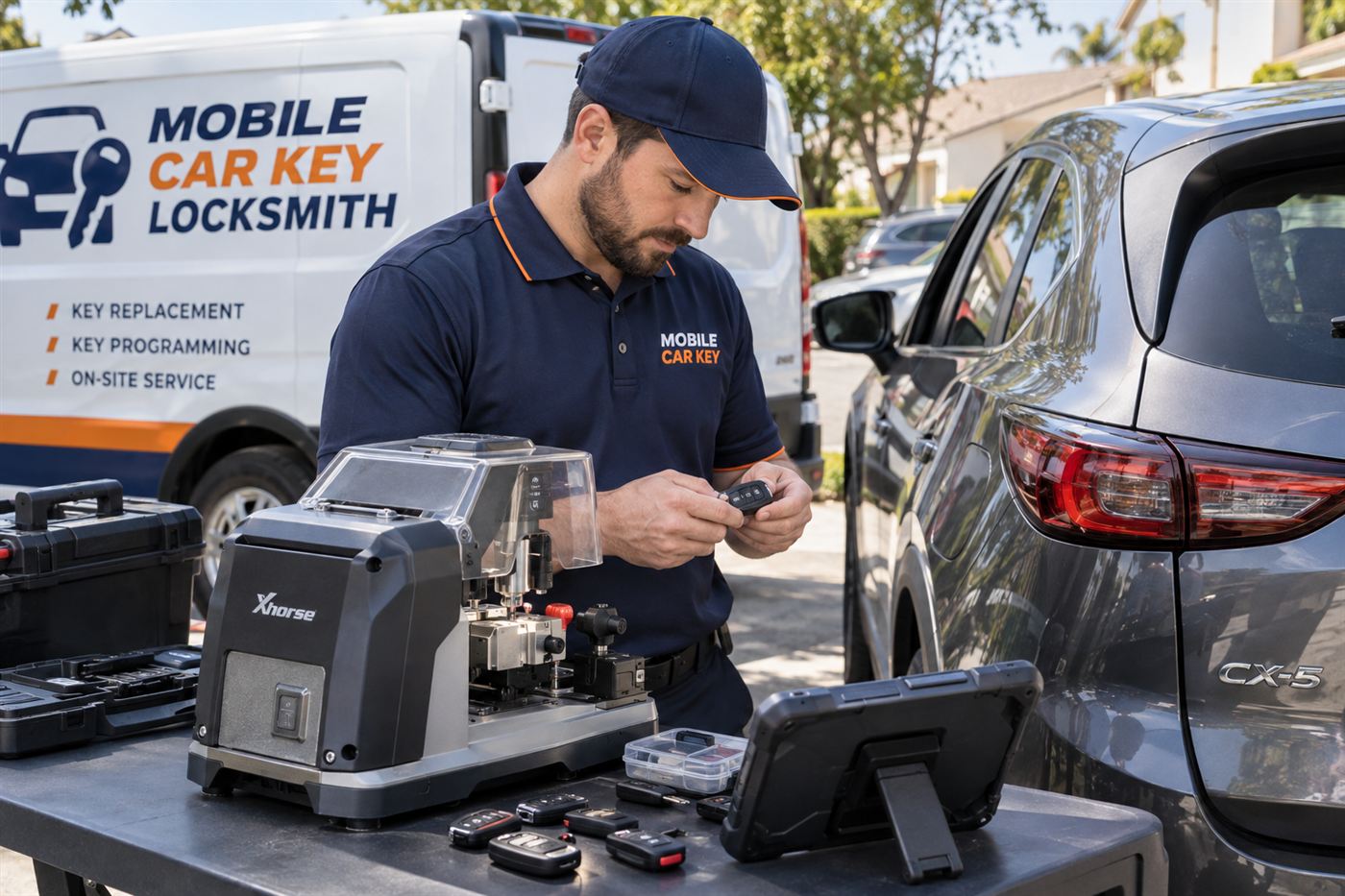
On arrival, the technician confirms your ownership, inspects the vehicle and explains what will be done. Equipment is used to read the car, prepare a new key and match it, and lost keys are removed from memory if you ask. Every function is tested before the technician leaves.
What a visit cannot do is override a limit set by the vehicle. If a model needs manufacturer access that a mobile technician does not have, the technician cannot invent it. In that case you will be told, and the next step is a dealership. This is not a failure of the service. It is an honest boundary, and knowing it early saves time.
Step ten: ownership proof for a BMW
A BMW key is valuable to a thief, so a reputable service takes ownership checks seriously. You will be asked to show that you own the vehicle or are authorized to use it.
Typical documents are a registration and a photo identification that match. A lease agreement or a letter from the lessor helps when the car is leased, as is common with BMW. For a company car, a letter from the employer and a copy of the registration are usual.
Take photos of your registration and insurance card. If your paperwork is locked in the car, the photos give you somewhere to start. The exact requirement is explained when availability and terms are confirmed.
Step eleven: set up a spare before you need it
A spare key made while you still have a working one is the strongest protection against a bad day. On a BMW, it can also be the difference between a simple job and a complicated one, since duplicating from a working key is generally easier than creating a key from nothing.
Keep the spare in a secure place away from the car: with a trusted person, in a lockbox or in a safe you control. Do not store it in the vehicle, and do not hide it on the bumper.
Remember battery care for any fob. A fob with a dead battery is a fob that cannot do its job. Replace batteries on a schedule, and test the spare occasionally. The spare key guide has more ideas.
Step twelve: compare with other European brands
BMW belongs to a group of European makes with sophisticated key systems, but each has its own details. The Porsche car keys page, the Mercedes-Benz car keys page and the Mini car keys page treat those brands separately. For a more mainstream comparison, the Volkswagen car keys page is a useful contrast.
The car keys by make hub lists every brand covered on this site. Whatever you drive, describe the vehicle precisely, tell the service where it is and let availability and terms be confirmed before anyone is dispatched.
Common questions
Can a mobile technician replace a lost BMW key?
Sometimes, depending on the model and year. The technician needs the year, model, trim and proof of ownership. Some newer BMW models may need dealer level tools or manufacturer access, and you will be told honestly before dispatch whether on site service is realistic for your car. Having the details ready lets the technician say what is realistic for your BMW.
Why is a BMW key job more involved than other brands?
The key is an electronic device that the car stores and checks, and a proper replacement includes removing lost keys from the car's memory. On some models the equipment or access needed is controlled by the manufacturer. That can make the process more specialized than for simpler key systems. The right answer for your BMW depends on the exact model and year.
My BMW fob stopped working. Is it the battery?
It often is. Replace the battery carefully, noting its orientation, and avoid metal prying tools. If that does not help, try the spare fob. A working spare points to a fault in the first fob, and a technician can advise whether repair or replacement is appropriate. A short, honest description of your BMW at the start makes the whole process smoother.
What is a display key?
It is a fob with a small screen that shows information about the car, offered on some newer BMWs. It is more complex than a standard fob, and replacing it may involve manufacturer controlled steps. Tell the technician if you have one so they can say what is realistic. It is always reasonable to ask what applies to your specific BMW before agreeing to anything.
Should I remove a lost BMW key from the car's memory?
Yes. A lost key can still operate the vehicle if it is not removed. A responsible replacement includes clearing lost keys so they stop working. Ask about this when you arrange the job, and consider additional precautions if the key may have been stolen. When in doubt, ask first; clear expectations save time for everyone involved. If you are unsure, describe what you see and the technician can help sort it out.
Can I rely on a phone as my only BMW key?
It is risky. Phones lose charge, get lost and fail. Keep a physical fob as a backup in a place away from the car. If you lose a phone that holds a digital key, disable it right away through the manufacturer's service and your phone carrier. Having the details ready lets the technician say what is realistic for your BMW.