
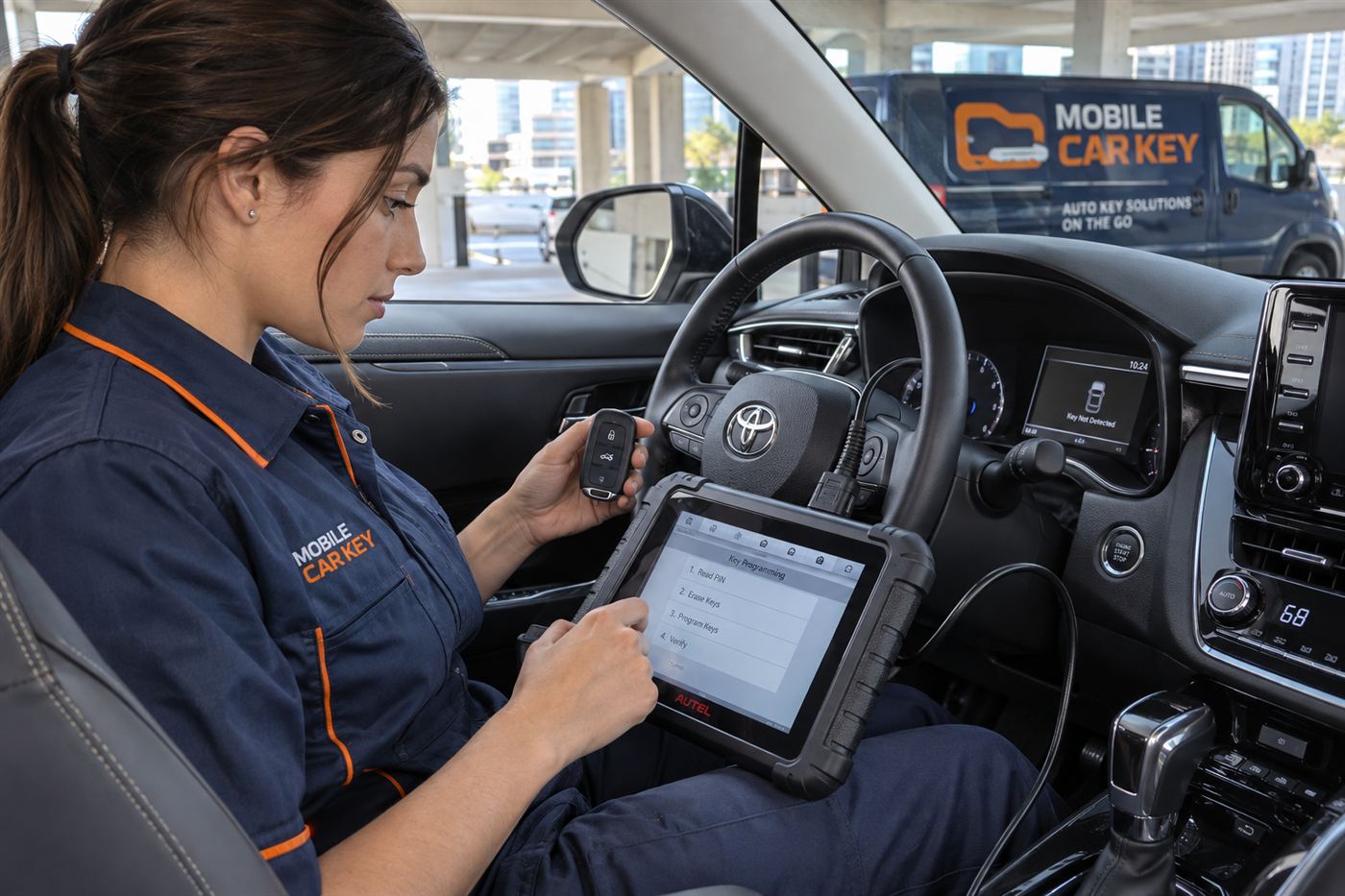
How the services fit together
Mobile car key service is a family of related jobs. They share tools and skills, but each begins from a different starting point. The first question is always what you have in your hand: a working key, a damaged key, a fob that will not respond, or nothing at all.
A driver who still has one working key and needs a spare is in the simplest position. A driver whose only key snapped in half is in a middle position, because a broken key can sometimes still supply useful information. A driver with no key anywhere is in the most involved position, and the vehicle itself becomes the source of everything the technician needs.
Lockouts sit slightly apart. They do not involve making a key at all. The task is to open the vehicle without harming it, and then the driver goes on with a key they already own.
Seeing the services as a ladder helps. At the bottom is the lockout, which touches no key at all. Above it sits the spare, then the replacement of a damaged key, then programming, and at the top is the job with no key anywhere. Each step up asks more of the technician and more of the paperwork, and more of your patience, which is why describing the starting point honestly is the most useful thing you can do on the first call.
Two questions that sort most requests
Do you have any key that still starts the car? And is the problem the metal, the chip, or the buttons? Those two answers place most situations in the right category at once, and they are worth thinking about before you call.
Car key replacement
Replacement is the service for a key that is lost, broken, worn, bent or damaged, when the vehicle can still be identified and a path to a new key exists. The new key must match the car's lock and, for most modern vehicles, must also be recognized electronically.
A replacement does not just copy the old key. For many vehicles it is cut from the vehicle's key code or by reading the lock, then programmed so the car accepts it. If a working key remains, the process is usually simpler than starting from nothing.
The page on car key replacement describes key types, what is needed, how a new key is made and matched, and what affects the job.
Replacement covers a wider range than people expect. A key that has cracked at the head, a blade bent from years of leverage, a plastic shell that has split and exposed the chip, and a key that has been through a washing machine are all replacement jobs. Each has its own wrinkles, and a damaged key can still be handed over, because the pieces may tell the technician something about the blank and the cuts.
Replacement also includes the quiet cases, such as a key that still works but has worn so smooth that it sticks. Replacing it before it breaks inside the ignition is far kinder to the vehicle than waiting for failure.
All car keys lost
When every key is gone, the job changes character. There is nothing to copy and nothing to read. The vehicle has to be identified precisely, ownership has to be established with care, and a new key has to be created and registered to the car.
This is also the situation where removing the lost keys from the car's memory matters most, because someone else may now hold a key that once worked. Whether that can be done depends on the vehicle and the system it uses.
It usually takes more time and preparation than adding a spare. The page on all car keys lost explains the steps in order and what to do first.
Do the early things first. Retrace your steps, check coat pockets and bags, and ask whoever else drives the car. Secure the vehicle if it is parked somewhere open. Collect the registration or title and your ID. Write down the vehicle identification number from the dashboard or the door frame, since that detail speeds up every other step.
Do not try to force the ignition or pry at the steering column. Damage there turns a key job into a repair job and makes the work harder for everyone involved.
Key fob programming
Programming is the step that makes a key or fob and a car recognize each other. A fob can look perfect and still do nothing, because it has not been introduced to the car. Programming is that introduction.
There are different routes. Some vehicles allow an on-board procedure done with the keys and a sequence of actions in the cabin. Others require a diagnostic tool connected to the car, and some require manufacturer access. Which route applies depends on the make, the model and the key system.
Programming also separates the buttons on a fob from the chip inside it. The buttons can fail while the chip is fine, and the reverse can happen. The page on key fob programming explains the difference and when a fob cannot be reused.
Battery trouble gets confused with programming trouble all the time. A weak battery makes a fob sluggish or erratic, and a dead one makes it silent. Replace the battery first, and if the fob still does nothing, the problem may be programming. The dead key fob battery and reset guidance sets out the symptoms in detail.
Some fobs lose their link to the car after a battery change or a drop, and others were never matched in the first place, as with a replacement bought online. A used fob taken from another car may be locked to that car and unable to learn a new one.
Transponder key duplication
A transponder key contains a small chip. The car sends a signal to the chip when you turn the key, and the chip answers with a code the car expects. If the answer is wrong or missing, the engine will not start, even if the metal blade turns the ignition perfectly.
That is why a plain hardware-store copy of a chip key tends to open the door and then fail to start the car. Duplication of a chip key means making a copy of the blade and also giving the new chip the right identity, through cloning or programming.
Our page on transponder key duplication explains immobilizers in plain words and why spare key planning matters.
Chips come in different generations, and the car cares which one it has. Older chips can often be copied outright, while newer ones use rolling or encrypted codes that must be programmed into the vehicle. In plain words, the more recent the system, the less a simple copy can do.
This is also why spare planning for chip keys is wise. Making a spare while a working key exists is generally a smaller job than recovering from a complete loss.
Remote and proximity fobs
Many keys combine the metal blade with buttons that lock, unlock and open the trunk. Remote head keys and flip keys fold these functions into one piece. Push-to-start smart keys go further, using proximity sensing so the key never has to leave your pocket.
Each type has its own replacement and programming considerations. A smart key, for example, may need a different procedure than a flip key. Key cards, found on some vehicles, behave differently again.
The page on remote and proximity fobs describes each type, along with relay theft precautions and battery care.
Battery care is part of living with these keys. A proximity fob is always listening for the car, so its battery drains steadily, and a weak battery shortens the range. Replace it when the car starts showing a low key battery warning, and keep a spare battery in the glove box.
Relay theft is worth a mention. Thieves can capture a smart key's signal while its owner is indoors and relay it to the car parked outside. Keeping the fob away from entrances and using a signal-blocking pouch are simple precautions.
Vehicle lockouts
A lockout is the situation where the key exists but you cannot reach it, because it is inside the car, in the trunk, or otherwise out of reach. A technician opens the vehicle using methods designed to avoid damage.
Lockouts can be urgent. A child or a pet in a closed vehicle is an emergency, and heat or cold raises the stakes sharply. Call 911 first if a person or animal is in danger.
The vehicle lockouts page covers what a technician can do, what information helps, trunk and door cases, and damage-avoidance methods in general terms.
Trunk cases deserve their own mention. A key left in the trunk after loading bags is common, and some cars lock the cabin when the trunk is shut with the fob inside. Door cases, with the key on the seat or still in the ignition, are the classic version.
The technician will ask where the key is, whether a window is open even slightly, and what the car does when its doors are touched. These answers shape the approach and help avoid damage.
How to choose the right service
If you are unsure, begin with the starting point. A rough guide is below, and it is only a guide. The person who takes your call will ask follow-up questions and may reclassify the job once details are clear.
A few edge cases are worth knowing. If the car is a rental or a car-share vehicle, call the company first, because the owner decides what can be done. If the key is stuck in the ignition or has broken off in the lock, say so, since extraction is a distinct step. If someone stole the keys, mention it clearly so the question of removing them from the car comes up at once.
- You have a key but cannot get into the car: a lockout.
- You have one working key and want another: replacement, usually a spare.
- Your key is broken or worn but still partly there: replacement, sometimes with the broken pieces as a reference.
- The buttons on your fob stopped but the key still starts the car: fob programming or a battery issue.
- You have no working key at all: all keys lost.
- You bought a used car with one key or an unknown set: replacement or programming, often with older keys removed from the car's memory.
What a technician brings
A mobile technician works from a vehicle equipped to handle the job at the curb. That generally means key cutting equipment for cutting new blades, a range of key blanks and fobs, diagnostic and programming tools for reading and writing key information, and the means to open locked vehicles without harm.
What is actually carried depends on the vehicle you describe. That is one reason the details you give at the start matter. A technician who knows the make, model and year can prepare the right blanks and fobs and avoid arriving with the wrong ones.
No technician can carry every key for every vehicle. If something is not on hand, a good service tells you so and explains what the options are.
Mobile work has its own rhythm. The technician sets up near the vehicle, identifies the key system, and prepares the blank. Cutting may be done on a portable machine, followed by programming using a tool connected to the car. Testing comes last, and it includes the lock, the ignition and every button.
You are welcome to watch and ask what is being done. A service that works openly is usually one that is comfortable with your questions.
Why the vehicle details matter
The same model can use different key systems across different years. The vehicle identification number lets a technician confirm which one yours uses, and which tools are needed. It takes a moment to read, and it prevents a wrong guess.
Why ownership is checked
Every one of these services creates or enables access to a vehicle. A reputable service therefore asks for proof that you own the car or are authorized to use it before work begins. It is a safeguard for owners, and it is one most people recognize and accept.
In general terms, that means a registration or title and an ID that matches. If you are using a car that belongs to someone else, expect to be asked for confirmation from the owner.
The guide on proving you own the car explains how people deal with missing paperwork and what usually helps.
Two people can be in a perfectly honest position and still need to wait. A son driving his mother's car, an employee in a company van, a buyer with a title still in the mail: each can resolve it with the right call or document. The aim is not to put up obstacles, but to make sure the key goes to the person entitled to it.
What can affect the job
Several things can make one job more involved than another. The key type is the biggest factor, since a basic cut key and a smart key are very different products. The number of keys you have left matters. So does the vehicle's age and make, and whether the car has security features that require special access.
Location can matter too. A vehicle in an open parking lot is easier to work around than one wedged in a tight garage space. Weather affects comfort and sometimes the work itself. Access to power or good light may be a consideration after dark.
Because these details change the arrangement, availability, coverage and terms are confirmed with you before a technician is sent. This page is educational and does not make an offer.
Newer security features can add steps without any visible sign. A vehicle might look like any other, but its key system may require a waiting period during programming, or a secure online connection. Technicians who work on these systems know to expect it, and they plan the visit around it.
Patience helps. A careful job takes as long as it takes, and a rushed one risks a key that works once and fails later.
- Key type: cut key, chip key, flip key, smart key or key card.
- Number of working keys remaining.
- Make, model and year of the vehicle.
- Whether dealer-level tools or manufacturer access are needed.
- Where and when the vehicle is parked.
Newer vehicles and dealer-level limits
Some newer vehicles, from some makes, use security systems that need dealer-level tools or manufacturer access to add or replace keys. A mobile technician cannot always bypass those requirements, and a trustworthy service will not pretend otherwise.
When a vehicle falls into this category, the options are usually to use the dealer, or to use a mobile technician who has access to the necessary systems for that make. Asking during the first call prevents a wasted trip.
The guide on a mobile locksmith or a dealership looks at both routes honestly, including when the dealer is the sensible choice.
Dealers have a legitimate role. They hold the manufacturer's records and tools for their own brands. A mobile technician has the advantage of coming to you, and of not needing a tow. The right choice depends on the vehicle, the situation and what you are comfortable with.
If you are unsure, ask the service directly whether it can handle your make and model, and listen to the answer.
Planning ahead with spares
Every service on this page is easier and more predictable when a spare key exists. A spare turns a lost-key emergency into a minor inconvenience. It also gives a technician a working key to read from, which can simplify the job.
Think of the spare as a small act of insurance. Keep it somewhere separate from the main key, outside the car, and in a place you can reach in practice. A spare in a drawer at your workplace is no use if you are stranded on a road trip.
For some drivers, a second spare for a partner or a grown child makes sense. For small fleets, a documented set of spares and a record of who holds which key avoids the worst surprises.
Check your spares every so often. A spare that has not been tried in three years may have a dead battery or a worn blade. Test it in the lock and, for a chip key, in the ignition. It is far better to discover a problem on a quiet afternoon than on the day you need it.
How a request works
The path is the same whichever service you need. You call or send a callback request. The service asks about the vehicle, the location and what happened. Availability, coverage and terms are confirmed before dispatch. A technician arrives at the vehicle, checks ownership or authorization, does the work, and tests it.
If you want the steps in detail, read how the service works. It also covers what can delay a job and what information speeds the conversation up.
Coverage is national. The service areas page explains how requests are matched to technicians near the vehicle.
It helps to keep notes during the process. Write down the name of whoever you spoke with, what was agreed, and what documents you were asked to show. That makes any later call simpler and keeps everything clear.
Safety and common sense
If anyone is in danger, call 911 first. That includes a child or pet locked in a hot car, a person who is ill, and any situation where you feel unsafe where you are standing. A key problem can wait.
If you are stranded at night or on a road, move to a lit and populated spot if you can. Do not accept help from strangers who offer to open the car for you, and be wary of anyone who approaches uninvited.
Tell someone where you are. A friend or relative who knows your location can wait with you or check on you while help is arranged.
Weather matters. In hot climates a closed car becomes dangerous within minutes. In cold ones a long wait outdoors is a risk of its own. Keep warm or shaded, keep your phone charged, and if conditions are severe, ask someone to wait with you indoors.
Common questions
How do I know which service I need?
Start with what you have. If you can reach a working key, you may need only a spare. If the key is inside the car, it is a lockout. If the buttons failed but the key starts the car, think fob programming. With no key at all, it is an all keys lost situation. The service will confirm.
Is all keys lost harder than adding a spare?
Generally yes. With a working key, a technician has something to read or copy from and the car already knows a key. With none, the car must be identified, ownership verified, and new keys created and registered. It involves more steps and preparation, which is why spares are worth planning.
Why did my copied key open the door but not start the car?
Most modern keys contain a transponder chip. The car checks the chip before allowing the engine to run. A plain copy of the metal blade can turn the lock but has no matching chip, so the immobilizer blocks the start. The chip must be cloned or programmed to match.
Can a fob be programmed by itself?
Sometimes. Some vehicles allow an on-board procedure using the keys and a sequence of actions in the cabin. Many need a diagnostic tool, and some need manufacturer access. It depends on the make, model and key system, and a fob that is damaged or locked to another car may not be reusable.
What does a mobile technician carry?
Typically key cutting equipment, a range of key blanks and fobs, programming and diagnostic tools, and equipment for opening locked vehicles. What is brought depends on the vehicle you describe. No technician carries everything for every vehicle, so accurate details at the start help a great deal.
Can every make and model be handled?
Many can, but not all. Newer vehicles from some makes may need dealer-level tools or manufacturer access. A trustworthy service tells you this early. If your vehicle falls into that group, the dealer may be the sensible route, and you will hear that before any trip is made.
Do I have to prove I own the car?
Yes. A reputable service asks for proof that you own or are authorized to use the vehicle, usually a registration or title and a matching ID. This protects owners. If the car belongs to someone else, expect to need that owner's confirmation before work begins.
Does this page create a service agreement?
No. It is educational. Availability, coverage and terms for a specific job are confirmed with you before a technician is dispatched, and the decision to go ahead remains yours. You can ask questions at any point during that conversation.