
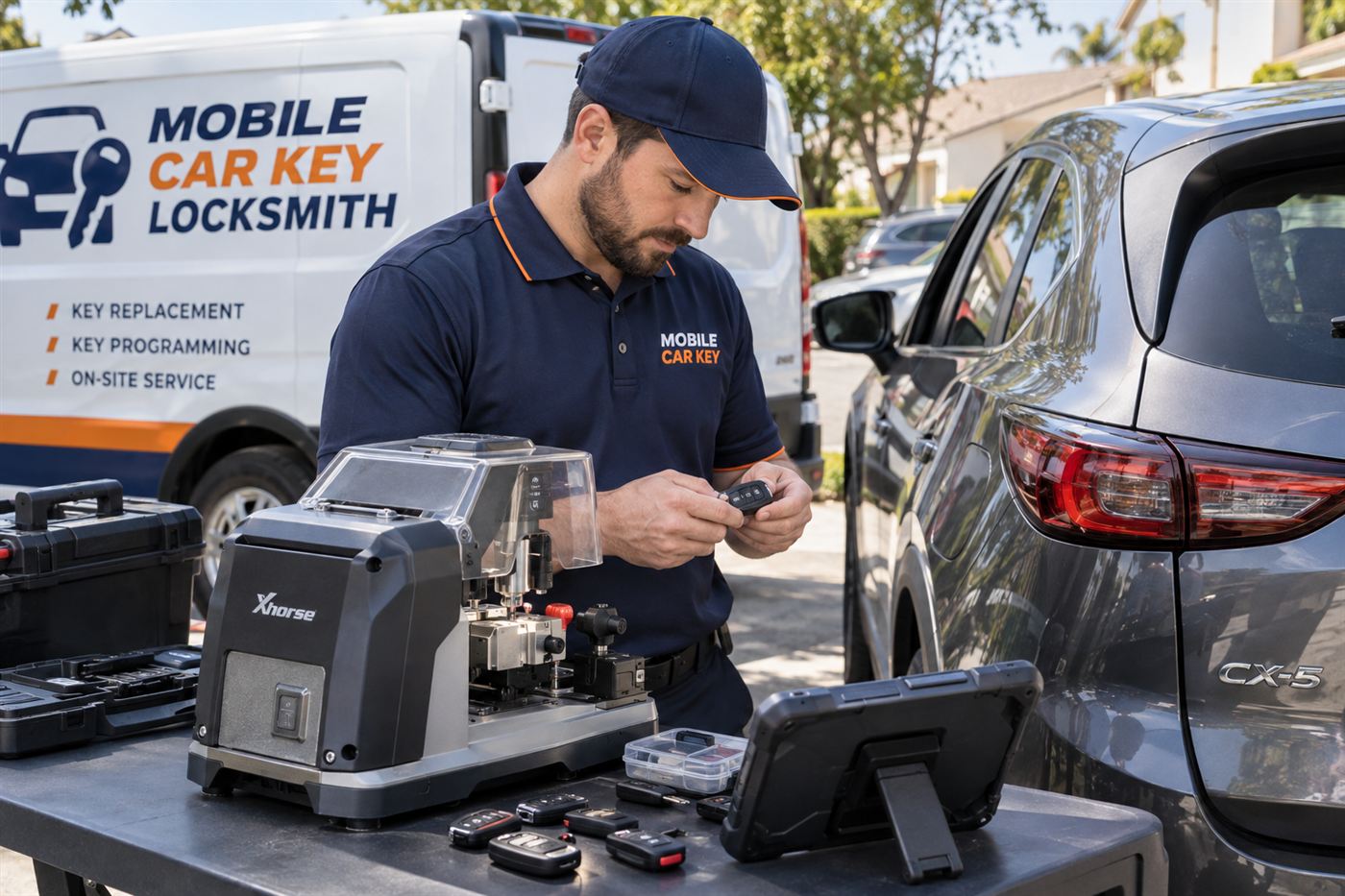
What a transponder key actually is
A transponder key looks like an ordinary car key with a thick plastic head, but inside that head sits a small chip. The chip holds a code that has nothing to do with the cuts on the metal blade. When you turn the key or press the start button, the car asks the chip to identify itself, and only the right answer allows the engine to run.
Most vehicles built over the last few decades use some form of this system. It exists to stop a thief from starting a car with a copied blade or a screwdriver. The blade can still turn the ignition cylinder, but without the correct chip the engine control unit refuses to cooperate.
For a driver, this means a key is really two things at once: a mechanical part that fits the lock and an electronic part that speaks to the car. A good spare has to satisfy both.
The two halves of the key
The metal blade is cut to match the ignition and door locks. The chip is a separate component, often encased in glass or plastic, that stores its identity code. A technician treats these as two separate jobs that must both succeed before the key is finished.
Why the chip is invisible to you
Nothing on the outside of the key tells you whether the chip works. A key can turn the ignition perfectly and still fail to start the engine. That is the most common surprise for drivers who try a plain blade copy and assume the job is done.
How an immobilizer works in plain words
An immobilizer is the part of the car that decides whether the engine is allowed to start. Think of it as a doorman with a guest list. The chip in your key is the guest, the car holds the list, and the engine will not start unless the guest is recognized.
When the key is in the ignition or close to the dash, a small antenna ring around the ignition sends out a weak field. That field powers the chip for a moment without needing a battery in the key. The chip answers with its code, the car compares it to the codes it has stored, and a match releases the fuel and starter circuits.
If the code does not match, the car may crank but not fire, or it may not crank at all. A security light on the dash often flashes to tell you the immobilizer has said no.
- The chip is powered by the car, not by a battery, in most traditional transponder keys.
- The car stores the codes of every key it has been taught to accept.
- A key that has never been introduced to the car is simply a stranger, even if the blade fits.
- Removing a lost key from memory means the car will refuse that key in the future.
Why a plain copy will not start the car
A key cutting kiosk can duplicate the blade in a few minutes, but it cannot add an identity the car recognizes. The copy may unlock the door and turn the ignition cylinder, yet the engine stays silent because the chip is missing or untaught. Drivers often discover this in a parking lot after paying for a copy that looked perfect.
Some copies include a blank chip that has never been programmed. That is no better than no chip at all. The car has to be told, through a diagnostic connection, that this new chip belongs to it.
This is the central reason a mobile technician carries electronic equipment as well as cutting equipment. The cutting machine shapes the blade, and the programming tool introduces the key to the vehicle.
The blade-only trap
If you hold a key that opens the door but will not start the car, stop trying repeatedly. Repeated attempts will not teach the car anything, and some systems lock out for a short period after several failed tries.
What a technician checks first
Before cutting anything, a technician identifies the exact key type for the vehicle. The same make and model can use different chip families depending on the build, so the vehicle details matter more than the badge on the trunk.
Cutting, cloning and programming: three different jobs
People often use the word duplication for everything, but a transponder job can involve three distinct steps. Understanding them helps you ask better questions and recognize what a technician is describing when they explain your options.
Cutting shapes the metal blade. Cloning copies the chip's identity onto a new chip so the car sees an identical key. Programming teaches the car to accept a new chip with its own identity. Which of these applies depends on the vehicle and on whether you still have a working key.
Cutting the blade
Blades come in two broad styles: the traditional edge cut and the laser or sidewinder cut with a groove milled into the center. Each needs a different machine. A mobile technician brings equipment for the common styles, and cuts either from a code tied to the vehicle or by following an existing key.
Cloning the chip
With cloning, the identity of a working key is read and written onto a fresh chip. The car cannot tell the two keys apart. Cloning is only possible with certain chip families, and it needs a working key to read from.
Programming the chip
Programming connects a tool to the car, usually through the diagnostic port under the dash, and registers the new key in the vehicle's memory. This is the route used when no working key exists or when the chip family cannot be cloned.
When cloning makes sense and when it does not
Cloning appeals to drivers because it feels simple: copy the key you have and receive a twin. For some older chip generations that is exactly how it works, and it can be a practical way to build a spare without connecting to the car's computer.
Newer systems use encrypted communication that cannot be copied by a simple read and write. These keys must be introduced to the car through programming. A technician will tell you which route applies once the vehicle year, make and model are known.
There is also a practical drawback to cloning. Because the car sees a clone as the same key, you cannot cancel one copy without cancelling the other. If you lose a clone and want to make sure nobody can use it, programming new keys and removing the old ones from memory is the more complete answer.
- Cloning needs a working key to copy from.
- Programming works even when every key is gone, provided the vehicle allows it.
- A clone shares one identity with the original; a programmed key has its own.
- Some makes restrict both methods and require manufacturer access.
Chip generations, described without jargon
Over time, makers have moved from simple chips to increasingly sophisticated ones. Early versions held a fixed code that the car read once. Later versions use a challenge and response, where the car sends a different question each time and the chip must compute the right answer.
The latest systems add stronger encryption and sometimes tie the key to the vehicle's identification number. Each step makes unauthorized copying harder, which is good for security but means a spare takes more specialized tools.
You do not need to memorize any of this. What matters is that the key for your car depends on the exact build, and a technician will identify the correct family after asking about the vehicle.
Older fixed-code chips
These are the simplest to handle and in many cases can be cloned. They are common on vehicles from the early days of immobilizers.
Rolling and encrypted chips
These respond differently each time and generally require programming through the diagnostic port. They are widespread on vehicles from the middle period of the technology.
Newer manufacturer-secured systems
On some newer vehicles, adding a key requires a secure connection to the manufacturer. In those cases dealer-level tools or manufacturer access may be involved, and a technician will explain the limits honestly.
What a mobile technician brings to the vehicle
A mobile technician works from a vehicle that doubles as a workshop. Inside are key cutting machines for different blade styles, a range of blank keys and chips, and programming equipment that connects to the car's diagnostic port.
Because the work happens where the car is parked, you do not need to arrange a tow or a ride. The technician sets up beside the vehicle, identifies the key needed, cuts the blade, programs the chip and tests the result.
That said, nobody can carry every blank for every vehicle. Part of the early conversation is confirming that the correct blank and the right software coverage are available for your car before anyone is dispatched.
- Blade cutting equipment for edge cut and laser cut keys.
- A selection of transponder blanks across common chip families.
- Diagnostic programming tools that talk to the immobilizer.
- Testing steps to confirm the key turns the ignition, starts the engine and works the locks.
What you will be asked to share
The first questions are about the vehicle: year, make, model and sometimes trim or engine, because these decide the key family. You will also be asked where the car is, what happened, and how many working keys you still have.
Ownership comes next. A reputable service asks for proof that you own or are authorized to use the vehicle before creating a new key. This protects you as much as anyone, because the same process that helps you would otherwise help a thief.
On site, the technician will typically want to see identification and something that ties you to the car, such as registration or title paperwork. Many drivers keep these in the glove box, which is one reason it helps to think ahead about where the documents live.
Why the vehicle identification number helps
The number on the dash or door frame lets a technician confirm exact build details and, for some makes, look up the key code. Having a clear photo of it ready can save time on the call.
If paperwork is missing
If you cannot produce documents right away, say so early. There are often other ways to establish authorization, but nobody should skip the check. Our guide on proving you own the car explains typical options.
Spare key planning for chip keys
The easiest moment to make a spare is the moment you still have a working key. With a working key in hand, the technician has more routes available, the car is less likely to need extended procedures, and nobody is stranded.
Once every key is gone the job changes character. The technician must create a key from vehicle data and register it without a reference key, which takes more steps. Our page on all car keys lost covers that situation in detail.
A sensible household plan is at least two working keys, with one stored somewhere other than the daily key ring. A spare that lives in the same bag as the original does nothing if the bag is stolen.
- Keep one spare in a secure place away from the daily key.
- Test every spare on the engine and the locks, not just the door.
- Replace weak batteries in remotes before they fail.
- Add a spare when you buy a used car with only one key.
Related fobs and remote buttons
Many transponder keys also carry lock and unlock buttons. The chip and the buttons are separate systems that happen to share a case. The chip lets the engine run; the buttons operate the doors by radio.
This means a key can lose its remote function but still start the car, or the reverse. When you ask for a spare, mention whether you want the buttons to work, because it affects which blank is chosen.
For more on the button side, see our pages on key fob programming and remote and proximity fobs.
What can complicate a transponder job
Most jobs go smoothly, but a few conditions slow things down. Understanding them keeps expectations realistic and helps you prepare.
A weak or dead car battery can interrupt programming, since the process needs steady power. Damaged diagnostic ports, aftermarket alarms and certain accessories can also interfere with communication. If the car has been repeatedly started with a worn key, ignition wear may need attention too.
Battery and electrical condition
A car that struggles to crank may need a jump or charge before programming. Mentioning a weak battery on the first call lets the technician plan for it.
Aftermarket security add-ons
Some vehicles carry extra alarm or remote start modules that sit between the key and the car. These can require additional steps or may need to be disabled during programming.
Vehicles with restricted access
A few manufacturers limit who can program keys for newer models, which can mean dealer-level tools or manufacturer access are required. A technician should tell you plainly if that applies instead of promising a result.
Common situations drivers describe
Real requests come in many forms, and the transponder angle appears in most of them. A driver has one key and wants a spare before a long trip. A parent hands the family car to a teenager and wants a second key so the first stays put. A buyer picks up a used car with a single key and wants to know whether previous owners could still have copies.
Another common case is the key that stopped working. The blade turns, the dash lights come on, but the engine will not start. Sometimes this points to a failing chip, sometimes to a worn ignition, and sometimes to a battery problem in the car. A technician can sort out which by testing rather than guessing.
Each of these has its own sensible path, so the right first move is usually to describe the situation in your own words and answer the vehicle questions that follow.
- Adding a spare before a road trip or a long absence.
- Replacing a key that no longer starts the car.
- Removing unknown keys after buying a used vehicle.
- Building a second key for a family driver.
Safety and security around chip keys
If someone is in danger, call 911 first. Children or pets locked inside a hot car are an emergency, and emergency services should be contacted before anyone calls a locksmith.
For ordinary security, treat your keys like cash. A lost transponder key means someone may hold something that starts your car. If you lose a key and want to prevent its use, ask about programming new keys and erasing the old ones from the vehicle's memory.
Be cautious about anyone who offers to make a key without asking about ownership. That convenience is exactly what a thief would look for. A careful service slows down for the paperwork because the paperwork protects owners.
Caring for a chip key day to day
A transponder key is more durable than it looks, but it is not indestructible. The chip is small and sits inside a plastic head, so the most common causes of failure are physical: drops onto concrete, a key left in a pocket through a wash cycle, or a heavy bunch of keys hanging from the ignition that wears the cylinder over years.
Heat is another quiet enemy. A key left on a dashboard in strong sun can warp its case, loosen the chip's seating or weaken the battery in the remote section. In cold climates the opposite happens, as plastic becomes brittle and a small drop that would do nothing in summer cracks the head.
None of this requires special effort. Treat the key as a small electronic device, because that is what it is, and it will usually last for many years.
- Remove heavy accessories from the ring that hangs from the ignition.
- Keep the spare away from the dashboard, the beach bag and the glove compartment in hot weather.
- Replace the case or shell if it cracks, before the chip is exposed to moisture.
- Notice early signs such as needing several tries to start the car, and act before the key fails completely.
Early warning signs
If the security light flashes more than usual, if the car starts only when you hold the key in a certain position, or if the remote buttons respond unevenly, the key is telling you something. A technician can test it and tell you whether a spare should be made now.
Worn blades and tired ignitions
A blade that has been copied from a copy can drift away from the original cuts. Over time the ignition cylinder wears to match. Making a fresh key from the vehicle's code rather than from a worn key often restores smooth operation.
How a request moves forward
You call or send a callback request. The service asks about the vehicle, your location and what happened. Availability, coverage and terms are confirmed before dispatch, so you know where things stand before anyone travels to you.
A technician is then sent to the vehicle. On site, ownership or authorization is checked, the key is cut and programmed, and the result is tested. The full path is laid out on how the service works.
This page is educational. Nothing here creates a service agreement, and what is possible depends on your vehicle and your location. For a broader view of everything offered, see car key services, or if you are in Texas, Florida or any other state, our service areas page explains how coverage is matched.
Common questions
Can a hardware store copy start my car?
Usually not. A kiosk can duplicate the metal blade, which may unlock the door and turn the ignition, but the engine control unit also needs to recognize the chip inside the key. A blank chip that was never taught to the car does nothing. A technician uses programming equipment to introduce the new key to the vehicle.
What is the difference between cloning and programming?
Cloning copies the identity of a working key onto a new chip so the car sees two identical keys. Programming teaches the car to accept a new chip with its own identity. Cloning needs a working key and only suits certain chip families. Programming works in more situations, including when every key is gone.
Do I need to have an existing key to get a spare?
Not always, but having one makes things simpler. With a working key, more routes are available and the job is usually more straightforward. Without one, the technician must create a key from vehicle data and register it, which takes more steps. Your vehicle and its security system decide what is possible.
Will you ask me to prove I own the car?
Yes. A reputable service asks for proof that you own or are authorized to use the vehicle before making a key. This usually means identification plus registration or title paperwork. The check protects owners from people trying to get a key to someone else's car, and it is a normal part of the process.
Can every make and model get a transponder key from a mobile technician?
Many can, but not all. Limits depend on the vehicle. Some newer models from certain makes need dealer-level tools or manufacturer access that a mobile technician may not be able to reach. The vehicle details you give on the first call help establish what is realistic before anyone is dispatched.
Why does my key turn the ignition but the car will not start?
That pattern often points to the immobilizer. The blade fits the lock, but the chip is missing, damaged or not recognized. It can also come from a weak car battery or a worn ignition. A technician can test the key and the car to find which cause applies instead of guessing.
If I lose a key, can the old one be blocked?
In many cases, yes. When new keys are programmed, the car's memory can often be reset so that only the keys you present are accepted, which cancels the lost one. This depends on the vehicle. If you are worried about someone using a lost key, mention it on your first call.
Is a spare key worth making before I lose the first one?
Generally yes. Making a spare while you still hold a working key keeps the job simpler and avoids being stranded. Store the spare away from your daily key, test it on the engine and locks, and replace weak remote batteries early so the spare is ready when you need it.