
How to use this question hub
Every question below is grouped under a theme, so you can jump straight to the part that matches your situation. If you are standing beside a locked car right now, start with the lockout and safety sections. If you are planning ahead, the key type, programming and spare key sections will help most.
The answers describe how a reputable mobile automotive locksmith service generally works. Details vary with the vehicle, the location and the situation, and a few vehicles need tools that only a dealer can reach. Where a limit exists, the answer says so plainly rather than promising more than any service can deliver.
For a longer walk through the whole process, the page on how the service works follows a request from the first call to a tested key in your hand.
Getting started with a request
The first contact is usually the part people worry about most, because it happens when they are stressed. These answers explain what the first call or callback request looks like and what it does and does not commit you to.
What does a mobile car key service actually do?
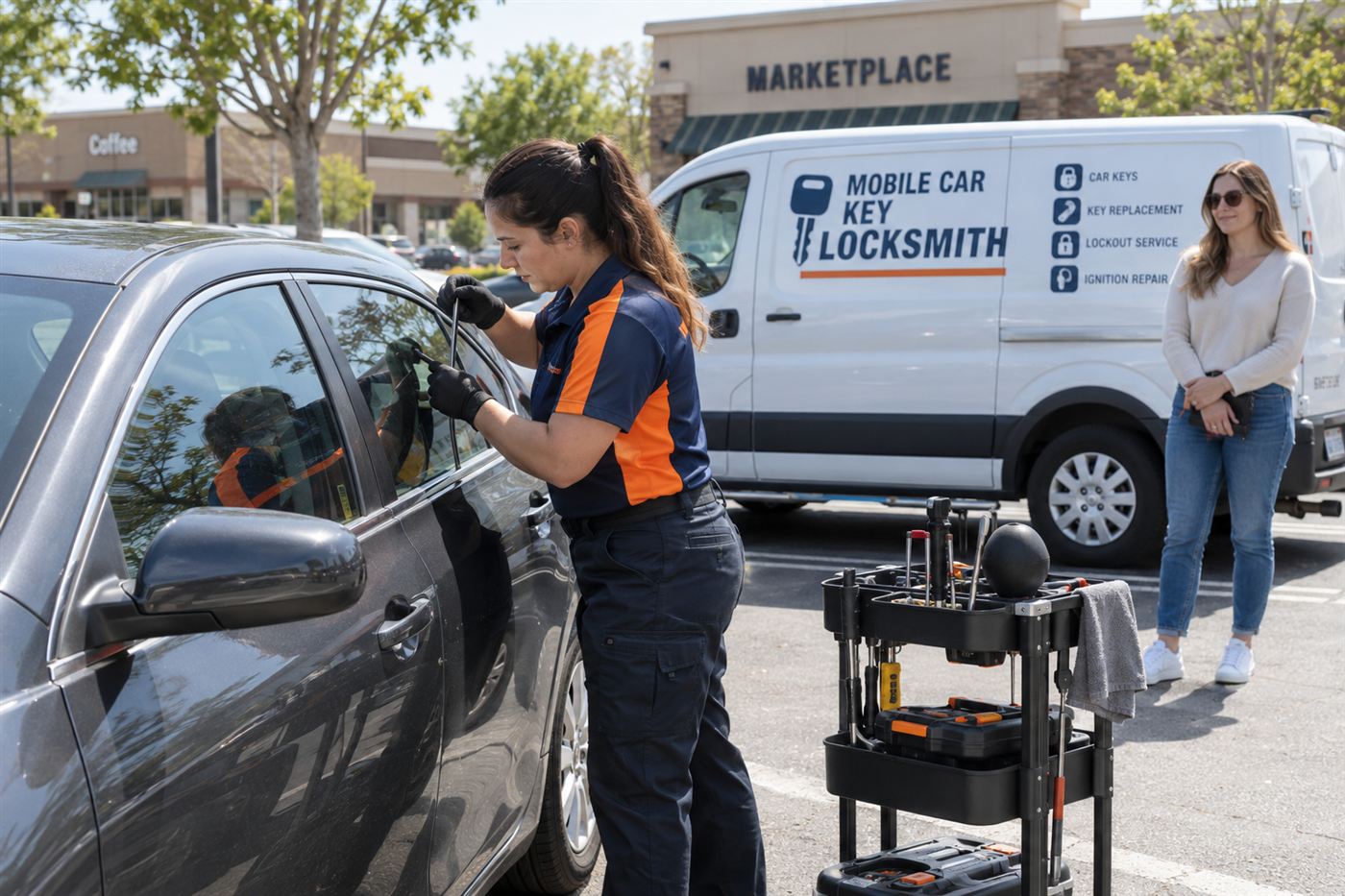
A mobile car key service sends a technician to the vehicle instead of asking you to bring the vehicle to a shop. The work is automotive only: replacing lost or broken keys, cutting and programming transponder keys, programming remotes and proximity fobs, creating new keys when every key is gone, and opening locked vehicles. The technician carries cutting and programming equipment so the job can be finished where the car sits.
How do I request help?
You call the number shown on the site or send a callback request through the contact page. Either way, a person gathers the basics about the vehicle and your location, explains what is possible, and confirms availability, coverage and terms before anyone is dispatched. If anyone is in danger, such as a child or pet locked in a hot vehicle, call 911 first and request key service afterward.
What will I be asked when I make contact?
Expect questions about the year, make and model of the vehicle, where it is parked, what happened, and how many working keys remain. You may also be asked whether the car uses a push button or a turn key, and whether any warning lights appear. These details tell the service which equipment to prepare and whether the job is a simple spare, a lockout or an all keys lost situation.
Does sending a request commit me to anything?
No. A callback request is a way to start a conversation, not a contract. The service explains what is involved, and availability, coverage and terms are confirmed before dispatch so you can decide with the facts in front of you. If the situation turns out to need a dealer, the service should tell you that honestly instead of sending a technician for work that cannot be done roadside.
Proving you own the vehicle
Any reputable automotive locksmith checks that the person asking for a key is entitled to one. It can feel like an obstacle when you are stranded, but it protects you as much as anyone else. The guide on proving you own the car goes deeper than the answers here.
Why do I have to prove ownership?
A working key is the one thing that lets someone drive a vehicle away. If a technician cut keys for anyone who simply asked, the service would be helping thieves. Checking ownership or authorization keeps your own car protected from the same problem. A service that skips the check entirely should concern you, because it would make keys for your vehicle just as easily for a stranger.
What counts as proof?
Typically a technician looks for a government photo identification plus something that ties you to the vehicle, such as a registration, title or insurance document in your name, along with a match between the vehicle identification number and the car in front of them. Company vehicles may need an authorization from the business. The exact items vary, so ask what is accepted when you make your request.
What if my paperwork is inside the car or at my residence?
This is very common. Many drivers keep the registration in the glove box, which is exactly where they cannot reach it during a lockout. Mention it early. Digital copies of registration or insurance cards on your phone are often helpful, and someone at your residence may be able to photograph documents. Ownership is checked on site before work begins, so arranging the paperwork in advance prevents delays.
Understanding key types
Car keys have changed a great deal. A key that looks like a plain piece of metal may hold a microchip, and a key that looks like a small remote may be the only thing the car needs to start. Knowing which type you have makes every conversation easier. See transponder key duplication for the longer explanation.
What is a transponder key?
A transponder key has a small chip in the plastic head. When the key is in the ignition, the car sends a low power signal and the chip answers with a code. If the code matches one the car has stored, the engine is allowed to start. The metal blade may turn the ignition perfectly well, yet the car still refuses to run if the chip code is not recognized.
What is the difference between a remote head key, a flip key and a proximity fob?
A remote head key has lock and unlock buttons built into the key head. A flip key folds the blade into the fob body and swings it out when needed. A proximity fob never enters a lock at all: the car senses it nearby, and a push button starts the engine. Each type has its own replacement and programming steps, covered on the page about remote and proximity fobs.
Can a basic hardware store copy start my car?
A plain cut copy may open the door and even turn the ignition cylinder, but if the car uses an immobilizer it will not start the engine without a chip the car recognizes. Many drivers discover this after paying for a duplicate that seemed identical. For any vehicle with a transponder system, the copy needs a chip that is programmed or cloned, not just a matching blade.
What is a key card?
A key card is a flat, credit card shaped fob used by some vehicles, often kept in a wallet or on a dashboard slot. It works like a proximity fob, with a chip and antenna inside. Replacements usually need to be matched to the car electronically. Because the design varies by manufacturer, a technician will want the exact vehicle details before saying whether the card can be replaced on site.
Programming keys and fobs
Programming is the step that makes a physical key or remote work with a specific car. It is where most confusion happens, so these answers cover the common misunderstandings. The service page on key fob programming adds more detail.
What does programming actually mean?
Programming means teaching the car to accept a particular key or fob. The technician connects equipment to the vehicle, enters the required security steps, and registers the new key's chip or remote code in the car's memory. Cutting the metal blade is a separate task. A key can be cut perfectly and still do nothing until the car has been told to trust it.
Can I program a key fob myself?
On some older vehicles, an owner can follow an on-board sequence using the existing keys, such as turning the ignition several times in a set pattern. Many newer vehicles do not allow this and need diagnostic equipment. If you try a sequence and it fails, stop and ask for help, because repeated wrong attempts can sometimes lock the process for a period.
Can a fob I bought online be programmed?
Sometimes, but not always. Fobs sold online may be the wrong frequency, locked to another vehicle, or low quality. A used fob that was already paired with a different car often cannot be reused at all, which is a point many buyers learn too late. If you already own one, mention it during your request so the technician can say whether it is likely to work before travelling.
Why does my fob unlock the doors but the car will not start?
The remote buttons and the immobilizer chip are separate systems. The buttons can work after a battery change while the chip, or its link to the car, has a problem. A weak battery, a damaged chip or a key that was never fully registered can all produce this symptom. A technician can check which part is failing before replacing anything.
When every key is lost
Losing every key is stressful, but it is a situation locksmiths handle regularly. The details depend heavily on the vehicle, which is why the service asks careful questions at the start. The page on all car keys lost walks through the full process.
What can I do if I have lost the only key?
First retrace your steps and check pockets, bags and the place you last parked. If the key is truly gone, gather proof of ownership and the vehicle details, then request help. A technician can often create a new key from the vehicle itself, using the vehicle identification number and the car's own systems, without needing an existing key to copy.
Why does an all keys lost job take more work than adding a spare?
With a working key in hand, the car can be told to accept an additional key through a simple step. With none, the technician must identify the exact key type, cut a key without a sample, access the car's security system, and register the new key while removing the lost one from memory. Each of those tasks adds time and sometimes specialized equipment.
Will my old lost keys still start the car afterward?
They can, unless the lost keys are erased from the car's memory. Good practice during an all keys lost job is to remove old key records so a lost key can no longer start the vehicle. Ask the technician whether that step will be done on your car. It matters most if you think the key was taken rather than simply misplaced.
Should I worry that someone can steal my car with the lost key?
It is a fair concern if the key might be in the wrong hands, especially if the key was lost near the vehicle or together with documents showing an address. A lost key can only start the car if its chip is still registered. Parking in a well lit spot and arranging for old keys to be erased are reasonable precautions. The guide to what to do when you lose your car keys covers the order of steps.
Fobs, batteries and push-to-start
Many calls begin with a fob that has simply stopped behaving. Before assuming the worst, it helps to understand what batteries and radio signals can do. Two longer guides, the dead fob battery guide and the push to start guide, expand on these answers.
How can I tell that a fob battery is dying?
Common signs are a shorter range, buttons that need several presses, a dashboard message about the key battery, or a car that sometimes fails to detect the fob. Cold weather can make a weak battery fail suddenly. Replacing a coin cell battery is often all that is needed, though it is worth confirming that the problem is the battery and not the fob itself.
My car says key not detected. What should I try?
Try the spare fob if you have one, since that shows whether the problem is the fob or the car. Move the fob away from phones and metal objects, replace the fob battery, and look for the emergency start position that many vehicles have, often a spot on the steering column or console. If none of this works, a technician can test the fob and the car's receiver.
Can I start a push-to-start car with a dead fob?
Often yes. Many vehicles let you hold the dead fob against a marked spot, such as the start button or a slot in the console, because the car can read the chip at very short range without battery power. The location differs by manufacturer, so check the owner's manual. This is a way to get moving, not a repair, and the battery should still be replaced.
What is relay theft and how does it relate to my fob?
Relay theft happens when a device captures and extends the signal of a proximity fob, tricking the car into thinking the fob is nearby. It can happen while the fob sits inside a residence close to the vehicle. Keeping fobs away from entry doors, using a signal blocking pouch, and turning off the fob's signal if the manufacturer allows it are common precautions.
Locked out of the vehicle
A lockout is among the most common reasons people request help, and also one of the most solvable. The service page on vehicle lockouts explains what technicians can do, and the questions here cover the surprises.
Can a technician open my car without damaging it?
In most cases, yes. Trained technicians use purpose made tools designed to open a door without harming paint, weather stripping or the lock. Methods vary with the vehicle, and some modern designs are more demanding than others. A careful technician explains the approach and the small risks before starting, rather than forcing anything.
What if my keys are locked in the trunk?
This is common after loading luggage or groceries. Many vehicles have a rear seat release, an interior trunk button or another way in once the cabin is open, and a technician can often open the cabin first and then reach the trunk. Tell the service about the trunk when you describe the problem, because it changes the plan.
Do I need to prove ownership for a lockout?
Yes, the same principle applies. A locked car holds the owner's belongings, and anyone able to open it could take them or drive away if a key is inside. The technician will ask for identification and something linking you to the vehicle. If your registration is locked inside, a digital copy or a match to the identification you carry is often discussed beforehand.
Does a lockout mean I need a new key?
Not usually. If the key is inside the car, opening the door is all that is needed. If the key was lost outside and the car is locked, then you face two problems: opening the car and replacing the key. These are treated as related but separate jobs, and the technician can often handle both in one visit.
Timing and availability
People understandably want to know how long everything takes. Because every vehicle and location is different, no honest service can give a single number for all situations. These answers explain what shapes the timeline, and the details are confirmed with you before dispatch.
How long does a typical job take?
It depends on the job. A lockout is usually shorter than creating a new key from nothing, and a simple spare is shorter than an all keys lost situation on a vehicle with a complex security system. Fob programming can take longer if the car needs an extended security process. The technician can describe a realistic range once the vehicle is known.
What affects when a technician can reach me?
Distance, traffic, weather, demand in your area and the time of the request all play a part. A vehicle in a dense city may be easier to reach than one on a remote road, though city traffic brings its own delays. Availability is confirmed before dispatch, so you hear about the likely situation before committing.
Can work happen in bad weather or at night?
Mobile work depends on conditions that let the technician work safely and accurately. Rain, snow and darkness make some tasks harder but rarely impossible. The service may suggest moving the vehicle to a covered or well lit spot, such as a parking structure. If conditions are dangerous, the technician may wait for improvement rather than risk damage to the vehicle or injury.
Safety questions
Some situations are not about convenience at all. A locked vehicle with a person or animal inside can become dangerous in a short time, especially in heat. The detailed locked out safety guide has a longer checklist.
What should I do if a child is locked inside the car?
Call 911 immediately. Do not wait for a locksmith. Emergency services can open the vehicle and are trained to respond. A hot or cold vehicle can harm a child within a short time, and emergency responders take priority over any key service. Once everyone is out of danger, a locksmith can help with the lost or locked in key afterward.
What about a pet locked inside?
Treat it as an emergency as well. Heat inside a closed vehicle rises rapidly, even on a mild day. Call 911 or local animal control right away, and ask bystanders for help while you wait. Do not rely on a cracked window or a short errand. Once the animal is out of danger, you can arrange for key service.
What if I am stranded on a roadside or a busy road?
Your safety comes before the car. If the vehicle is in traffic, move to a protected spot well away from moving lanes, keep your hazard lights on if you can reach them, and call emergency services if you feel unsafe. Tell the service where you are as precisely as possible, including a mile marker, an exit or nearby landmarks.
Payment and cost questions
Cost is one of the first things people ask about and one of the hardest to answer in the abstract. This site does not publish prices, because the factors below change the work involved. Terms and arrangements are explained to you before dispatch.
How is the cost of a car key job determined?
Several factors shape it: the type of key or fob, the vehicle's make, model and year, whether you still have any working key, the equipment needed, the location, and the time of the request. Because those factors vary so much, a service that quotes a single amount before knowing the vehicle should make you cautious.
Will I know the terms before a technician is sent?
That is the purpose of the confirmation step. Before dispatch, the service explains availability, coverage and the terms of the work. Asking questions at that stage is encouraged. If something is unclear, say so and ask again, because it is far easier to adjust the plan before a technician travels than afterward.
Why do costs differ so much between vehicles?
A basic metal key for an older vehicle needs little more than cutting. A proximity fob for a newer vehicle needs a precise part, specialized programming equipment and sometimes manufacturer access. Luxury and imported models often fall in the second group. The differences reflect parts and process, not a pattern of arbitrary pricing.
Coverage across the United States
The service operates across the United States, and requests are matched to a technician near the vehicle. Coverage is real but not identical everywhere, and these answers explain the differences. The page about service areas across the United States lists every state.
Does the service cover my state?
The service covers the entire United States, and each state has its own page describing local driving conditions that affect keys, from winter cold to coastal humidity. Even so, availability depends on your exact location and the time of the request, so it is confirmed before any technician is dispatched.
What about rural areas and long distances?
Rural locations can take more planning because technicians may travel farther and there may be fewer options nearby. The service tells you what is possible before dispatch. Giving a precise location, such as a road name with a nearby landmark or crossroads, helps a great deal when a street address does not exist.
I am travelling or in a rental car. Can I still get help?
Travellers use mobile service regularly, since a lost key far from your usual area is especially stressful. For rental cars, the rental company owns the vehicle, so you usually need its permission and should contact it first. The guide on lost keys on a rental car explains the typical sequence.
Vehicles and limits
No automotive service can honestly claim to handle every vehicle. Some makes and models are routine and some are demanding. These answers describe how limits work so that nothing surprises you.
Does the service support every make and model?
No service should promise that. Many vehicles are supported, and the service asks for the year, make and model precisely so it can say what is likely to work. Limits depend on the vehicle, and the answer you receive before dispatch reflects the specific car, not a general claim.
Do some newer vehicles still need the dealer?
Yes. Some newer vehicles from certain manufacturers need dealer level tools or manufacturer access to register a new key. When that is the case, the honest answer is that a dealer visit may be necessary. The guide to a mobile locksmith or a dealership compares the two in a balanced way.
What about trucks, vans and work vehicles?
Many trucks and vans use the same kinds of keys as passenger cars, though some have unusual systems. Fleet vehicles may also require authorization from the company before work starts. If you manage several vehicles, planning spare keys ahead of time is wise, and the fleet key guide covers key control in more depth.
What if my car is older and has no chip?
Older vehicles without immobilizers use simple mechanical keys, which are often the most straightforward to replace. Cutting from the vehicle's lock, without an original key to copy, is a regular task for automotive technicians. Check whether any door or trunk uses a separate key, since those sometimes differ from the ignition key.
After the work and planning ahead
A finished job should leave you confident rather than uncertain. These last answers cover what a good finish looks like and how to avoid a repeat of the situation that brought you here.
How is the new key tested?
A careful technician tests every function before leaving: turning the ignition or starting the engine, locking and unlocking with the remote, opening the trunk, and using any extra buttons. Ask to see each function work with your own eyes. If something is wrong, it is much easier to correct it before the technician leaves.
How many spare keys should I have?
At least one working spare is a sensible baseline, kept somewhere other than where you carry your main key. Households with several drivers often want one key per driver. The cost of waiting is the real lesson: adding a spare is simpler when a working key exists. The spare key guide has the planning details.
How can I avoid losing keys again?
Give keys a fixed place at your residence and a fixed pocket when you travel, attach a sturdy ring, and avoid leaving the fob in the vehicle. Photograph registration documents and keep a copy on your phone. Replace fob batteries before they fail. Small habits remove most of the situations that lead to emergency calls.