
Two services that sound alike
Roadside assistance is a broad service, usually offered through an auto club, an insurance policy, a vehicle manufacturer program, a credit card benefit or a rental agreement. It exists to get a stranded driver moving again, and it typically covers things like towing, jump starts, flat tires, fuel delivery and, in many plans, a lockout.
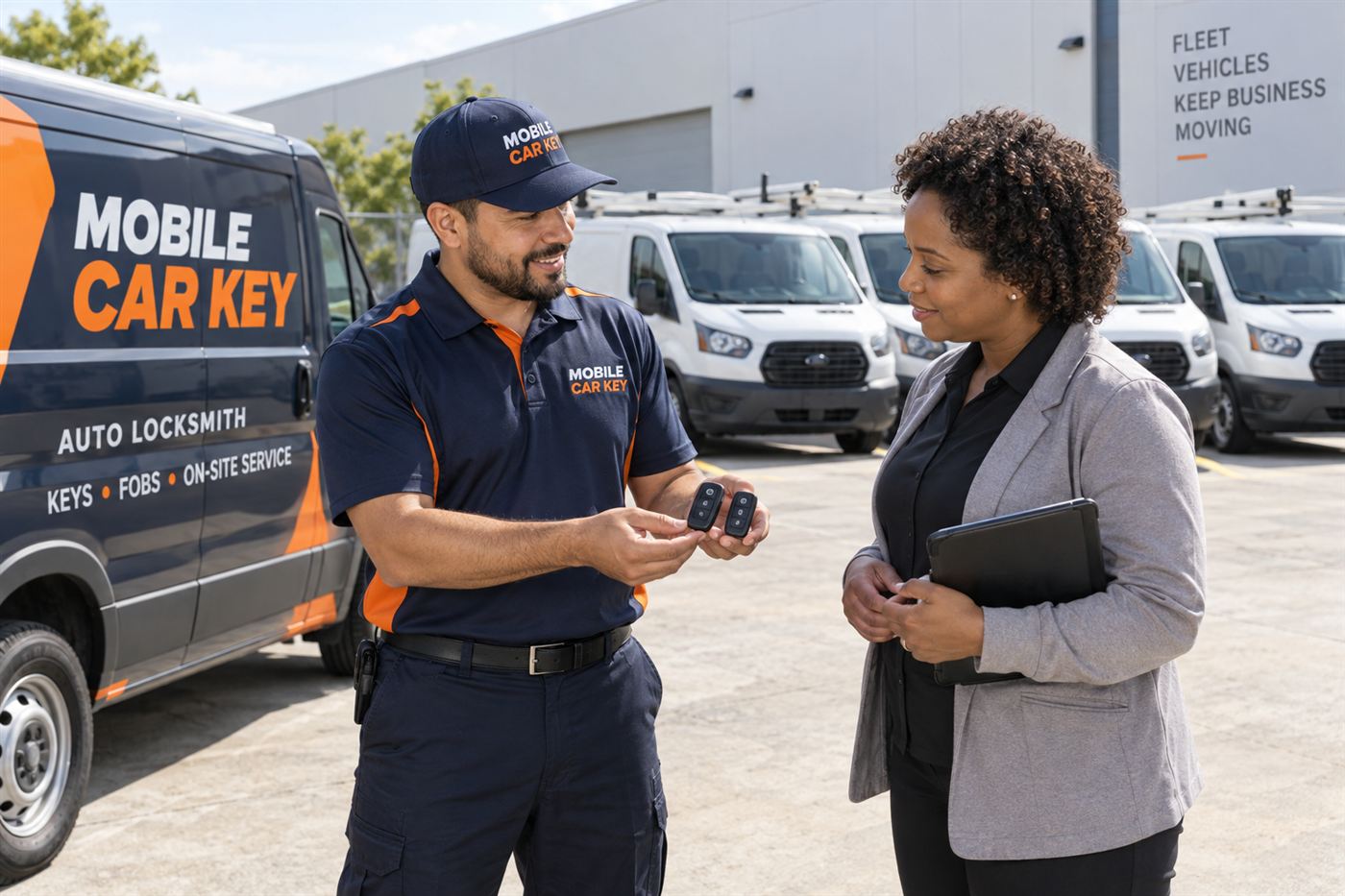
A mobile automotive key service is narrower. It focuses on keys: cutting, programming, replacing and opening vehicles. Its technicians travel to the vehicle with equipment designed for locks, ignitions and key electronics, which is a different toolkit from the one used to change a tire.
Neither is better in every situation. The question is which one fits your problem. This page is general guidance, and it does not describe any particular plan or service. Availability and terms are confirmed before any dispatch.
Start by naming your problem exactly
People often say my car will not open or my key is gone, but those phrases cover very different problems. The more precisely you name yours, the easier it is to pick the right call. Ask yourself a few plain questions.
Is the key inside the car or missing entirely? Do you have any key at all? Does the car crank but not start? Does it make no sound? Is the key broken? Did a fob get wet? The answers separate a simple lockout from a lost key from a mechanical issue.
- Key visible inside, doors locked: a lockout.
- No key anywhere, car locked or unlocked: a lost key situation.
- Key present but car will not start: could be a key, battery or starter issue.
- Key broken in a lock or ignition: a broken key situation.
- Fob buttons dead but key works: likely a fob battery issue.
- Car dead with no lights: more likely a battery or electrical problem.
When roadside assistance is the right first call
If your problem is not really about the key, roadside is the natural choice. A dead battery, a flat tire, an empty tank and a car stuck in a ditch are all roadside problems. A key specialist cannot fix any of them, and a general plan is designed for them.
Roadside is also sensible for a simple lockout if your plan includes it. Many plans send a provider to open a door when the key is visible inside, and if the service is part of what you already pay for, using it makes sense. Ask what your plan covers before you call.
Finally, roadside is the right call when you need a tow. If a key problem cannot be solved on the spot, because the vehicle needs dealer-level tools or manufacturer access, towing to a dealer or shop may be the next step, and your plan may cover it.
When a mobile key service is the better first call
If the key is gone and the car has an electronic key system, roadside plans often have limited options. A general provider may be able to open a door, but making and programming a new key is specialized work. A key service is built for it.
A key service is also a good first call when the issue is a broken key, a worn key that barely turns, a fob that stopped communicating with the car or a need for a spare. These are all key-specific tasks. Calling the specialist directly can save a step.
Whenever the problem is clearly about the key rather than the vehicle, think about starting with the service that works on keys. For the general idea of what that involves, read car key replacement and all car keys lost.
Check what your plan actually covers
Plans differ more than most people realize. Some include lockout service with generous terms, some limit the number of calls per year, some cover only certain vehicles, and some exclude key replacement entirely. The fine print matters, and it is better to read it before an emergency.
Look at your auto club membership, your insurance policy, your vehicle manufacturer's roadside program, your credit card benefits and your phone's wallet for roadside details. A single driver can have several overlapping plans without knowing it. Knowing which ones apply gives you options.
Also check what the plan considers a lockout. Some treat a key inside the car as a covered event but do not cover a lost key. Others may offer a reimbursement for a locksmith, with conditions. Terms vary, and this site does not describe any plan's specifics.
The practical limits of a roadside lockout
A roadside lockout visit usually aims to open the door. It generally does not include making a key or programming a fob. If the key is inside, opening the door solves the problem. If the key is lost, an open door does not help you start the car.
Some roadside providers are generalists, and their ability to open a vehicle without damage depends on training and the vehicle. Many handle common vehicles well. Some newer vehicles with advanced door systems or side airbags call for particular care. If you are worried, ask the provider about their experience with your type of vehicle.
If your plan sends someone who cannot complete the job, you may lose time. It is not wrong to ask at the start whether the provider has done the work on your type of vehicle.
Three scenarios, three different answers
A driver leaves the engine running at a gas station, steps out to pay and the doors lock with the keys on the seat. This is a straightforward lockout. If the driver's plan covers it, roadside is a natural first call. If not, a key service can open the door. Safety note: a running engine in a closed location is a risk, so move away from the vehicle and do not wait in a closed space.
A second driver finishes a shopping trip and cannot find the fob. The car is locked. There is no spare nearby. This is a lost key, and roadside can open a door only if the key is inside, which it is not. A key service is more likely to be the right call, possibly after confirming the vehicle's system.
A third driver turns the key, hears a click and nothing else. The lights are dim. That looks like a battery problem. A roadside jump start is the first thing to try. If the car starts, the key is fine. If it does not, the issue may be elsewhere. Do not assume the key is at fault until simple checks are done.
Calling both, in the right order
There are cases where both calls are useful. A tow to a dealer, followed by key work there. A roadside lockout to open the door, followed by a key service to make a spare. A key specialist who finds a battery problem and suggests a roadside jump.
Order matters. Start with the call that solves the biggest blocker. If you cannot get into the car, that comes first. If you can get in but the car will not start, diagnose before deciding. If the vehicle must move, arrange towing before anything else.
Be honest with each provider about what you have already done. If you called roadside and they are on the way, say so to the key service. Do not stack unnecessary visits. A moment of coordination can prevent wasted effort and duplicate costs. If one provider is already on the way, ask the other what they would do differently and whether it makes sense to wait for the first visit before committing to a second one.
What to say on each call
The first minute of a call sets the tone. Whether you dial a roadside line or a key service, a short, organized description helps the person on the other end decide what to do. Rambling or guessing slows everything down, and a precise account speeds it up without anyone having to rush.
For roadside, begin with your membership or policy details, your location and the nature of the problem in one sentence. For a key service, begin with the vehicle year, make and model, the location and what happened to the key. In both cases, mention whether anyone is in the car, whether the engine is running and whether the vehicle is in a secure position away from traffic.
Then listen. Ask what the provider can do, what they need from you and what happens if the job cannot be completed on site. If you do not understand an answer, ask again. A confused call produces mistakes.
Questions worth asking a roadside provider
Ask whether your plan covers this exact situation, whether there is a limit on the number of calls, whether the provider has experience opening your type of vehicle and what to do if the first attempt fails. Also ask for a reference number so you can follow up.
Questions worth asking a key service
Ask whether your vehicle can be handled at the roadside, what proof of ownership you will need, whether availability and terms are confirmed before dispatch and what happens if dealer-level tools turn out to be necessary. A direct answer to the last question is a good sign.
Time, location and the practical side
Where you are affects the decision. In a city with plenty of providers, you may have several options. In a remote area, you may have very few, and your plan may reach places a specialist does not. The remote area page explains how distance affects key service.
Time of day and weather matter as well. A plan with a large network may have providers available at unusual hours, and a specialist may too. Availability is never assured on either side, so the honest approach is to call and ask rather than assume.
If you are in a parking structure, a gated area or a private lot, mention it. Both types of provider need access, and both are more effective when you give them the details at the start. The parking garage page covers those details.
Safety situations skip the decision entirely
If someone is in danger, call 911 first. If a child or pet is locked in a hot car, treat it as an emergency, and do not spend time choosing between providers. Emergency services are equipped to deal with the situation immediately.
If you are in an unsafe location, such as a highway shoulder, a dark road or an area where you feel threatened, your safety is the priority. Move to a safer place if you can. Tell the provider where you are and how you are feeling. A responsible provider takes safety seriously.
Do not take risks to save a call. A key problem can always be solved later. Your wellbeing cannot be replaced.
Proof of ownership applies to either call
Whichever provider you call, expect to be asked to show that you own the vehicle or are authorized to use it. Roadside plans usually attach to your membership and verify you through your account, but a technician may still ask for identification at the vehicle. A key service asks for proof as part of its process.
If your documents are inside the locked car, say so at the start. There may be other ways to show your connection to the vehicle, such as a digital registration or insurance information in an app. Terms are confirmed before dispatch, so ask what will be accepted.
For more on what counts, read the ownership proof guide. Whether a dealer or a mobile service is the better fit for a given car is a separate question that depends on the vehicle, the key and how soon you need it.
A short decision guide
If you want a simple rule of thumb, ask three questions in order. Is the problem about the key, or about something else in the car? If it is about something else, start with roadside. Is the key inside the car and your plan covers lockouts? If yes, roadside may handle it. Is the key missing, broken or not recognized? If yes, a key service is a strong first call.
None of these rules is absolute. Plans differ, vehicles differ and situations differ. Use the rules as a starting point, then adjust based on what you learn from the first call.
When in doubt, call the provider you trust most and ask them. A good provider will tell you honestly whether the problem is theirs to solve and will not pretend otherwise.
If you are still unsure after the rule of thumb
Some situations refuse to sort neatly. A fob that sometimes works, a car that starts only on the third try and a key that was wet last week all sit between categories. In those cases, describe the pattern rather than a single event: when it started, what changed and what you have already tried. Patterns are what a technician uses to decide whether the key, the battery or something else is the cause.
It also helps to try the obvious inexpensive steps first. Swap the fob battery, try a spare key, check the car battery and make sure the steering wheel is not locked against the key. These steps take little effort and often remove the need for any visit at all.
Next steps
If your problem is clearly about a key, read how the service works and request a callback through the contact page. If you want to see other common questions, the questions hub collects them.
Nothing on this page is an agreement or a promise of availability. A service agreement exists only when a service confirms availability and terms with you before dispatch.
Common questions
Is roadside assistance a lower-cost option than a key service?
This site does not discuss prices, and plans vary widely. What matters is what you already pay for and what the plan covers. If a lockout is included in your membership, using it may make sense. If the problem is a lost key, a lockout visit may not solve it, so compare what each option actually does.
Can roadside assistance make me a new key?
Generally not. Roadside plans focus on towing, jump starts, tire changes, fuel and lockouts. Cutting and programming a key is a specialized task. Some plans may offer referrals or partial reimbursement for key services, but terms vary, so read your plan or ask the provider directly.
What if my roadside provider cannot open my car?
Tell them exactly what they should not do, ask whether they can send someone with the right experience, and consider calling a key service. Some vehicles have door systems that need careful handling. It is reasonable to ask a provider about their experience with your type of vehicle before they begin.
Should I call roadside first if my car will not start?
Often yes, if there are signs of a battery problem, such as dim lights or a clicking sound. A jump start is a simple test. If the car starts, the key is probably fine. If it does not, the issue may be elsewhere, or it may be a key recognition problem that a key service should look at.
Do I need to prove ownership to roadside assistance?
Usually your account or membership identifies you, but the provider may still ask for identification at the vehicle. Rules vary. Expect to show who you are and that the vehicle is yours or that you are authorized to use it, especially when a door is being opened.
What if my plan only reimburses me afterward?
Some plans pay a provider directly, and others reimburse a driver who paid out of pocket, often with conditions and documentation. Ask your plan what it needs before you hire anyone, and keep every receipt, reference number and note. Whether a key service qualifies depends entirely on the plan's terms.
Can I use both at once?
Yes, in many situations. A tow to a dealer, a lockout followed by a spare key or a jump start followed by key work are common combinations. Keep each provider informed of the other's involvement so visits are not duplicated, and start with the call that removes the biggest obstacle.