
Why remote locations are a special case
Most of the United States is not a city. Highways cross long stretches of farmland, desert, forest, mountain pass and coastline where the nearest town may be a long drive away. A key problem in one of those places feels more serious than the same problem in a mall lot, and in some ways it is, because help has to travel and your options are fewer.
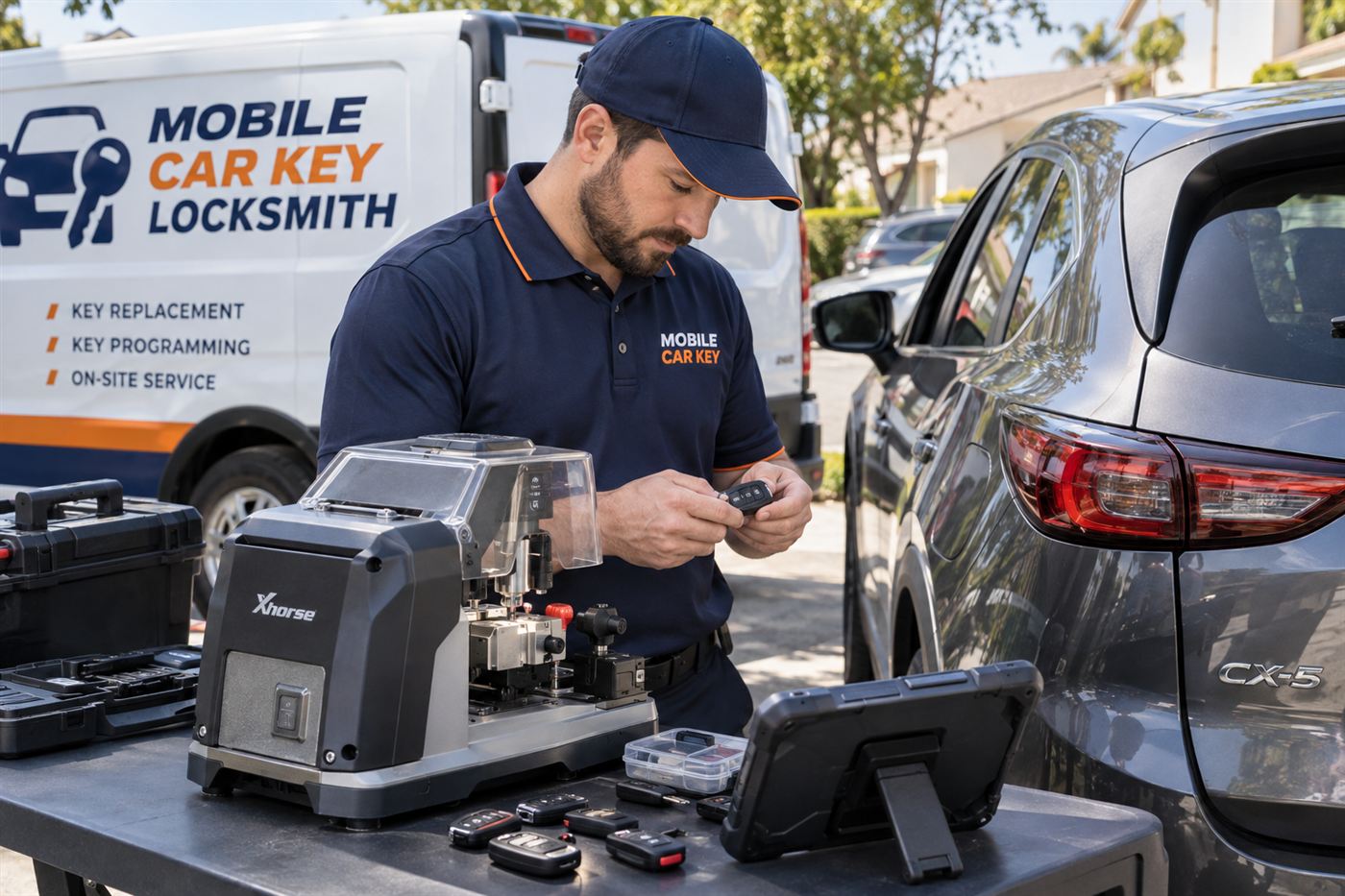
Mobile automotive service is built around the idea that the technician comes to the vehicle. That idea does not disappear in a remote setting, but it meets real limits. Distance, road condition, weather, daylight and the equipment needed for your specific vehicle all play a part in whether a visit can be arranged.
A service that is honest with you will tell you whether it can reach your spot before it sends anyone. Availability, coverage and terms are confirmed first. That confirmation is the safest source of truth, and this page helps you prepare for that conversation rather than promising an outcome.
First, check that you are not in danger
Before you think about keys, think about yourself. If you are injured, if the weather is extreme, if someone is acting threateningly nearby or if your vehicle is in the path of traffic, call 911. A key problem can wait. Your wellbeing cannot.
A child or pet locked in a car is an emergency in any location, and a remote one makes it worse. Do not wait for a locksmith. Call 911 and follow the dispatcher's instructions. Heat builds up inside a closed vehicle in ways that are easy to underestimate, even on mild days.
If you are simply stranded but otherwise fine, take a breath. Make sure you have water, that you are visible and that your phone has charge. Then work through the steps below in order. Remote problems are easier to handle when you take them one piece at a time.
Pinpointing where you are
In a city, you can say a street name. In a remote area, the same words may be meaningless. A technician and a dispatcher need something they can find on a map without guessing, and your phone can often supply it.
Most smartphones show your location in a map app. You can drop a pin, share your location with a contact or read out the coordinates shown on the screen. Highway markers, mile posts, exit numbers, road names at the last intersection and the names of towns you passed are all useful as a second source.
- A map pin or a set of coordinates from your phone.
- The highway or road number and the direction you were traveling.
- The nearest mile marker, exit, crossroads or landmark.
- The last town you passed and the next one ahead.
- Whether the road is paved, gravel, dirt or a park access road.
- Any gates, cattle guards, locked barriers or steep grades between the main road and your car.
When there is no signal at all
No signal is common in canyons, forests, mountain valleys and some rural stretches. Your first job is to get a message out. Walk or drive a short distance to higher ground if you can do so without leaving the vehicle behind for long, and check whether a text message goes through when a call will not. Texts and emergency calls often work with weaker reception than voice calls to ordinary numbers.
Many phones can call emergency services even without a signal from your carrier by connecting to any available network. Newer phones may also offer satellite messaging in some conditions. These features exist for real emergencies, so use them if you are truly in trouble, but do not treat a lost key alone as justification unless your situation has become unsafe.
If you cannot get a signal and cannot leave the vehicle, wait in a visible location. Most remote roads see traffic eventually, and a passing driver can carry a message to the next place with a signal. Do not walk long distances in heat or cold unless you are sure of the route and have the supplies.
What the dispatcher will want to know about distance
Once you reach a dispatcher, expect questions about where exactly you are and how far you are from the nearest town. This is not a trick. Mobile technicians work in a defined area, and being far outside it can make a visit impractical. The service may also tell you that your spot is within reach but that arrangements take more planning.
You may be asked about road access. A paved highway shoulder is one thing. A gravel forest road, a trailhead lot, a ranch road or a beach access path is another. Technicians drive working vehicles that may not be suited for rough ground, and they are right to ask before committing.
Be honest about what you see. If the road is rutted, muddy, snow covered or washed out, say so. If you passed a locked gate or a cattle guard, say so. The more accurate the picture, the more likely the plan is to work the first time.
Weather, daylight and seasonal factors
Remote areas amplify weather. A mountain pass in winter can close for snow. Desert roads can flood after a storm and heat can make working outdoors uncomfortable. Coastal fog can reduce visibility and rural roads after dark can feel very different from the same road in daylight.
A service may consider these factors before dispatching, and you should as well. If conditions are dangerous, it is better to wait or choose another route than to rush a technician into a risky trip. A responsible service will not send someone into conditions it considers unsuitable.
Weather also affects your key. Cold drains fob batteries and can make them unreliable. Heat can warp plastic and loosen a worn key. If your problem started with a fob that suddenly stopped working on a cold morning, read the dead fob battery guide before assuming the worst.
Lost key versus locked key, and why it matters out there
The kind of problem affects how remote help works. A lockout, where the key is visible inside the car, usually needs tools that open a door and little else. A lost key requires making a new key and matching it to the vehicle, which needs more equipment and more preparation.
That difference matters when distance is involved, because a technician who travels far for a lockout can finish the job at the car. A technician who travels far for a lost key must bring everything required for your specific vehicle, and if that vehicle needs dealer-level tools, the trip may not solve the problem at all.
Tell the dispatcher exactly what happened. Describe whether you have any key, whether the doors are locked and whether the engine still runs. For the full picture of the harder case, read all car keys lost.
Vehicle type and how it shapes the plan
Not every vehicle can be handled at the roadside. Many older cars and trucks use simple keys or basic chip keys that a mobile technician can work with. Many newer vehicles use smart keys, encrypted systems or manufacturer-restricted programming that limits what can be done outside a shop.
A service that is honest about this will tell you early. Provide the year, make and model and, if you can, the type of start system: key in the ignition, a push button or a twist knob. If you are in a rental or a borrowed vehicle, say so, because ownership and authorization work differently.
If your vehicle turns out to be one that needs dealer-level access, remote service may not be the right solution, and you will want to think about a tow. A tow has its own tradeoffs: it moves the problem to a shop with the right equipment, but it also adds a vehicle transport step, a wait for a tow driver in a remote place, and a stop at a dealer or specialist whose schedule you do not control. Weigh those honestly against what a roadside visit can realistically accomplish before you choose.
Alternatives worth considering while you decide
Remote problems benefit from a backup plan. Think about whether your insurance, your auto club membership, your vehicle manufacturer's roadside program or your rental company offers help. Some of these include lockout service or towing as part of their coverage. Checking what you already have can save time.
If a friend or relative has a spare key, consider whether they can bring it or ship it to a town near you. For some drivers this is the simplest solution. It does not work for every situation, especially when the car is far from anyone who can help, but it is worth asking.
A tow to a town with a dealer or shop is the fallback. It is often more convenient when the vehicle is tricky or the location is difficult. When you are ready to compare approaches, read when to call roadside assistance instead.
Four remote scenarios and how each one differs
A hiker finishes a long trail and finds the fob is gone from a jacket pocket. The trailhead lot is empty, the nearest town is a long drive and the car is locked. This is a lost key with no spare in reach. The practical questions are whether anyone can bring a spare, whether a technician can reach a trailhead road and whether the vehicle is one that can be keyed at the roadside.
A family on a road trip across open country stops at a scenic overlook and locks the key inside while unloading the trunk. The key is visible on the seat. This is a lockout, which is usually the simplest category. The main questions are the exact location and how long the family can wait comfortably, especially if children are present.
A rancher or farm worker drives a work truck along a dirt road and the ignition key snaps off in the switch. The truck is far from the yard and a replacement is needed. This is a broken key situation, and the broken piece matters because it shows the key type. Read key stuck in the ignition for how this is approached.
A traveler in a rental car at a remote campground discovers the smart key battery is dead. The doors open with a hidden blade but the car refuses to start. The rental company owns the vehicle, so the first call is usually theirs. A battery swap may solve the problem without any new key at all.
Staying comfortable and visible while you wait
Waiting in a remote place is easier with a plan. Keep water with you. In hot weather, stay in shade and avoid sitting in a closed vehicle with the windows up. In cold weather, layer clothing and use whatever shelter you can find. If the car is unlocked and has power, use it carefully and do not run an engine in a closed space.
Make yourself visible. Hazard lights, a bright jacket, a reflective triangle or a cloth tied to a mirror help other drivers and the technician find you. If you are on a shoulder, stay well away from traffic and out of the path of passing vehicles.
Keep a small kit in the car for long drives: a charged battery pack for your phone, a blanket, snacks and a flashlight. These cost little and turn a stressful wait into a manageable one. Share your plan with someone you trust. Text them your location and expected next steps, and tell them when you plan to check in again. If you are traveling alone, that simple message is a useful layer of safety.
Proof of ownership still applies
Being far from town does not change the need to prove ownership. A reputable service asks for evidence that you own the car or are authorized to use it. This protects you from someone else gaining access to your vehicle and protects the technician from being drawn into a theft.
In a remote area your papers may be inside the locked car, and your phone may be the only tool you have. Tell the dispatcher what is available: an identification card on you, a photo of your registration on your phone, an insurance card in an app, a rental agreement in an email. Terms are confirmed before dispatch, so ask what will be accepted.
If you cannot show anything yet, say so openly. The service may suggest a plan that includes retrieving documents first. It is better to learn that on the phone than to have a technician arrive and be unable to proceed.
Planning so the next trip is easier
A remote key problem is a strong reminder to carry a spare key. Keep it somewhere you can reach even if the car is locked, but not somewhere obvious to a thief, and not in the vehicle itself. A trusted person who can get it to you is a better backup than a hidden magnet box.
Check the fob battery before a long trip. A battery that is weak at the start of a drive may be dead by the third day. Many fobs give subtle warnings, such as shorter range or needing several presses, which are easy to ignore until they stop working altogether.
Finally, know where your vehicle documents are and whether a copy sits on your phone. The spare key guide covers spares in detail.
How to begin when you have a signal
When you can reach a dispatcher or submit a callback request, start with your location, then your vehicle, then what happened. Be honest about road conditions and your surroundings. Ask what information the service needs from you and what happens if they cannot reach the spot.
You can find the steps in how the service works and request a call through the contact page. If you want to see how other drivers handle related questions, the questions hub has more.
Everything here is general and educational. No arrangement exists until a service confirms that it can reach you and states its terms, so stay flexible and keep your backup plan alive until a technician is truly on the way.
Common questions
Will a mobile technician travel to any remote location?
No service can promise that, and a reputable one will not try. Whether a visit is possible depends on distance, road access, weather, daylight and the equipment your vehicle needs. Coverage and availability are confirmed before dispatch, so the answer for your spot comes from a conversation, not from a general rule.
What if my phone has no signal where my car is?
Try moving to higher ground without leaving the vehicle for long. A text message sometimes goes through when a call will not. In a true emergency, phones can often reach emergency services without carrier coverage. Otherwise, wait where you are visible and ask a passing driver to carry a message to a place with a signal.
Should I walk to find help instead of waiting?
Only if you know the route, have supplies and conditions allow it. Walking long distances in heat, cold or darkness is risky. A vehicle is easier to spot than a person, and it offers shelter. If you must walk, tell someone your plan and leave a note in the car showing your direction.
Can my location affect which key services are possible?
Yes. A lockout can often be handled with fewer tools, while a lost key may require more preparation and equipment. If your vehicle needs dealer-level programming, the problem might not be solvable at the roadside at all. Describe your vehicle clearly so the dispatcher can tell you honestly what is realistic.
Is roadside assistance a better option in a remote area?
Sometimes. If your membership or insurance includes towing or lockout service, that may reach places a key specialist does not. Often the two work together: a tow to a town, then key work there. Call both if you are unsure, and compare what each says it can do for your situation.
What if my only key broke and I have no other way into the car?
Describe exactly how the key broke and where the pieces are. A broken key blade still inside a lock or ignition needs careful handling, and the remaining pieces can help a technician identify the key type. Do not try to force anything, because damage to a lock or ignition makes the repair harder.