
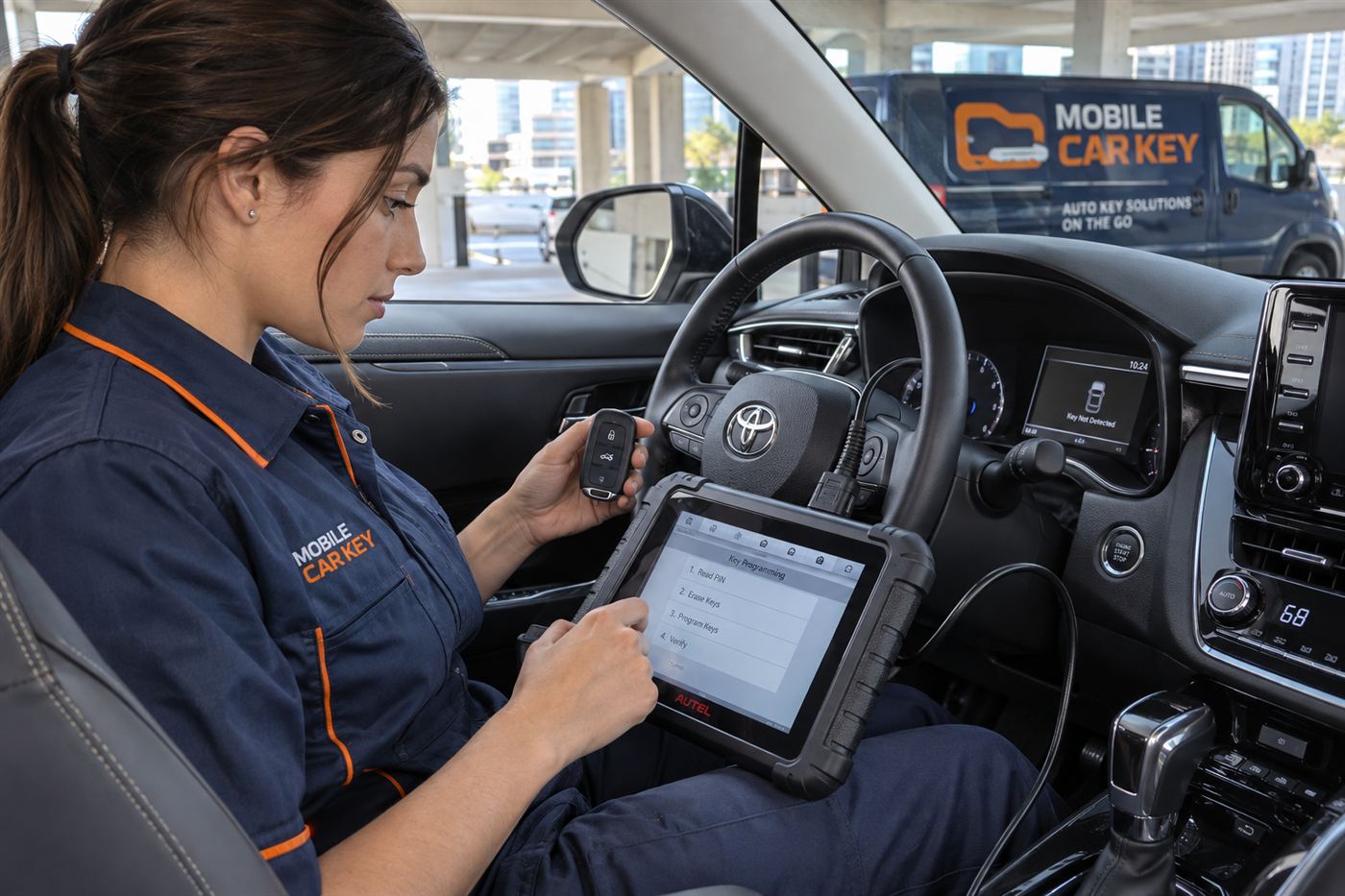
The short answer, and why it comes with conditions
A parking garage is one of the most common places for a key problem to happen. People park, walk away, come back with arms full of shopping or luggage, and discover the keys are gone or sitting on the seat. Mobile automotive service exists for exactly these moments, because the technician travels to the vehicle rather than asking you to bring the vehicle anywhere.
The honest answer is still a conditional yes. Whether a visit can be arranged depends on the location, the type of structure, the work needed and the vehicle itself. Availability, coverage and terms are confirmed before anyone is dispatched, and that confirmation is where garage details come into play.
This page is educational. Nothing here is a promise of service at any particular structure. It explains how garage situations usually unfold so you can give a clear, useful description when you call.
What makes a garage different from a street or a lot
A street or an open surface lot is simple: the vehicle is visible, the approach is open and there is plenty of room around it. A parking structure adds layers. There may be an entry barrier, a ticket system, height limits, one-way ramps, security staff and tight spaces between concrete pillars.
None of these layers stop a visit by themselves. They do change what the dispatcher needs to know. A technician arriving in a work vehicle may need to pass a height bar, take a ticket or be allowed in by an attendant. Those are practical questions that are far easier to solve before the visit than at the entrance.
Think of the garage as a place with its own rules. Your job is not to solve them. Your job is to describe the situation well enough that the service can decide whether and how to proceed.
Details to gather before you call
A good call starts with a clear picture. You are likely standing next to a car in an echoing concrete space with poor reception and a low phone battery, so it helps to know what to say.
Aim to give the dispatcher the following in a calm, organized way. Short answers are fine. If you do not know something, say so, because a guess can send the visit in the wrong direction.
- The name or type of the structure, such as a downtown public garage, a hospital deck, an airport structure, a mall garage or an apartment garage.
- The level, row or nearest pillar number, and which way the car faces.
- How vehicles enter: ticket gate, card reader, license plate reader, attendant or open access.
- Whether the structure has a posted height limit at the entrance.
- The year, make and model of your vehicle, and what happened to the key.
- Whether you have any key at all, and whether the doors are locked or unlocked.
Getting a technician through the gate
Gates are the part of a garage visit that surprises people most. A technician is not a customer who parked there, so the barrier may not simply lift. Options depend on the structure. Some garages let a visitor take a ticket and pay on exit. Others require a call to the operator. Some apartment and office garages require a resident or tenant to open the gate.
If you hold a ticket, a permit card or an app-based parking pass, mention it. If the structure has an intercom or an attendant booth, tell the dispatcher, because contacting staff in advance can prevent a stalled arrival.
Do not assume that a gate is a dead end. Operators deal with towing companies, delivery drivers and roadside providers every day, and they usually have a routine for outside service providers. Your part is to learn the routine and share it.
Height limits and vehicle access
Many parking structures post a maximum clearance at the entrance, and the posted figure matters to anyone arriving in a tall van. A technician may arrive in a vehicle that fits under most clearance bars, or may carry equipment in and walk to the car. Either way, the dispatcher should know about any height restriction so the visit can be planned around it.
If your structure has more than one entrance, tell the dispatcher which one you used and whether another entrance has a different clearance. Some multi-level garages have a low-clearance section on the lowest level and taller sections elsewhere.
If your car is on an upper level of a deck with a strict limit, say so. A technician who carries tools on foot can still reach the car in many situations, but this is the sort of detail that should be settled during the call rather than on arrival.
Tight spaces and door clearance
Even once inside, the car may be wedged between a pillar and a neighbor. A lockout often requires opening a door a little way, and a key job may require sitting in the driver's seat. If the space is tight, mention it. The technician may need a moment to plan the approach or may ask whether the neighboring car's owner is nearby.
Signal, lighting and the practical side of working in concrete
Concrete and steel absorb radio signals. In a lower level of a deep structure your phone may show a weak bar or none. Walk toward a ramp, a stairwell door or the entrance and make the call from where reception is better, then return to the car or tell the dispatcher exactly where it is.
Key fobs can be affected as well. A fob that struggles to unlock a door in a deep garage may work better a few steps away from the thick walls. If you are having trouble, try the fob near the entrance side of the car or after moving away from a pillar. It does not solve a dead battery, but it can rule out interference.
Lighting is another factor. Technician work involves small parts and fine detail, and dim corners of a garage make that harder. If the level is poorly lit, tell the dispatcher. If you are uncomfortable waiting alone in a dim area, move to a better lit spot near an elevator, stairwell or staffed booth.
Permission from the garage operator
Garages are private or publicly managed property. Even though the car is yours, the space around it belongs to someone else, and some operators require advance notice for outside service. Many are relaxed about it. A few have strict policies, especially at airports, hospitals and secured office buildings.
A good first step is to ask whoever staffs the structure, if anyone does, whether outside automotive service is allowed on site and whether a visitor needs a pass. If you cannot reach staff, tell the dispatcher what you know. They may have handled similar structures and can suggest what to ask.
If the operator refuses, ask whether there is an exit-side or surface-level area where the car can be moved safely once it is unlocked, or whether the operator would rather arrange a tow. That is their decision to make, and it is better to learn it before a technician arrives.
Proving ownership in a public setting
A reputable service asks for proof that you own the vehicle or are authorized to use it. In a garage this can feel awkward, because other people are walking by and you may have only a phone and a wallet. Fortunately, the proof is usually simple: an identification card plus a registration, title or similar paperwork that connects you to the car.
If your documents are inside the locked car, tell the dispatcher at the start. There are often other ways to connect you to the vehicle, such as a digital copy of your registration, insurance information in an app or paperwork that someone can bring. Terms are confirmed before dispatch, so ask what will be accepted.
Garage staff and security can sometimes help by confirming that the car has been parked there under your name or permit. Their word is not a substitute for ownership proof, but it supports your account and helps the visit run smoothly.
Garage situations: three different scenarios
Consider a driver who left a phone, a wallet and the key fob on the passenger seat of a car at a downtown deck. The doors locked when the driver closed the door. The driver can see the key through the glass. That is a lockout and the work is about opening the door, not making a key.
Now consider a driver at an airport structure who returns from a trip and finds the fob has no response because the battery died. The doors may open with the mechanical key hidden in the fob, but the car may not start without the fob nearby. That is a battery and detection issue, which often resolves with a replacement battery.
Finally, picture a driver who dropped the only key through a gap, or lost it somewhere along a shopping trip. That is a lost key situation. It takes more work because a new key must be created and matched to the vehicle. See all car keys lost for how that process works.
Different kinds of structures, different habits
Not every garage behaves the same way. A hospital deck is busy at all hours, has plenty of foot traffic and often has a security office nearby. A mall structure may have long shopping-hour crowds and wide lanes, but entrances that close after the stores do. An office tower garage can be nearly empty on weekends and fully gated, with a card reader at every ramp.
Airport structures add their own complications. They tend to be large, with several terminals, long-term and short-term sections and heavy security. If you are stuck there, tell the dispatcher which terminal or lot you are in and whether you have a rental car, because rental vehicles bring ownership questions of their own. The rental car key guide explains that side of the problem.
Apartment structures and mixed-use buildings are different again. They often belong to a management company, and the rules for outside visitors are set by the building. If you are a resident, you hold the access the technician will need, so be ready to coordinate that. If you are visiting someone, contact your host early rather than at the moment the technician arrives.
What a technician needs from the area around your car
Once a visit is approved, a little preparation helps. The technician will want room to open a door, a place to set tools down and enough light to see small parts. If the car is parked tightly, you can sometimes help by asking neighboring owners, if they are around, whether they could move a short distance. Never ask anyone to do something risky, and never move a vehicle that is not yours.
Clear the area of loose belongings you have taken out of the car, and keep children and pets away from the working space. If you are with a group, ask most of them to wait elsewhere so the aisle stays clear. A garage lane is a shared space, and cars may still pass nearby.
Keep the key-related items you do have close at hand. A spare fob, a mechanical key blade, a parking receipt and the registration paperwork all give the technician useful information. Even a broken or worn key can show the type of system the car uses.
Safety comes before the key
If someone is in danger, call 911 first. If a child or pet is locked in a car, treat it as an emergency, because concrete structures trap heat and temperatures inside a closed vehicle climb in a way that surprises people. Do not wait for a locksmith in that situation.
If you feel unsafe because of who is nearby, move to a staffed area, an elevator lobby or the street and tell the dispatcher you will meet the technician there. A key problem is never worth putting yourself at risk.
Keep away from moving traffic in the aisles. Garage drivers are often looking for spaces rather than pedestrians, and visibility is limited at ramp corners. Stand beside the car, not behind it, and keep your phone charged enough to take a call.
When the car needs to leave the garage with a new key
Some key jobs end with a working key and a running car. Others end with a technician telling you that a particular vehicle needs dealer-level tools or manufacturer access that cannot be provided at the curb. This happens with some newer vehicles, and a good service says so honestly rather than pretending.
If that happens in a garage, you have a different problem: the car is stuck in the structure. Ask about towing options, and ask the garage whether they allow a tow from the level you are on. Some operators charge for extended parking, so check how long the car can stay while you arrange the next step.
Read car key replacement to understand how a new key is created and why some vehicles need more than a mobile visit can offer.
Questions to ask the dispatcher about a garage visit
You are allowed to ask questions. A service that works with garages regularly will not mind explaining how it handles gates, height bars and operators. Good questions show that you are organized and help you understand what will happen.
Write a few down before you call, so you do not forget them when stress is high.
- Is service available for this type of structure and for my vehicle?
- What proof of ownership will I need to show on site?
- Is there anything I should arrange with the garage staff beforehand?
- What should I do if the gate will not open for the technician?
- What happens if the work cannot be completed at the car?
- Where can I read about how the process works in general?
Where to go next
If your situation is a locked door, read vehicle lockouts. If a key is missing, see car key replacement. A garage lockout in a specific setting is described in locked out in a parking garage, and airport structures are a topic of their own.
For a wider look at the questions drivers ask, visit the questions hub. When you are ready to start, the contact page explains how to request a callback.
Everything on this page is general information. A service agreement exists only when a service confirms availability and terms with you directly before dispatch.
Common questions
Do I have to be at my car when the technician arrives?
Usually yes. A reputable service checks that you own the vehicle or are authorized to use it, and that check happens on site. If you cannot be present, the service may ask for another arrangement, but it will want to confirm authorization before doing any key work. Raise this when you call so the plan is clear.
What if I do not know which level my car is on?
Walk the structure if you feel comfortable doing so, or check your parking ticket, receipt or parking app. Many structures print a level and zone on the ticket, and some apps save your location. Photos you took at arrival can also help. If nothing works, tell the dispatcher the entrance you used and the part of the building nearby.
Can the garage staff open my car for me?
Some staff can call a service or help with a jump start, but many are not allowed to open vehicles for liability reasons. Ask politely. Even if they cannot open it, they can often tell you what outside services are permitted and help you coordinate access for a technician.
Will I be charged extra parking while I wait?
Parking charges depend on the structure and its rules, and a key problem does not usually change them. Ask at the booth or exit whether a grace arrangement exists for a vehicle that is waiting for service. Keep your ticket and any notes, because staff may be able to adjust charges if you explain the situation.
What if the garage is private and requires a resident to let people in?
Tell the dispatcher at the start. A resident, tenant or manager may need to open the gate or add the technician to an access list. If you are a resident or tenant yourself, you can usually do this directly. If you are a visitor, you may need to contact your host.
Is a lockout in a garage treated differently from one on the street?
The work on the car is the same, but the planning differs. Gates, clearance limits, weak signal and tight spaces all affect arrival and setup. Giving the dispatcher those details early lets the service decide how to approach the visit and avoids delays at the entrance.