
A Sprawling City Built Around the Car
Atlanta is spread across a wide region of hills, trees and highways. Interstates 75, 85 and 20 meet near the middle of the city, and the perimeter highway circles the core. Many people live in suburbs such as Marietta, Decatur, Alpharetta and Sandy Springs and commute long distances. Traffic is a regular part of life, and drivers spend a lot of hours behind the wheel.
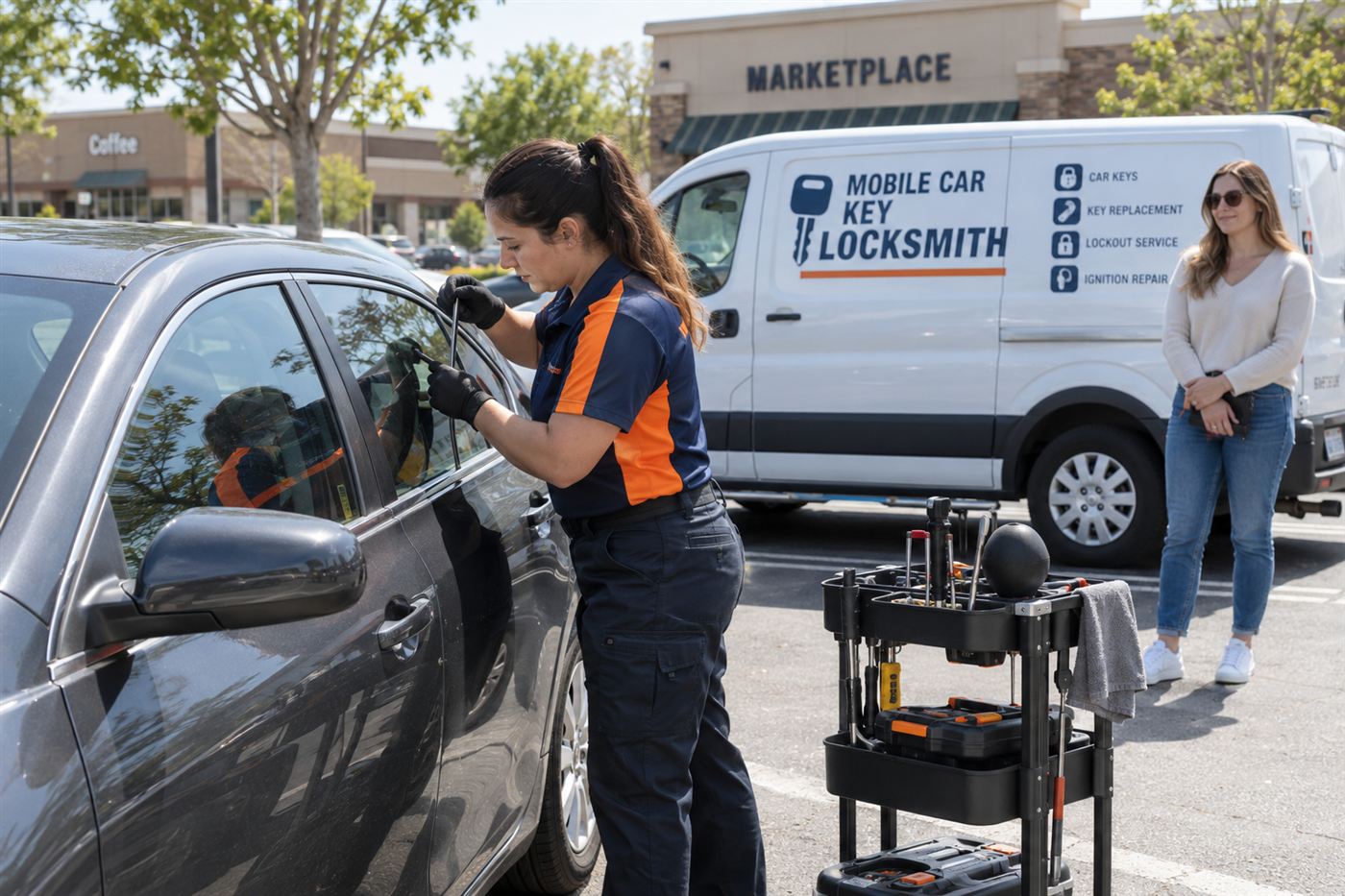
Mobile Car Key Locksmith is an automotive service that covers the entire United States, and Atlanta is one of the cities this site describes. A technician comes to the vehicle, which suits a city where cars are parked in garages, office lots, apartment complexes and roadside pullouts.
The text on this page is educational. It describes what is common, what you can try, and how the process works in general. Availability, coverage and terms are always confirmed before dispatch, and nothing here forms a service agreement.
What is ahead
Sections follow on the airport, garages, weather, universities, suburbs, road trips and the practical steps for preparing. Jump to whichever one matches your situation.
The World's Busiest Airport and Your Car
Hartsfield-Jackson Atlanta International Airport is widely known as one of the busiest passenger airports in the world, and it is a huge source of parked vehicles. Travelers leave cars in economy lots, daily decks and off-airport facilities for days or weeks at a time. When they return, a surprising number of keys do not behave.
The reasons are simple. A fob that spent a week in a bag may have a battery near the end of its life. A key may have been dropped in a security line or left in a jacket at a connecting airport. A car battery may have drained while parked. The traveler arrives tired, with luggage, often at night.
If your car will not respond, take a breath. Check the manual key blade, try the spare if someone can bring it, and look at the dashboard for hints. Then tell the dispatcher exactly where you are. Our page on being locked out at the airport gives a step-by-step approach.
Describing an airport lot
Name the lot or deck, the level, the row letter or number and the nearest column marker. Photograph the sign when you park, so you can quote it on return.
Shuttle lots and off-airport parking
Private lots near the airport have their own operators and rules. Ask staff what they allow, and pass that to the dispatcher.
Traffic, the Connector and Long Commutes
Atlanta's central highway runs through the city as a wide corridor, and congestion is common. Drivers spend long periods in stop-and-go traffic, and the habit of stopping for fuel, a snack or a short errand on the way is almost universal.
Key trouble often happens at those stops. A driver leaves the engine running at a fuel pump, steps inside, and returns to a locked car. Another leaves a fob on the passenger seat while loading groceries. Our page on push-to-start systems explains why a car that senses no fob can lock itself, depending on the model.
Long commutes also mean constant wear. Keys carried in pockets with phones, coins and other keys develop smooth edges, and fobs get dropped repeatedly on pavement. If your key looks worn, replace it before it fails.
Breakdowns versus key problems
A car that will not start in traffic may have a dead battery, a failed starter or a key issue. Dim dash lights point to the battery. Bright lights with no crank can point to the immobilizer not recognizing the key. Share these clues with the dispatcher.
Garages, Valets and Dense Midtown Blocks
Midtown, Buckhead and downtown Atlanta are full of parking decks, hotel valets and restaurant lots. Cars are tightly packed, ceilings low and signage confusing. A lockout inside a garage requires patience from everyone involved.
The dispatcher needs the deck name, the level and a landmark such as a stair, an elevator or a numbered column. A technician has to approach the vehicle without blocking traffic lanes, so mention any one-way flow or reserved sections. Check with garage staff about what is allowed.
Valets add a different kind of trouble. At the end of a busy night, fobs get mixed up, keys are placed on the wrong hook or the valet cannot find your car. Speak to the manager before deciding the key is lost. Taking a photo of the key and the dashboard when you hand them over helps resolve any dispute.
Hotel and event garages
Convention weeks and big events fill decks to the top. Expect crowds, closed levels and slow exits. Give the dispatcher the clearest location detail you can.
Gate and ticket problems
If the parking ticket is locked inside the car, tell the attendant so the exit gate is not another obstacle once the car is open.
Pollen Season and Sticky Fobs
Spring in Atlanta is famous for pollen. A yellow-green dust covers cars, sidewalks and everything outdoors. It collects in door seams, on handles, in key slots and around fob buttons. Over several weeks, it can gum up small mechanisms.
A fob with buttons that feel mushy or sticky may only need a gentle cleaning. Use a dry soft cloth, avoid soaking, and keep liquids away from the circuit board. A lock that resists the key may have a build-up of pollen and grit; a dry graphite lubricant for locks can help, and forcing the key does not.
Rain washes pollen away but also brings moisture. A fob that gets wet should be dried thoroughly in open air before use, with the battery removed if the case opens. Avoid heat guns, ovens and hair dryers, because they can warp the case and damage the circuit board. Wait until the fob is completely dry, then test it near the car before relying on it.
Do not pry
Opening a fob case with a screwdriver can crack the plastic and tear the battery contacts. Use the notch designed for the purpose, or leave it to a technician.
Summer Storms and Humidity
Summers in Atlanta are hot and humid, and afternoon thunderstorms arrive with little warning. Drivers run to their cars with wet hands, throw wet bags onto seats and slam doors without checking pockets. The moist air and sudden downpours are hard on electronics.
Heat is also a risk. A closed car becomes very hot within a short time. If a child or pet is locked inside, call 911 immediately. Do not wait for anything else. For an empty car, find shade, hydrate and arrange help.
Lightning is another factor. If a storm is overhead, stay in a building, not beside the car. A locked-out driver should never stand in an open lot during lightning. Wait inside and let the dispatcher know your situation.
After the storm
Wet seats, dripping jackets and slick pavement all hide dropped keys. Check the ground around the car door and under the car before deciding a key is gone.
Georgia Tech, Emory, Georgia State and Student Cars
Atlanta hosts many colleges and universities, including Georgia Tech, Emory and Georgia State. Students park in campus decks, apartment lots and neighborhood streets. They share cars, borrow keys and lose spares.
A student with only one key should think about making a duplicate early. A student whose key is lost should find the registration, locate a parent if the car is titled to them, and gather the vehicle details. A student who bought a used car should check how many working keys came with it. Our all keys lost service page describes what happens when no key remains.
Ownership is checked on site. A reputable service asks you to show that you own the vehicle or are authorized to use it.
Shared apartment lots
Large apartment complexes have many identical cars. Give the building name, the lot letter and the exact space number, and tell the dispatcher the vehicle color.
Suburbs, Cul-de-Sacs and Shopping Centers
Beyond the perimeter, Atlanta becomes a patchwork of subdivisions, shopping centers and office parks. School pickups, soccer practices and big-box stores fill the week. The most common key stories happen in plain view: a parent loads a child and closes the door with the keys on the seat, or a shopper sets the key on the roof.
If your car is in a shopping center, name the center, the entrance you used, the store nearest your car and the vehicle description. The technician then knows where to find you. Visit the transponder key page if you suspect your key has a chip that matters for replacement.
Children in the car
If a child is locked inside, call 911 before anything else. Emergency responders can act immediately. Locksmith service can wait until everyone is out and accounted for.
School and activity lots
Parent pickup lines move in a steady flow. Move out of the line before dealing with a key problem, and avoid blocking other drivers.
Hills, Trees and Narrow Streets
Atlanta's terrain is hilly and tree-covered. Older neighborhoods have narrow streets, steep driveways and cars parked tightly along the curb. A technician needs room to work and a secure place to stand. Mention a slope, a blind curve or heavy traffic when you describe your location.
Tree sap and falling debris can coat cars in some seasons. A sticky door handle or a sap-covered lock may feel like a key problem when it is only dirt. Clean gently before assuming the worst.
Night parking
Poor lighting makes dropped keys hard to find. A small flashlight, or the light from your phone, helps. Check under the car and in leaf litter.
Road Trips From Atlanta
Atlanta is a hub for road trips. Drivers head northeast to Charlotte, south toward Florida, east to Savannah and west to Birmingham. If you are headed toward the Carolinas, see our page for Charlotte. For a trip down the peninsula, Miami is another covered city. You can view all of them on the major cities hub.
Long drives raise the odds that a key problem happens far from your usual area. Replace tired fob batteries before leaving, put the spare in a different bag, and keep the vehicle details on your phone. Rest stops and fuel stops are classic locations for lockouts, so build the habit of checking your pocket before closing the door.
Mountain drives
North Georgia drives bring cooler air and winding roads. Cold mornings can make fobs sluggish, and trailhead lots can be remote.
A Walkthrough: Landing Late and the Car Will Not Start
Picture a general scene, not a real customer. A traveler lands at night after a long flight, takes the shuttle to the deck where the car has sat for several days, and finds the car silent. The fob does not unlock the door, and the manual blade works only after some fumbling. Inside, the dash does not light up.
The traveler stops and thinks. Is it the fob or the car? The interior light came on weakly when the door opened, so the car battery is low. The fob may still be fine. That clue is useful. The traveler writes down the deck, level and row, photographs the nearest sign, and finds the registration in the glove box.
The request then goes to the service. The dispatcher asks for the year, make and model, the location and what has happened. Availability and terms are confirmed before anyone is sent. A technician is dispatched to the vehicle, checks ownership using the registration and photo identification, tests the key and the car, and explains whether the issue is the fob, the car battery or something else.
Not every case ends the same way. Sometimes the key is the problem, sometimes the car is, and sometimes the right answer is a tow or a dealer visit. A good technician tells you which, even when it means the job is not theirs.
Clues you can collect
Do the interior lights glow or flicker? Do you hear a click when you press start? Does the dash show a key symbol? Each detail narrows the cause.
What not to do
Do not repeatedly jump the car without knowing the cause, and do not pry at the fob. If you are unsure, wait for guidance.
Understanding Which Kind of Key You Carry
Many Atlanta drivers cannot say what kind of key they hold, and that is normal. Knowing the type makes every conversation easier, and it affects how a replacement is made.
A plain mechanical key has no chip and opens doors and starts the engine by shape alone. A transponder key looks similar but carries a small chip that the car must recognize. A remote head key adds buttons for locking and unlocking. A switchblade key folds out of a fob. A smart key or proximity fob lets you start the car with a button without inserting anything.
Each type is handled differently, and a technician can identify yours at the vehicle. If you are not sure, take a clear photo of the key and the dashboard start area, or the ignition slot, and share it with the dispatcher.
Why chips matter
If the chip is not coded to the car, a key that fits the lock still will not start the engine. Programming teaches the car to accept it.
Why proximity fobs are different
They talk to the car by radio, so the car must sense them inside the cabin. A weak battery, a damaged circuit or interference can all produce a not detected message.
A note on counterfeit keys
Low-cost keys sold online may not carry the right chip or may fail to program. A technician can often test one on site and say whether it is worth using.
Replacement Without a Spare
When every key is gone, a mobile technician can often cut and code a new one at the vehicle. The process depends on the make, model and year. Some newer vehicles require dealer-level tools or manufacturer access, and the dispatcher will tell you early.
Have your VIN, registration or title and photo identification ready. If you have a broken key piece or an old shell, bring it. The work is tested before the technician leaves, so you know the key opens the door, starts the car and runs the remote functions.
A duplicate while you can
Making a copy while one key still works is usually simpler than starting from nothing.
How the Request Works
You call or send a callback request. The service asks about the vehicle, the location and what happened. Availability, coverage and terms are confirmed before dispatch. A technician is sent to the vehicle, ownership or authorization is checked on site, and the work is done and tested.
No arrival time is promised on this site, because it depends on availability. The how it works page lays out the sequence, and the dispatcher can explain what applies to your request.
- Registration, title or lease paperwork
- Photo identification
- VIN and vehicle details
- Old keys or fob pieces
- Exact location: deck, level, row, or cross streets
Common questions
My fob does not work after a week at the Atlanta airport. What now?
Try the manual key blade hidden in many fobs, then check whether a spare is available. A week in a bag can drain a weak battery, and a parked car's own battery may also have run down. Tell the dispatcher your lot, level and row. Availability and terms are confirmed before a technician is dispatched.
A valet gave me the wrong fob. Is my key lost?
Not yet. Return to the stand and speak to the manager, who can check the key board and the other cars. Take photos of the fob and the dashboard. Only if the key cannot be found should you consider replacement. A technician can help if the manager confirms the key is truly missing.
Can pollen really cause my lock to stick?
Pollen mixes with dust and moisture and can build up in locks and around fob buttons. A key that needs force is a warning sign. Wipe the blade, use a dry graphite lubricant made for locks and do not force it. If it keeps sticking, have it looked at before it snaps.
Does the service work inside parking decks?
Technicians come to the vehicle, including many parking structures. Give the deck name, level, row and nearest landmark, and check what the operator allows. Some decks have height limits or access rules. Availability and terms are confirmed before dispatch.
I lost every key to a newer car. Is that fixable on site?
For many vehicles, yes. Limits depend on the make, model and year, and some newer vehicles need dealer-level tools or manufacturer access. The dispatcher will say early whether yours is workable in the field. Bring the VIN, registration and photo ID.
What if a storm is overhead while I wait?
Move indoors. Lightning is a real danger in open lots. Tell the dispatcher where you are sheltering and where the vehicle is. Call 911 if anyone is in danger. Availability may be affected by weather, and the dispatcher will explain what applies before anyone is sent.