
Why rain makes lockouts more likely
Rain changes how people behave around a car. You hurry from the door of a building, hold an umbrella with one hand, shake water off a coat with the other and slide into the seat as soon as you can. In that rush, a fob can end up on the seat, in a wet bag or dropped into a puddle without anyone noticing.
Rain also makes doors easy to close with force. Some drivers push the door shut with a hip while carrying bags, and the car locks itself a moment later because the fob was inside. Wet hands and wet gloves make the fob slip, and a fob stored in a damp pocket can lose signal or short out.
Understanding the pattern helps you recover. The key is rarely lost. It is usually in the seat, the cupholder, a wet bag or the last place you stood. Start by checking the simple spots before you assume the worst.
Footwear plays a part too. Slick soles and wet pavement make drivers focus on their footing, not on the pocket where the fob lives. A distracted moment at the curb is all it takes. Slowing down for a second at the car door, and touching the pocket that holds the key, is the simplest habit you can build.
Get dry and protect your phone
Move under a roof, an awning, a bus shelter or a store entrance before anything else. A dry place lets you think, read your screen and use your hands. Standing in rain makes every decision feel more urgent than it is.
Protect your phone. Most modern phones tolerate some rain, but touch screens misbehave when wet, and a drenched phone is harder to use for a call. Dry the screen with a clean sleeve or a napkin, turn the volume up and keep it in an inside pocket between calls.
If the phone gets very wet, do not charge it until it dries, and do not use a hairdryer. A phone that stops working is its own emergency when you are stranded, so ask a nearby business for a landline or a charger if needed.
- Move under a roof or awning before you call
- Dry the screen with a clean cloth
- Keep the phone in an inside pocket
- Ask a nearby business to help if the phone fails
Check inside the car for people and pets
Before you plan anything, look inside the vehicle. If a child, a pet or an adult is in the car, call 911 first. A closed car with the engine off can be dangerous in many kinds of weather, and rain does not remove the risk. Windows may fog, air may become stale, and cold and humidity can add up.
If the engine is running, tell the dispatcher right away. A running car can drive off if the gear is accidentally engaged, and exhaust in an enclosed space is hazardous. Move others away from the tailpipe.
If the car is empty and the engine is off, the situation is a plain lockout. You can plan in a calm way. Rain is uncomfortable but rarely dangerous for a healthy adult who can stay under cover.
Fog on the glass can hide what is inside. Wipe the window with a dry cloth or your sleeve and shade your eyes with your hand to see the seats and floor. A person curled in a back seat or a pet under a blanket is easy to miss in a rainy dusk, so look at every row before you decide the car is empty.
Look for the key in the usual wet places
Rainy days produce a particular set of hiding places for keys. Check your coat pockets, including the inner ones. Check umbrella handles and holders, shopping bags, tote bags and the bottom of backpacks. Look at the ground by the car door in case the fob fell into a puddle.
Check the building you came from. Entrance mats, coat check desks, umbrella stands and lobby counters are common places for a fob to be left. Staff often keep found items at a desk, and a short walk can save a service call.
If you can see the key inside the vehicle, note where it is. A key on the driver seat is a different job from a key under the seat, and the dispatcher can use that. Take a photo through the glass if the angle is clear.
Retrace your steps from the last place you remember holding the key. If you stopped to adjust a hood, pick up a package or open an umbrella, those are the moments the fob is most likely to have been set down. Walk the path slowly under cover and look at ledges, railings and benches along the way.
What to tell the service
Describe the vehicle: year, make, model, color and key type. Say whether it uses a metal key, a remote fob or a push button start. Give your exact location with a cross street, a store name or a row number. Say what happened, such as key locked inside, fob lost or fob stopped working after getting wet.
Mention the weather. A technician who knows it is pouring will bring the right gear and plan to shelter tools, and may suggest a covered spot for the work. If you are under a roof, tell the dispatcher where it is in relation to the car.
Availability, coverage and terms are confirmed before dispatch. Take your time to ask what the service can do for your vehicle. This page is educational and does not create an agreement.
Details that matter in the rain
Whether the car sits under cover, on a slope or near running water; whether doors or windows are open a crack; and whether the fob took on water.
Proving ownership in bad weather
A reputable service asks for proof that you own the vehicle or are authorized to use it. This is checked on site, and the rain does not change the requirement. Keep your ID and documents dry. A plastic sleeve or a zip bag protects paper from soaking.
If your registration is in the glove box, tell the dispatcher. Many services can work from a digital copy on your phone and a matching photo ID. For a rental or company vehicle, the owner may confirm by phone.
Do not hand a soaked stack of papers to a technician in the rain. Show them under cover, and ask for a moment to find the right page. See the ownership proof guide for the usual documents.
Fobs that got wet
A fob that has been rained on, dropped in a puddle or washed in a coat often acts strangely. Moisture can bridge the contacts inside, drain the battery or corrode the circuit board. If your fob is wet and not working, do not press the buttons repeatedly, which can make things worse.
Remove the battery if you can do so without forcing the case, pat the parts dry and let them air out. Do not use heat from a hairdryer or an oven, because it can warp the case and damage the electronics. Rice is a popular trick, but air and time work just as well.
A technician can test the fob and tell you whether it can be saved. The page on a key fob that got wet describes the steps in more detail.
- Do not press the buttons repeatedly
- Remove the battery gently if it can be reached
- Pat dry and air out, away from heat
- Have a technician test it before you replace it
Wet locks and door handles
Rain can find its way into door handles, lock cylinders and keyholes. In cold weather, that water can freeze, and the lock may stick. In warm weather, it can wash grit into the mechanism.
If the key turns with difficulty or not at all, do not force it. A bent key or a broken tip leaves you with a bigger problem, and a technician may have to remove a stuck piece. If a piece breaks off, stop and let a technician remove it.
Wiping the keyhole dry with a clean cloth is fine. Spraying random lubricants into a lock can attract dirt, and some products are bad for the wafer parts inside. Wait for a technician to advise on what is suitable for your vehicle.
Winter rain that turns to ice can seal a door in its frame. If the handle gives but the door will not open, the seal may be frozen. Pulling hard can tear the rubber. Pressing gently along the edge, or waiting for the surface to warm, is safer than forcing it. Tell the dispatcher about the freeze so the technician plans for it.
What a technician does in the rain
The technician arrives with tools and with a plan for wet conditions. In a standard lockout, the aim is to open the door without damaging the lock, the paint or the electronics. Moisture is not a reason to refuse the job, but it changes how the work is done.
A canopy, a tarp or a covered parking area makes the job more comfortable and protects the interior when the door is open. If the car sits under cover, say so. If not, the technician may ask you to stand back while they set up.
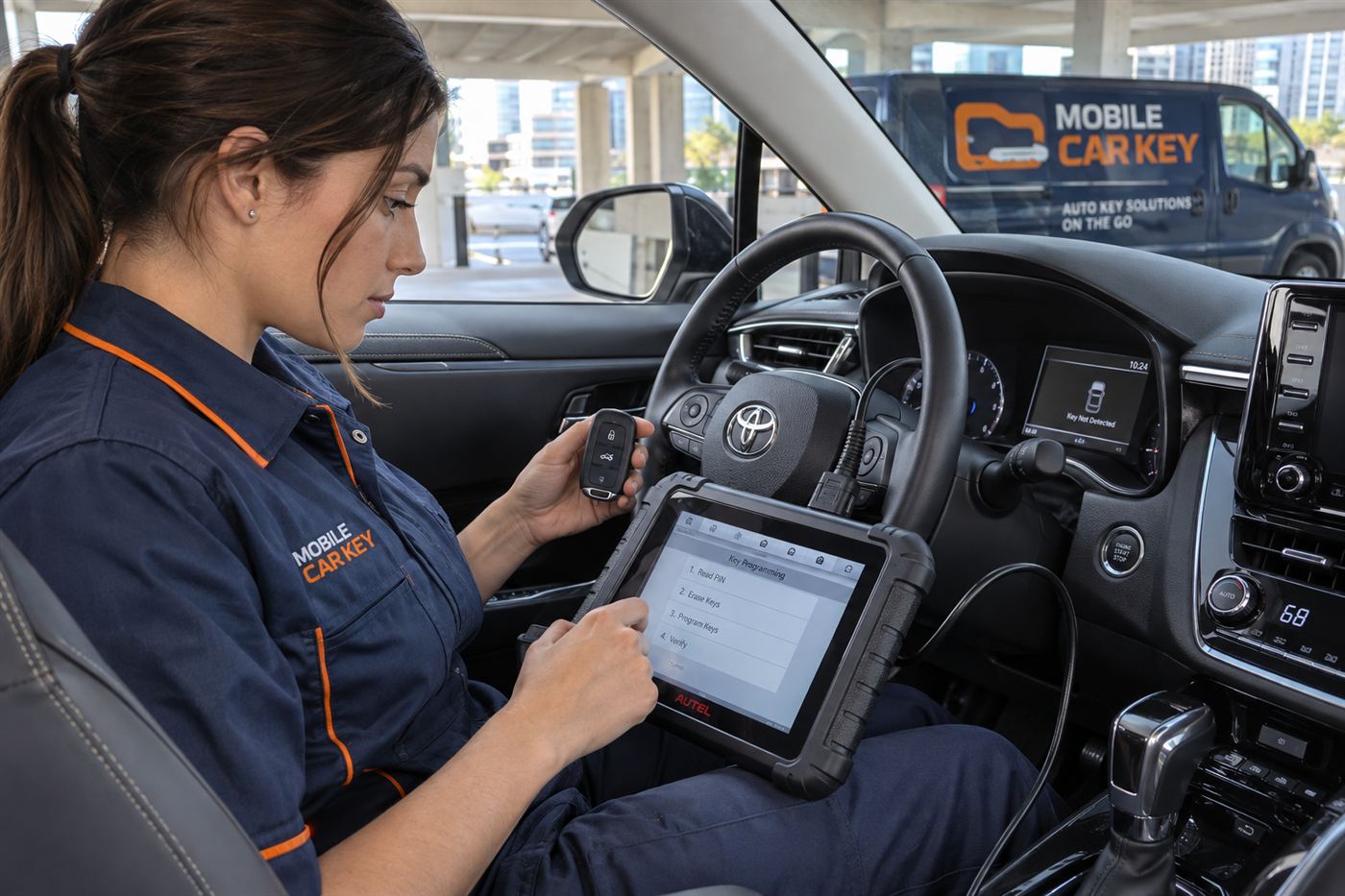
When the key is lost or the fob is dead, the work may include making and programming a new key. Limits depend on the vehicle, and some newer models need dealer-level tools or manufacturer access. For the usual process, read about vehicle lockout service.
After the car is open, ask the technician to test every function of the key or fob in the rain, not only the lock. Check that the doors lock and unlock, that the trunk release works and that the engine starts. A problem discovered while the technician is still there is far easier to fix than one found the next morning.
Protecting the interior when the door opens
When the car opens in the rain, water can pour in. Seats, carpet, electronics and the dashboard are all at risk. Ask the technician to open the door only when you are ready, and have a towel, a coat or a bag ready to cover the seat.
If the technician needs to work with the door open for a time, ask whether an umbrella or a canopy can be placed over the opening. Some vehicles have sensitive controls in the door, and water in those can cause trouble later.
Close the door once the work is done and wipe down any wet surfaces. If water entered, run the climate control to dry the cabin, and check the floor mats for dampness. Mold can start in a wet carpet if left alone.
If you have a passenger who can hold an umbrella over the door opening, ask them to do so, and stand clear of the technician's tools. A little cooperation keeps the seat dry and keeps the work moving without anyone stepping into the technician's way.
Parking surfaces, puddles and flood risk
Where you park in the rain matters. A car in a puddle or on a low lot can be hard to reach, and heavy rain can raise water levels around the tires. If water is rising, treat the situation as urgent, move yourself to higher ground and call local emergency services.
Do not enter standing water to reach a car. Water can hide holes, debris and electrical hazards, and a flooded car can be damaged beyond a simple key fix. If a flood has already reached the vehicle, see car keys after a flood for what to do next.
For ordinary wet pavement, tell the dispatcher about the slope and the surface. A technician can plan the placement of the service vehicle and the tools.
Travel, tourists and rental cars in the rain
Rain often catches travelers off guard. You land in a new place, pick up a rental and head out in a storm. A new fob and unfamiliar controls make a lockout more likely, and the rental company must be involved in the ownership check.
Call the rental company first and ask whether they authorize outside service. Keep your agreement and ID dry, and describe the fob clearly. If the rental is a push button car, the key may be a small card or a fob with a hidden blade.
Your hotel front desk or a visitor center can help with shelter and directions while you wait. Travel changes the plan in small ways, so keep the rental paperwork within reach.
Visitors in an unfamiliar town often do not know where to shelter. Gas stations, large retailers, hotel lobbies and public libraries are usually open and dry. Tell the dispatcher which one you are using. A technician looking for a driver in a downpour needs a clear meeting point, not a vague description of the road.
Habits for rainy days
Give your key a fixed spot. A zipped pocket in a raincoat, a lanyard clipped to a bag or a carabiner on a belt loop all work. Avoid carrying the fob loose in a wet pocket with other items.
Use a small waterproof pouch for the key and the phone. They cost little and protect against drops in puddles. Replace the fob battery once a year, because a weak battery gets worse in damp weather.
Keep a spare key in a dry place away from the car, with someone you trust. The spare key guide explains the options. A spare turns a wet and unpleasant lockout into a short delay.
Think about the season too. In a part of the country with a long wet season, make the key routine part of getting in the car: key in hand before the umbrella goes up, key in pocket before the door closes. Routines hold up better than memory when the weather is bad and the mind is busy.
Related pages
If your situation is different, there are other pages that may fit. See locked out at night for after dark advice and locked out in hot weather for the opposite extreme. The situations hub lists every common car key problem.
This content is educational only. It does not create a service agreement, and terms are confirmed before dispatch.
Rain is an inconvenience, not a barrier. Stay dry, protect your phone and fob, tell the service what you see and let the technician work with the tools made for the job.
Common questions
Can a mobile technician work in heavy rain?
Technicians work outdoors in many conditions, but heavy rain or lightning can affect safety and scheduling. Tell the dispatcher about the weather and any covered spot nearby. Availability and terms are confirmed before dispatch, and the service can explain what it can do for your vehicle in those conditions.
What should I do if my fob fell in a puddle?
Do not press the buttons repeatedly. Remove the battery gently if it can be reached, pat the parts dry and let them air out away from heat. Avoid hairdryers and ovens. Then have a technician test it, since water damage can be hidden and may corrode over time.
Will the inside of my car get soaked when it is opened?
It can, if the door is open for a while in a downpour. Have a towel or coat ready to cover the seat, and ask the technician about a canopy or an umbrella. Once the work is done, wipe down wet surfaces and run the climate control to dry the cabin.
My documents are wet or locked inside. What now?
Tell the dispatcher at the start. A digital copy of your registration and a photo ID on your phone may be accepted. For rental or company cars, the owner can confirm by phone. Keep paper dry in a plastic bag so it stays readable when the technician arrives.
Is it dangerous to wait in the rain?
A healthy adult can wait under cover without trouble, but wet and cold can add up. Move to a shelter, keep children and older adults dry, and watch for lightning or flooding. If conditions become dangerous, go indoors and call local emergency services if needed.
Can rain cause the car to lock me out on its own?
Rain does not lock a car by itself, but wet conditions can interfere with fobs, drain batteries and make doors close with force. Some vehicles lock automatically when you walk away or shut a door with the fob inside. Check the manual for the settings on your model.
What if a child or pet is locked in the car?
Call 911 first and stay with the vehicle. Do not wait for a locksmith. A closed car can become dangerous in many weather conditions, and emergency responders can open the vehicle right away. Give the operator your exact location and follow their instructions.