
Why a keyless car is a different purchase
When a seller says the car has no keys, the sale is no longer just about the vehicle. You are also buying the job of making keys, and that job has its own difficulty, timing and cost, all of which depend on the specific car. A simple older model can be easy. A late model with push-button start and encrypted security can be far harder.
Sellers have all sorts of reasons for being keyless. The previous owner may have lost the keys, an estate may be selling a vehicle, an auction lot may not include them, a repossession may leave them out, or a dealer may have kept them separate. Understanding the reason tells you a lot about the risk.
Treat the missing key as information. A sensible buyer asks why the keys are missing and what proof the seller has of the right to sell. If the story is clear and the paperwork is solid, the key is a manageable task.
Confirm ownership and paperwork before anything else
The biggest risk in buying a car without keys is buying a car that the seller does not have the right to sell. A vehicle without keys is exactly the kind of vehicle that can be stolen, abandoned or in a dispute. Do not rely on a verbal story.
Ask to see the title and compare the name on it to the seller's identification. Check that the identification number on the title matches the number on the vehicle itself, usually visible at the base of the windshield and on a door frame label. Ask whether any lender holds a lien, and what the plan is to clear it.
If the title is missing, the seller is not the titled owner, or the paperwork looks altered, pause. Rules about titles, bills of sale and transfers differ by area, so check with your local motor vehicle agency. This page offers general information, not legal advice.
- Title in the seller's name, matching identification.
- Vehicle identification numbers matching on the car and the paperwork.
- No unexplained lien, or a clear plan to release it.
- A written bill of sale with date and details.
- A willingness from the seller to answer questions plainly.
Why the paperwork matters for the key too
The same documents that protect your purchase decide whether a technician can make a key. A reputable service asks for proof that you own the vehicle or are authorized to use it. If you cannot show a title or a bill of sale that ties you to the car, a good service may decline to make a key.
This means the order matters. Complete the purchase properly, receive the title or the documents that lead to it, and keep copies. Then arrange the key. Trying to arrange the key first, without papers, usually leads to a polite refusal.
Our ownership proof guide explains the documents that commonly help. If you are buying through an auction or a dealer, ask what paperwork you will receive, and when.
Inspect what you can without keys
Without keys, you may not be able to open the doors, run the engine or test the electrical system. That limits what you can learn. Walk around the car. Check the body, the tires, any fluid on the ground, the condition of the glass, and signs of past accidents or water exposure.
Look through the windows. Is the dash lit, are there warning lights, how many miles are shown if you can see them? Check for visible damage to the ignition area or the door locks, such as scratches, pry marks or a broken cylinder. Those are signs of a past theft attempt, and they raise the cost of getting going.
If you are serious, ask whether the seller will allow a pre-purchase inspection by a mechanic, with the understanding that you may need power and a way to open the vehicle. A seller who refuses any inspection is telling you something.
Take photographs of everything you see, including the identification plate, the odometer if visible, the tires and any damage. Photos help you remember details, compare cars and talk to a technician or mechanic. They also protect you if the condition of the car is later disputed.
Signs of trouble in the ignition and doors
A damaged ignition or lock is more than a cosmetic issue. If the cylinder has been forced, the repair may involve replacing the cylinder and recoding keys to it. If the doors have been pried, there may be damage to wiring and seals.
Look for loose trim near the steering column, a cylinder that sticks out or sits crooked, or a door lock that looks scratched. Ask the seller directly whether the car has been broken into. Their answer, and how they give it, matters.
If you find signs of tampering, factor in additional work. A technician can assess the lock and ignition once you have the car, but you should know about the possibility before you buy.
What making a key involves
When no key exists, the job is called all keys lost. The technician gets the cut pattern from the lock or from vehicle data, cuts a blade where there is one, and programs the key to the car's security system. On many vehicles this can be done at the vehicle, with equipment that connects to the diagnostic port.
Some vehicles are simpler than others. Older cars with a plain key may need only cutting. Cars with a transponder chip need programming too. Newer cars with push-button start use fobs that must be registered to the vehicle, and some makes need dealer-level tools or manufacturer access.
Read more on all keys lost, transponder keys and car key replacement. Each page explains a different part of the picture.
The unknowns that affect the job
Several factors decide how simple or hard a keyless vehicle is to work on. The first is the make and model year, because security systems vary widely. The second is whether the vehicle's computer is original. A replaced engine computer or ignition module may be out of sync with the rest of the car.
The third is the battery. A car that has sat for a long time may be completely flat, which affects locks, alarms and programming. The fourth is whether the vehicle has been modified, for example with an aftermarket alarm or remote start, which can add layers to the security system.
Because of these unknowns, it makes sense to talk to a service before you buy, with the year, make and model in hand, to ask whether the vehicle is generally workable. The answer is not a promise, but it shapes your risk.
Ask the technician before you buy
One of the most useful steps is also one of the least common: call a mobile automotive locksmith before you hand over money. Give the year, make and model, and ask what a keyless purchase of that car typically involves. You will not receive a promise, but you may learn whether the vehicle is in the easy group or the difficult group.
Availability, coverage and terms are confirmed before a technician is dispatched. This page is educational and creates no service agreement. A service can tell you in general terms what it needs, such as proof of ownership and access to the vehicle, and whether limits are likely for that vehicle.
With that knowledge, you can set your offer sensibly. A car that needs a complicated key process, plus a battery, plus other repairs, should be priced with that in mind.
What mobile service looks like after the purchase
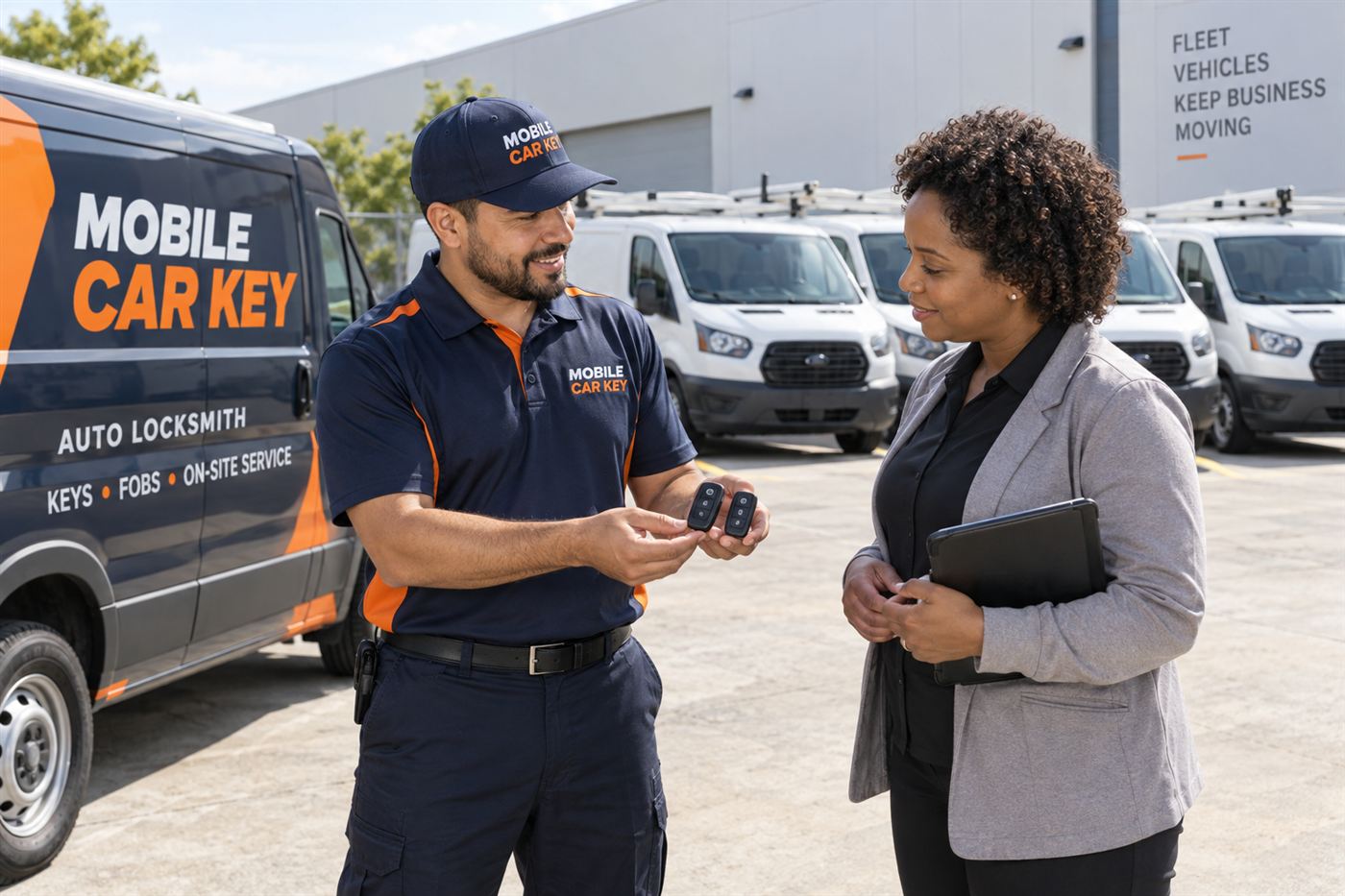
A mobile automotive locksmith comes to the vehicle, which is useful because you may not be able to drive or tow it easily. You begin with a call or a callback request. The service asks about the vehicle, its location and what happened, and tells you what documents to have ready.
On site, ownership or authorization is checked first. The technician then opens the vehicle if needed, checks the lock and ignition, and makes and programs the key, testing it in the doors and ignition. If the vehicle cannot be completed in place, the technician says so.
Keep the title or bill of sale and your identification ready. Have the vehicle in a spot with room to work. If the battery is dead, mention that, so the plan can include power.
Red flags worth walking away from
Most keyless sales are honest, but a few patterns deserve a pause. A seller who pushes you to pay in cash right away, who cannot produce a title, who gives different stories about why the keys are missing, or who wants to meet somewhere other than where the car is kept, is giving you reasons to be careful.
Be wary of a vehicle whose identification plate looks tampered with, whose door label is missing, or whose numbers do not match the paperwork. Be wary of a car whose ignition has been punched out or whose steering column has been forced. A seller who becomes impatient with simple questions is also a signal.
Walking away is allowed. There are many cars for sale, and a bargain that cannot be explained is rarely a bargain. A little caution at this stage protects you from a much larger problem later.
The age of a car shapes how the keyless purchase plays out. An older vehicle with a basic key is often the most forgiving. A mid-range vehicle with a transponder chip needs programming, but many can be handled by a technician at the vehicle. A newer vehicle with a proximity fob and layered security may need dealer-level tools or manufacturer access.
Even within one make, different models can behave differently. A technician looks at the exact car, not the brand in general. That is why no honest service says that all vehicles or all makes are supported.
For you as a buyer, the practical lesson is to learn the year and the type of key system before you commit. If the car turns out to be in the harder group, you can decide whether the car is still attractive after the work required.
If something feels wrong, you can also ask a trusted friend or a mechanic to look at the situation with you. A second opinion costs little compared with the cost of buying a vehicle that has a hidden problem, and a seller with nothing to hide will usually welcome it.
- No title, or a title in someone else's name with no explanation.
- Identification numbers that do not match.
- Damage to the ignition, steering column or door locks.
- Pressure to complete the sale immediately.
- Reluctance to let you inspect or to answer simple questions.
A scene from a private sale
Picture a buyer who finds a used hatchback listed online with no keys. The seller says the keys were lost during a move. The buyer asks for the title, sees that the seller's name matches the identification, checks the vehicle numbers against the paperwork and confirms that no lender is listed. So far, so good.
The buyer then calls a mobile service, explains the year, make and model, and learns what to expect. They agree on a price that reflects the key work, complete a written bill of sale, and arrange for a technician to meet them at the car. On site, the technician checks the papers and identification, makes a key, programs it and tests it in the doors and ignition.
The whole process works because the buyer did the paperwork first, asked about the key second and bought third. That order is the heart of a sensible keyless purchase, and it is the order this page recommends.
Once you have a working key, take steps to protect it. Make a spare while you have a technician on site, store it somewhere secure that is not in the car, and keep a copy of the paperwork where you can find it.
Consider a basic inspection by a mechanic, especially for a car that sat. Replace the battery if it is old. Check the tires and the fluids. If the car had a damaged ignition or locks, ask about repair.
Finally, register and insure the car according to your area's rules before you drive it. That is outside the scope of this page, but it is part of finishing the job properly.
Auctions, salvage and dealer lots
Many keyless cars come from auctions or salvage sales. These can be a good source for the right buyer, but they require extra care. Ask what paperwork comes with the vehicle, whether the title is clean or branded, and whether the vehicle was in a flood, a fire or a major collision. Each of those can affect the work.
Dealers sometimes sell older stock without keys, and may be able to supply keys through their own channels. Ask. A dealer sale usually brings clearer paperwork, but the same careful questions apply.
For any seller, ask in writing what is included. If the sale says as is, understand that you carry the risk of missing keys and any consequences.
A note on flooded or fire-damaged cars
A keyless car that was in a flood needs extra caution, since water damages electronics. See car key after a flood for more on how water affects keys and vehicles.
Budgeting without quoting prices
It is sensible to treat the key as a line item in your total plan, alongside insurance, registration and any repairs. This page does not quote prices, because costs depend on the vehicle, the type of key, the location and the work required. A service can explain its terms before dispatch.
Your strongest protection is to learn the key type for your model, ask what is possible, and compare that against the price of the car. A low-priced car with a difficult key can end up costing more than a pricier one with a simple key. Ask questions before you commit.
Also plan for a spare key. Making two keys in one visit is often more practical than making one now and another later. Our spare key guide explains the thinking.
Before you pay, run through a list. Pause on any item that gets a no.
Related situations
If you are in the opposite position, handling a relative's car, see inherited vehicle without keys. For the wider range of key problems, visit the situations hub.
If a child or pet is locked in a hot car, call 911 first.
Common questions
Is it risky to buy a car with no keys?
It can be, mostly because of paperwork and unknowns. Confirm the title and the seller's identity, match the vehicle identification numbers and ask why the keys are missing. The key itself is usually a solvable problem for many vehicles.
Can a locksmith make a key without the title?
A reputable service asks for proof that you own the vehicle or are authorized to use it. A title, bill of sale or other document that ties you to the car is usually needed. Without it, a good service may decline.
How hard is it to make a key for any car?
It depends on the make, model year and security system. Some are simple, others need dealer-level tools or manufacturer access. A technician can tell you after hearing the vehicle details.
Should I call a locksmith before buying?
It is a smart step. Give the year, make and model and ask what the job typically involves. You will not get a promise, but you will learn whether the car is in an easier or harder group.
What if the car has been sitting and the battery is dead?
A dead battery can block locks, alarms and programming. Mention it when you call, since the plan may need a jump or a charge first. A long-sitting car may need a mechanic as well.
Is this page legal advice about titles and sales?
No. Rules differ by area. For title, lien and transfer questions, check with your local motor vehicle agency or a qualified professional.