
Why Nashville drivers run into car key trouble
Nashville is a city that moves in waves. Weekday commuters pour in along the interstates that meet near downtown, evenings bring concertgoers and diners, and weekends bring visitors who have never parked here before. Each wave creates its own kind of key problem, from a fob dropped on a sidewalk to a spare left in a rental car.
Most of these problems are not dramatic. A key breaks in the ignition, a battery in a proximity fob quits, or the car simply refuses to recognize the key it has known for years. What turns a small problem into a stressful one is the place you are standing when it happens.
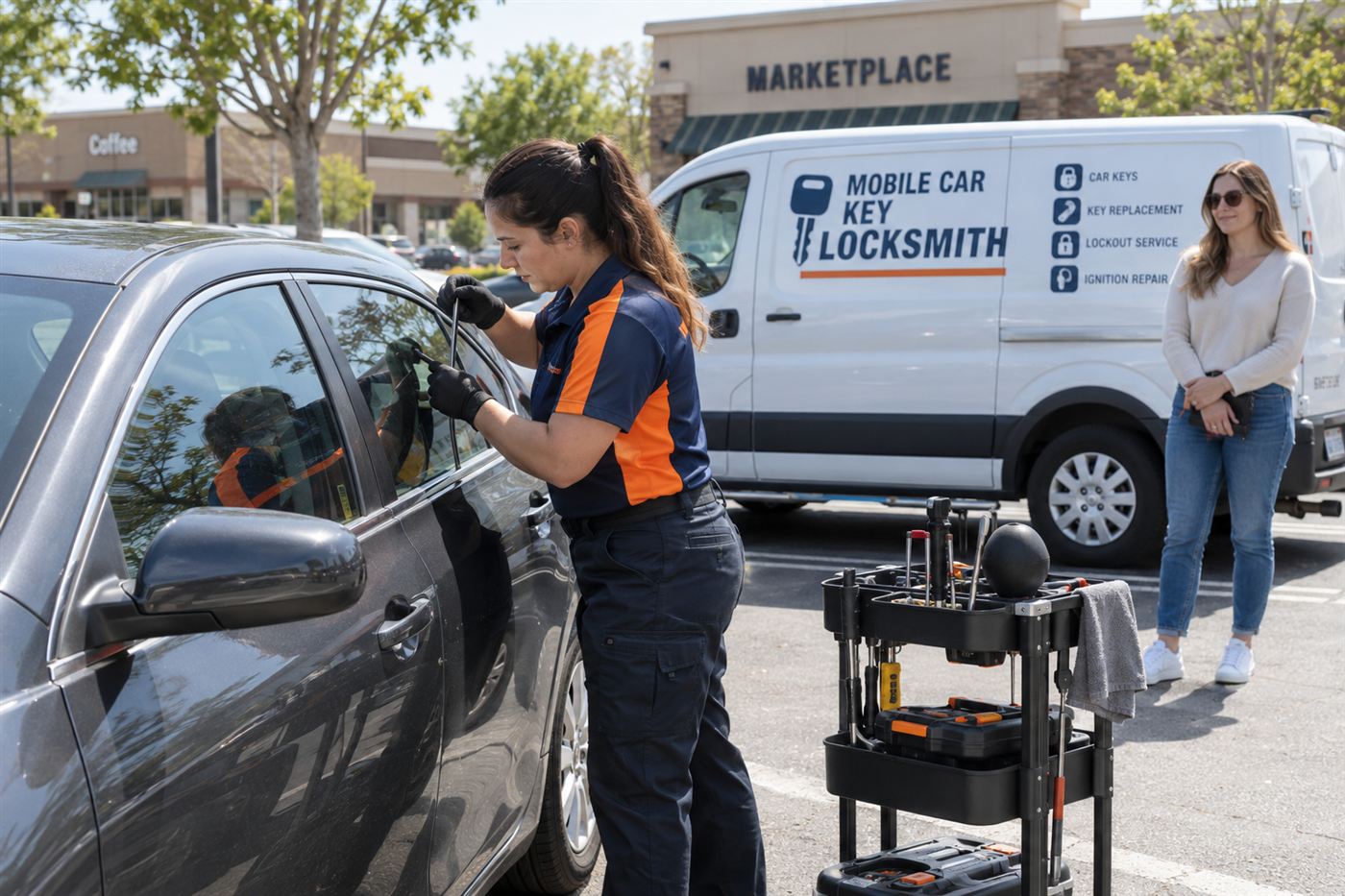
A mobile automotive locksmith removes the biggest obstacle, which is getting the vehicle to a shop. Instead, the technician comes to the vehicle, whether it sits in a hotel lot, a garage level or a roadside pull-off. This page walks through the situations that are common around Nashville and how each is usually handled.
How the service works from the first call to the finished key
The process is the same wherever you are. You call or send a callback request, and the service asks about the vehicle: year, make and model, where it is parked and what happened to the key. Those answers decide what kind of work is needed and what equipment the technician should bring.
Availability, coverage and terms are confirmed before anyone is dispatched. That step matters because it means you know what to expect before a technician starts driving toward you. Nothing on this page creates a service agreement on its own; it is general education.
Once the technician reaches the vehicle, ownership or authorization is checked on site. The work is then done and tested, which means the new key is tried in the ignition or start button, the remote functions are checked and the old problem is confirmed gone. If you want a fuller walkthrough, the page on how the service works covers each step.
- Call or send a callback request and describe the vehicle and location.
- Answer questions about what happened to the key.
- Receive confirmation of availability, coverage and terms before dispatch.
- Meet the technician at the vehicle and show proof of ownership or authorization.
- Watch the work being done and tested before you drive away.
Downtown parking and the Broadway weekend crowd
Downtown Nashville is full of parking structures, surface lots and metered curbs, and on busy nights every space has a driver hunting for it. Drivers hurry, hand over keys to attendants or tuck a fob into a jacket pocket that later ends up in a bar. The result is a steady supply of lost fobs and keys locked in cars.
A parking structure raises practical questions of its own. Height clearance can matter for a technician's vehicle, and you may need to tell the dispatcher which level you are on and whether you can meet at the entrance. Mention anything that could slow access, such as a gated section or a ticket requirement.
If you are the visitor who lost a key on a night out, stay near the car if you can and keep your phone charged. The dispatcher will want a clear landmark, and a photo of the nearest level sign can help you describe your spot without guessing.
What to tell the dispatcher about a garage
Give the level, the nearest column letter or number, and the entrance you used. If the structure has a pay station, say whether you already paid, since that can affect how long the vehicle may stay where it is.
If an attendant has your key
When a valet or attendant holds your only key and cannot find it, the situation is closer to a lost key than a lockout. The attendant cannot prove ownership for you, so keep your registration and identification ready.
Music events, stadium nights and what they do to your keys
Concerts, festivals and professional sports bring thousands of drivers to the same few blocks at the same hour. Crowded walking routes mean pockets get bumped, bags get jostled and fobs fall out unnoticed. Then everyone leaves at once, and a driver who has just discovered a missing key is standing in the middle of a traffic jam.
Event nights also create a timing issue. The roads around a venue can be slow for a while after the show, so a technician may need to approach from a different direction or wait for traffic to clear. Tell the dispatcher about the event so the arrival plan can be realistic.
If you are with friends, consider whether a ride back to your lodging for the night makes more sense while the key question gets sorted out in the morning. A car parked safely overnight is easier to deal with than one blocked in by departing crowds.
- Check every pocket and bag, including the one you used for tickets.
- Look under the seat of any rideshare you used earlier in the night.
- Ask the venue lost-and-found about items found during the event.
- Consider moving the car only after the key situation is settled.
Airport travelers and rental car surprises
Nashville International Airport sees a constant flow of business travelers, wedding parties and music-industry visitors, and many of them arrive in rental cars. Rental vehicles are a special case because the key belongs to the rental company, not to the person holding it. A locksmith will usually need the rental company to confirm that you are authorized to use the car.
A rental that will not start with the key in hand is often a dead fob battery or a car that has lost the fob signal, rather than a broken key. Try the spare mechanical key if the fob has one, and check the manual for the place where the car reads a fob with a flat battery. If you are unsure which situation you have, the guide on rental car keys explains the difference.
Travelers who leave a personal vehicle in airport parking face a different problem. Coming back after a long trip, they may find a dead car battery that has also drained the fob receiver, or a fob battery that lasted only until the trip ended. Describe what the car does when you press the button, because that detail guides the technician.
Weather in the Middle Tennessee region and key fobs
Middle Tennessee has hot, humid summers and winters that swing between mild days and freezing mornings. Both ends are hard on small electronics. Heat can warp plastic fob cases and shorten battery life, while cold can make a weak battery seem to fail all at once.
Spring and early summer storms bring rain that finds its way into pockets, cup holders and open window gaps. A fob that gets wet may keep working for a day and then quit, as corrosion builds on the contacts. If your fob took a soaking, let it dry and do not press the buttons repeatedly. The situation page on a key fob that got wet covers what helps and what does not.
Humidity also affects keys that live in a car for long periods. Spare keys stored in a glove box or console can pick up moisture and wear, so they fail on the day you finally need them.
Commuters on the interstates and the daily key problems
Nashville commuters often cover real distance each day, driving in from the suburbs and neighboring counties. That daily routine hides small warning signs. A fob that needs two presses, a key that sticks before it turns, or a start button that works only on the second try are all hints that a part is wearing out.
Fixing a worn key before it fails is almost always easier than dealing with it after the car refuses to start in a parking lot. A technician can often cut and program a new key while the old one still works, which also gives you a spare. Read more about car key replacement to see what that involves.
If a key has already failed you at work or on the road, say so plainly when you call. The dispatcher needs to know whether the vehicle is blocking traffic, sitting in a private lot or parked at a place where you can wait comfortably.
Students, campuses and shared vehicles
Nashville has several colleges and universities, and campus life brings its own key habits. Students share cars, borrow them from relatives or inherit an older vehicle with a single worn key. Move-in and move-out weeks add stress, because keys travel in boxes and bags that get lost in the shuffle.
Shared vehicles raise an ownership question that is worth settling early. A locksmith needs to see that the person asking is the owner or has the owner's permission. If a parent owns the car and a student is stranded, the owner can often confirm authorization by phone or provide documents, depending on what the service requires.
For a car with only one key, consider making a spare as soon as possible. The page on vehicles with one key only explains why a single key is a risk and what the options are for adding another.
Documents that help
A registration, a title or a bill of sale linked to the vehicle, along with a government photo ID, usually covers it. If names differ, bring whatever explains the connection.
When the key is lost and the car will not start
Losing every key to a vehicle is the most stressful key problem, and it happens in Nashville the same way it does anywhere: a bag is stolen, a coat is left behind, a key falls into a storm drain. When no working key remains, a locksmith cannot simply copy one. The vehicle's computer has to be taught a new key, which usually means programming equipment and sometimes dealer-level access for newer models.
The first thing to do is stop searching in a panic and retrace your steps once, calmly. Then gather your documents and your vehicle details. The more precisely you can describe the car, the better the dispatcher can judge what is needed. Details on the full process are on the page about all keys lost.
If you think the key may have been stolen, mention that when you call. It does not change the basic work, but it may affect whether you want old keys removed from the vehicle's memory, which is something you can discuss with the technician.
- Retrace your steps once and check the places you were most recently.
- Locate your registration, title or other ownership paperwork.
- Write down year, make, model and, if you can see it, the VIN through the windshield.
- Report a theft to the police if you believe the key was stolen.
What to have ready before you call
Preparation shortens the call and reduces surprises. You do not need to know technical terms. You only need to describe what you see and what you can prove.
Start with the exact spot where the car is parked, including a nearby cross street or a business name. Then give the vehicle details and say whether you have any working key, even a damaged one. Finally, mention anything that limits access, such as a locked garage level or a car parked on a narrow street.
Photos can be helpful. A picture of the dashboard, the key and the vehicle identification number plate can answer questions before they are asked. Keep your phone charged and stay reachable, because the dispatcher may call back with a question.
Information checklist
Location, year, make, model, trim if you know it, what type of key you have, what happened, and whether anyone is at risk.
Proof of ownership
Registration, title, insurance card plus identification are common examples. A reputable service asks for proof of ownership or authorization on site, and you should expect that.
Safety first: when a key problem is an emergency
If anyone is in danger, call 911 first. A child or a pet locked inside a hot car is an emergency, and Tennessee summers can make a closed car dangerous in a short time. Do not wait for a locksmith in that situation. Emergency services can reach the occupant, and a locksmith can help with the vehicle afterward.
Also take care of your own safety while you wait. If you are on a roadside, stay away from traffic and keep hazard lights on. If you are in a dark lot at night, wait near people or in a lit area, and tell someone where you are.
For less urgent lockouts, the guide on personal safety while locked out gives a clear checklist that applies in any city.
Newer vehicles, dealers and what a locksmith can and cannot do
Many vehicles on Nashville roads can be handled by a mobile locksmith, and the work is often done where the car is parked. However, limits depend on the vehicle. Some newer models from certain makes need dealer-level tools or manufacturer access, and a service that tells you this up front is being honest rather than evasive.
When a car does need the dealer, the sensible next step is usually to arrange a tow or a separate visit and to bring your ownership documents. The page comparing a locksmith and a dealership helps you weigh the options.
Whichever path applies, you should hear it before work begins. Asking whether your particular vehicle has any special requirements is a fair question during the first call.
Nashville and its neighbors
Drivers around Nashville often cross county lines and state lines without thinking about it. A road trip to Memphis or a drive up to Kentucky can put a key problem far from where you live. Coverage is confirmed before dispatch, so tell the dispatcher where the vehicle actually is, not where you live.
If you are traveling between cities, you may find the pages on Memphis and Louisville useful, since both describe how the same service works in those areas. For a statewide view, see the page on Tennessee.
Wherever you end up, the approach stays the same: describe the car, describe the place, prove ownership and let the technician do the work at the vehicle. For the full list of cities, visit the cities hub.
Common questions
Can a technician come to a parking structure in downtown Nashville?
Mobile technicians commonly work in parking structures, but access depends on the structure. Tell the dispatcher the level, a nearby column or sign, and any gate or ticket rules. Coverage and availability are confirmed before dispatch, so you will know whether the location can be reached before anyone starts driving to you. If the structure is tight, mention the vehicle height you expect to see.
What if I am visiting Nashville with a rental car and lose the key?
The key belongs to the rental company, so a locksmith will usually need that company to confirm you are authorized to use the car. Call the rental company, keep your rental agreement and identification ready, and then describe the vehicle to the dispatcher. Some rental companies prefer their own roadside process, so it is worth asking them before you book any outside help.
Do I need my title with me to prove ownership?
Not always. A registration, insurance card, bill of sale or title can each help, together with a government photo ID. What matters is that the documents link you to the vehicle. If you do not have any with you, explain that on the call so the dispatcher can tell you what else may be accepted before a technician is sent.
Will a locksmith be able to program any new key for my car?
Not necessarily. Many vehicles can be handled by a mobile locksmith, but limits depend on the vehicle. Some newer models from certain makes need dealer-level tools or manufacturer access. The dispatcher can tell you early in the call whether your car is likely to be one of them, which saves you from waiting around for work that cannot be done on site.
My fob got wet during a summer storm. Should I keep pressing it?
No. Repeated presses can push moisture further inside. Open the case if you can, remove the battery, let everything dry fully and avoid heat sources that could warp the plastic. If it still fails afterward, the board may be damaged and a replacement fob may be needed, but it is better to learn that than to damage the circuit further.
Is it better to make a spare before I lose my only key?
Yes. Making a spare while you still have a working key is generally simpler than programming from nothing after every key is gone. A spare also protects you on trips, and it gives you a backup if the original wears out or the fob battery fails at a bad moment, which is why many drivers keep one stored away from the main set.
What should I do if a child is locked in my car?
Call 911 immediately. A child or pet in a closed vehicle is an emergency, especially in warm weather. Do not wait for a locksmith to arrive. Emergency responders are trained and equipped to reach the occupant, and minutes matter when the cabin heats up. They can get to the occupant, and the vehicle can be dealt with afterward once everyone is out of danger.