
Why vacations are hard on keys
On a normal day your key lives in a pocket, a bag or on a hook. On vacation, the routine disappears. You swim, hike, ride, eat late, change clothes three times and carry different bags each day. The key goes wherever the day goes, and it can be left behind at any stop.
Water, sand and sun add their own trouble. A fob left on a beach towel can be buried by a wave of sand. A key in a pocket of swim shorts can fall out in the pool. A fob left in a hot cupholder can weaken. Leisure also lowers your guard, and you stop checking pockets every few minutes.
Vacations also bring unfamiliar cars. If you rented a vehicle at an airport, you may not know how the fob works or how many keys exist. Add a new town, a hotel and a schedule full of plans, and a missing key becomes a very large headache.
Group travel adds another layer. When five people share one rental car, the key passes from hand to hand, and each person assumes someone else has it. Assign one keeper for the day and make a habit of checking in with that person before you leave a stop. It sounds fussy, but it prevents most vacation key losses.
Retrace the day before you call anyone
Take a quiet few minutes and work backward through your day. When did you last use the key? Where did you park? What did you do after you left the car? Where did you change clothes, eat or rest? Write the stops down in order. The key is likely at one of them.
Call or visit each stop. Beach concessions, hotel pools, restaurants, tour offices, shuttle drivers and ride operators often hold lost items. Describe the key ring and the fob. A colorful keychain, a bottle opener or a distinctive tag helps staff identify it.
Check your group. Someone else may have picked up your key by mistake or may hold it for safekeeping. Check the rental cabin, the cooler, the stroller and the kids' bags. Searching as a group is faster and more thorough than searching alone.
Use your phone as a detective. Photos carry timestamps and often show the key in the background: on a table, on a towel, in a hand. Look at the pictures from the last few hours. Receipts and ride app histories also place you at certain times and spots, which narrows the search.
- Last use of the key and the place you parked
- Beach bags, towels, coolers and strollers
- Hotel pool, locker room and lobby desk
- Restaurants, shuttle drivers and tour offices
- Lost and found at attractions and transit points
The beach, the water and the key
Beaches are among the most common places for keys to disappear. A fob in a pocket can fall out as you run into the water. A fob buried in sand may be impossible to see. Waves and tides can move small objects a surprising distance. If you think the key is on the sand, mark the area and ask lifeguards or beach staff for help.
Metal detectors are sometimes used by hobbyists and may help, but never wade into rough water to search. Safety comes before the key. If the fob went into the sea, it is probably gone, and the electronics will not survive long in salt water.
If a wet fob is recovered, do not press the buttons. Rinse nothing, dry it with a soft cloth and have a technician test it. Salt can corrode the board. Water damage can hide for days before it shows.
Lifeguards and beach patrol staff see lost items daily and often keep a log. Describe the key, the time and the stretch of beach. Leave your phone number. Beach shops, rental stands and parking attendants may also hear of found items, so ask along the boardwalk.
Sand and pockets
Zip the fob into a pocket or a waterproof pouch before you go onto the sand, and check it each time you stand up.
Pool and lake days
Leave the fob with a non swimmer in the group, or in a locked locker, instead of in a pocket near the water.
If the car is a rental
Rental cars are a major part of vacation travel. If the key is lost, the first call goes to the rental company. They own the vehicle, and their agreement explains what is allowed. They may offer roadside help, send a replacement or authorize an outside technician.
Keep the contract number, your driver license and the plate number close. Ask about fees or responsibility in plain terms, and take notes. Ask whether using an outside mobile service is allowed, and whether they need to approve it before work begins.
Rental fobs are often the newer, proximity type. A technician may or may not be able to make one, depending on the make and model. The rental car key guide explains the usual paths in more detail.
If the rental company offers a replacement vehicle, ask what happens to your luggage and how the swap works. Take photos of the car's condition when you hand it back, and keep every receipt and message. A clear record keeps a small problem from becoming a dispute after the trip.
If you drove your own car to the destination
A key lost far from your usual city is a different problem. Your car is with you, but your usual resources are not. You do not know the area, your spare may be at your residence and the dealer may be hours away.
A mobile technician can come to the car in many places. Ask whether the service covers the area and can reach the town where you are staying. Availability and coverage are confirmed before dispatch, and in remote areas coverage may be more limited.
Ask a trusted person at your residence to look for the spare key. If someone can ship or bring it, that may be a plan, but shipping takes time and trust. Compare it to making a new key on site and choose what fits your schedule.
Check whether your insurance or an auto club membership includes key help or roadside service. Many drivers forget they have a benefit until they need it. Have the policy number or membership card available, and ask what is covered and how to use it, before you arrange outside service.
What to tell the service as a traveler
Give the service your current location in a way that works for a visitor. Use the name of the hotel, the resort, the parking lot, the cross street or a landmark. If you do not know the town well, say so, and share a map pin from your phone.
Describe the vehicle: year, make, model, color, and the type of key. Say whether it is a rental or your own. Mention whether you hold a spare back at your residence. Mention your schedule, such as a ferry, a tour or a flight, without expecting a promise.
Availability, coverage and terms are confirmed before dispatch. This page is educational and does not create an agreement. Ask questions and decide with a clear head. Do not agree to anything you do not understand.
Proving ownership while traveling
A reputable service asks for proof that you own the vehicle or are authorized to use it. When you travel, your documents may be in different places: your wallet, the glove box, your phone, a hotel room vault or at your residence. Gather what you can.
Photo ID, registration, title or a rental agreement are the usual items. If your registration is at your residence, ask a family member to photograph it and send it. A digital copy is often useful, though what is accepted depends on the service and the vehicle.
Make sure your name matches the documents. If you are driving a friend's car, ask the owner to send authorization. The ownership proof guide lists the commonly accepted items.
- Photo ID
- Registration or title, or a photo of it
- Rental agreement for a rental car
- Owner authorization for a borrowed car
- Insurance card
Resorts, cruise ports and long term parking
Vacation parking comes in many forms. Resort lots, valet stands, cruise terminals, ski lodges and airport garages all have rules. Before you call, learn what the property allows. Some require a pass for a visitor or a vehicle. Some have security that wants to log the visit.
If your car is parked while you cruise or travel by plane, a lost key may only show up when you return. That is a different problem: you are tired, you have luggage, and the lot may be far from help. See locked out at the airport for more on that situation.
Ask the property whether staff can help locate you, arrange a waiting area or hold your luggage. Many places do this routinely. A kind word and a clear request go a long way.
Large resorts often have security staff who can verify that your car is on the property and registered to a guest. This may help with the ownership check and with gate access for a technician. Ask the front desk or security office, and mention it to the dispatcher.
Waiting well in a vacation spot
Treat the wait as part of the trip, not a disaster. Find a comfortable spot with shade or shelter, a seat and a bathroom. A cafe, a lobby or a visitor center can be a good base. Order something, charge your phone and let the family settle.
Keep children occupied with simple games or snacks. If the weather is hot, keep everyone hydrated and out of the sun. If it is cold, find warmth. A fussy family makes everything harder.
Stay reachable. Keep the phone charged, volume on and the number the service has for you in front of you. If the technician cannot find the car, a short call from you with a landmark can solve it.
Keep a short list of what you need while you wait: the vehicle details, your ID, your location pin and the name of the person you spoke to. Having it in one note on your phone saves repeating yourself and keeps you steady if the call drops.
What a technician can do for a traveler
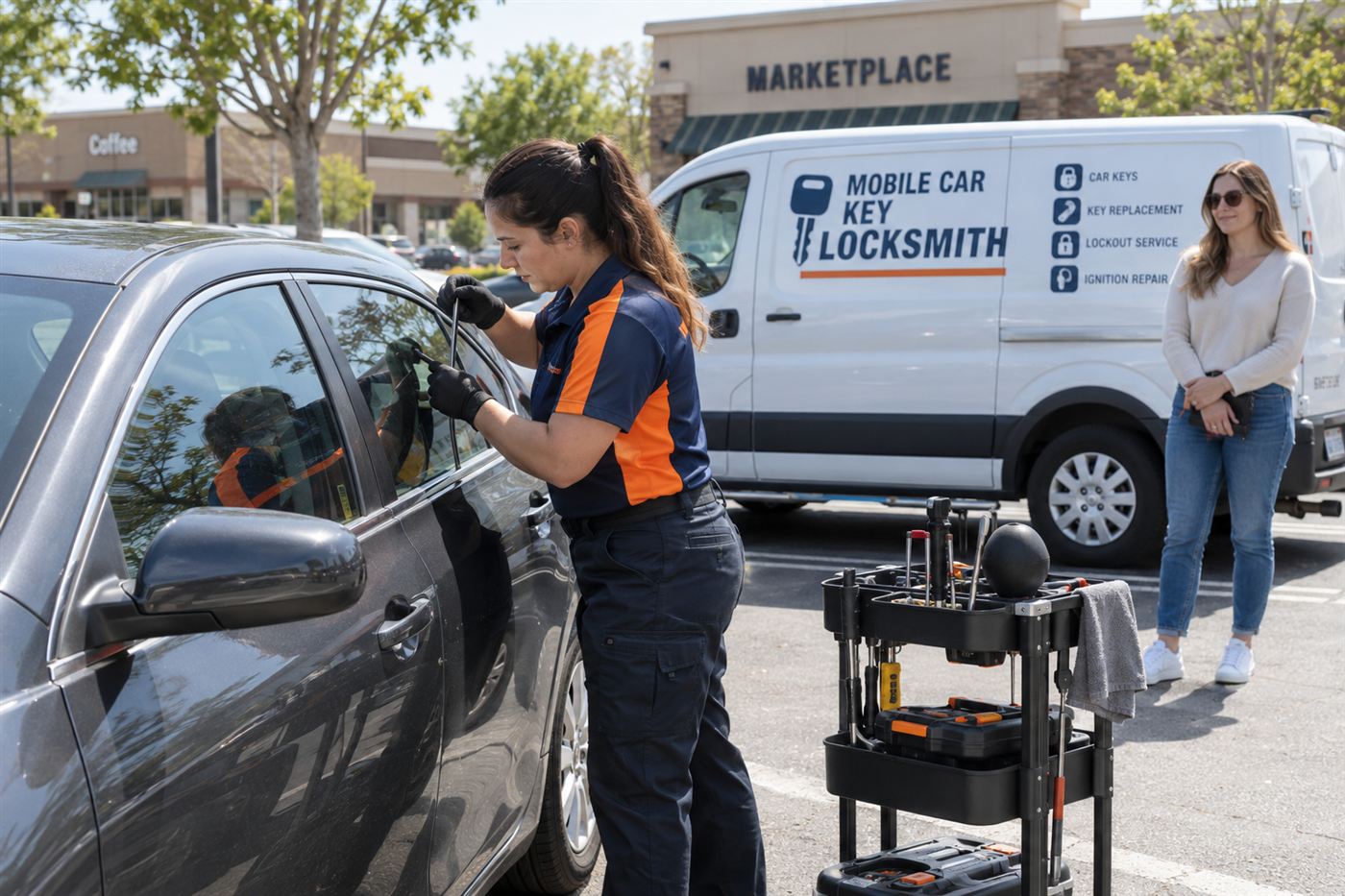
A mobile technician can open a locked vehicle, make a new key and program a fob for many cars. The service happens where the car is parked, which is useful for travelers who cannot easily get to a shop. Limits depend on the vehicle.
Some newer vehicles from certain makes need dealer-level tools or manufacturer access. If your car is one of them, the technician will say so, and you can plan a dealer visit or a tow. Honest information helps you make the right choice for your trip.
For an overview of the work, read about all car keys lost. If you also have a lockout, see vehicle lockouts.
After a new key is made, ask the technician to show you how to use every part of it, especially if it is a smart key or a flip key. On a trip, you will be handing the car to different family members, so everyone should know how the fob works, including the hidden mechanical key.
Protecting the rest of the trip
After the key is solved, adjust the plan. Ask for a second key while the technician is there, and keep it in a different bag from the first. Keep one with a traveling companion. Doubling up prevents a repeat on the same trip.
Review your gear. Add a waterproof pouch, a lanyard or a bag clip. Photograph your registration and key tag. Check the fob battery, which weakens in heat and water. Replace it if it is old.
Tell the rental company or the car owner what happened and keep any receipts. A short note now avoids confusion later. If you plan more outdoor activities, plan where the key will stay while you play.
Tell your travel companions the plan for the key so nobody is surprised. Agree who holds the new key, where the spare lives and what to do if one is lost again. A two minute talk at the start of the next day replaces a long argument later.
Before the next beach day
Decide who holds the key, where it will be stored and how you will check it before you leave.
Habits that keep a vacation on track
Make a key plan on day one. Choose a place for the key at the hotel, a pocket for the road and a rule for the beach. Tell everyone. A shared plan is a strong protection against a lost key.
Use a tracker tag on the key ring if you own one. Many tags work across a wide area, and a notification can save a lot of searching. Do not rely on it alone, and keep a spare nearby.
Ask the hotel about its lost and found. Many hotels keep a record, and you can check at the end of each day. Small habits like these cost little and keep your trip pleasant.
At the end of every day, do a key check in the room: key on the hook, spare in the bag, fob battery fine. It takes seconds and means you start the next morning knowing where everything is. Make the check a family habit and let the children help.
Related pages
For more situations, see keys lost on a road trip for long drives and losing your only car key for the basics. The situations hub lists every common car key problem.
This content is educational. It does not create a service agreement, and terms are confirmed before dispatch.
A missing key on vacation is a hassle, not the end of your trip. Search, gather the facts, prove ownership and let a technician do the work while you get back to the rest of your time away.
Common questions
Can a mobile technician come to a resort or vacation spot?
In many places, yes. Availability and coverage depend on the location, and remote areas may have limits. Give the dispatcher the resort name, the parking area and any gate or pass requirements. Terms are confirmed before dispatch, so ask questions and decide with a clear head.
What if my rental car key is lost?
Call the rental company first. They own the vehicle and may offer roadside help or authorize an outside technician. Keep the contract number and your ID ready. Rental fobs are often newer types, and limits depend on the make and model, so ask what is possible before arranging anything.
My documents are at my residence. Can I still prove ownership?
Often yes. A family member can photograph the registration and send it, and a photo ID in your wallet can match the name. What is accepted depends on the service and the vehicle. Tell the dispatcher what you can show so the service can explain the options before dispatch.
Is my fob ruined if it went in the ocean or a pool?
It may be, especially after salt water. Do not press the buttons. Dry the fob with a soft cloth, remove the battery if it can be reached without force and have a technician test it. Water can corrode the circuit board, and hidden damage may show up later.
Should I ship my spare key from my residence?
It can work, but shipping depends on time and trust, and a lost package makes things worse. Compare it to making a new key on site. If the spare is a push button fob, a technician may still need to register it to the car, depending on the vehicle.
What if the car is parked at a cruise port or airport while I travel?
Tell the property about the problem and ask what is allowed. Some lots need a pass for outside service. Give the dispatcher the lot, row and gate details. Ownership is checked on site, so have your ID and registration ready.
How do I avoid losing the key again on this trip?
Make a plan on day one: a fixed pocket, a waterproof pouch, a tracker tag and a rule about who holds the key during water activities. Ask for a second key while a technician is on site, and store it in a different bag from the first.