
A truck key lives a rough life
Think about where a Ram key goes in a normal week. It rides in a work glove, a tool belt pocket, a jacket covered in sawdust or a cup holder full of change. It gets dropped from a ladder, left on a tailgate and tossed onto a bench beside a hammer. Few consumer electronics endure that.
The key is also shared. A crew leader, a helper, a spouse and a teenager may all drive the same truck, and the single fob moves from hand to hand. Each handoff is another chance for it to be lost or kept in the wrong place.
None of this is unusual, and it is not a sign of carelessness. It is the reality of using a truck for work, and the solution is to plan for the key the way you plan for fuel and tires.
A helpful habit is to give the truck key a fixed place. A hook in the shop, a pocket that always holds it or a lanyard clipped inside the cab keeps the key from wandering. It sounds simple, and it is, but consistency prevents more lost keys than any gadget.
- Left on a tailgate while loading
- Dropped from a ladder or scaffold
- Handed to a helper who left early
- Lost in the bed among tools and materials
Where Ram keys go missing
Job sites, fuel stops, farm gates, boat ramps, tailgate parties and loading docks are common places. So are the pockets of borrowed jackets and the beds of other trucks.
Ram and its Dodge heritage
Ram trucks were once sold under the Dodge name, and many drivers still think of them together. Today Ram is a separate brand, and its trucks and vans have their own key systems. If you want to compare with the sibling brand, read about Dodge car keys.
The two share a corporate family and some engineering, so there are similarities in how keys, immobilizers and remotes work. Even so, a key made for one is not automatically right for the other, and a technician treats each vehicle on its own terms.
The takeaway is practical: do not buy a key because someone says it is the same as the one on a different truck. Give the technician your exact year and model and let them confirm what applies.
Fleet buyers sometimes mix Ram trucks and vans, and drivers move between them during the week. If you manage more than one vehicle, keep a note for each: year, model, key style and how many keys exist. That note makes a call to a service much shorter.
Key styles you may find on a Ram
Over the years, Ram trucks have used several key styles. Some have a traditional metal blade with a plastic head that holds a chip. Some use an integrated key and remote, where the buttons sit in the head of the key itself. Newer trucks often use a proximity fob and a start button.
Heavy duty trucks, light duty trucks and vans may differ from one another even in the same period. The trim matters too. A work-oriented trim may have a simpler key than a luxury trim, and a fleet truck may have been ordered with particular equipment.
Without seeing the vehicle, no one can say for sure which style yours has. A photo of the key and the dash will answer the question readily. You can also read more on the page about pickup truck keys.
If you are not sure which style you have, count the buttons, look for a blade and check whether the truck has a start button. These three facts narrow the options, and they are easy to relay by phone. A photo of the key beside a coin for scale is even better.
Integrated key and remote
The blade and the buttons are in one piece. It is compact and convenient, but a cracked head or a worn button pad can make the whole key unreliable.
Proximity fob with a start button
The fob stays in a pocket, the truck senses it and the engine starts with a button. A small emergency blade is normally inside the fob.
The chip that tells the truck to start
Most Ram trucks use an immobilizer, a security system that checks the key before allowing the engine to run. The key contains a chip that returns a coded answer. If the answer is wrong, the engine may crank without firing or refuse to start.
This is why a key cut at a hardware counter often fails. It fits the lock but not the electronics. The cut blade is only half a key. The chip, and its pairing with the truck, is the other half.
The page on transponder key duplication explains the idea in plain language and is worth reading if you are not sure what your key does.
There is another benefit to understanding the chip: it explains why used keys from online listings are risky. A used key may already be locked to another truck, and no amount of cutting will change that. A new, unlocked key is a different matter, and your technician can tell you what to look for.
- The blade turns the lock
- The chip answers the truck's security check
- The remote buttons are a separate function
- A complete key needs all three working
Lost on the job site
Job sites are busy and full of places a key can hide. If you lose your Ram key at work, start with the obvious: the bed, the cab floor, the seat gaps and your own pockets. Ask the crew whether anyone picked it up. Check the toolbox, the bench and the places where you took off your jacket.
If the key is truly missing, stop and think before doing anything drastic. Do not try to force the door or the ignition. Do not hot-wire or tow the truck without advice. These actions can cause damage that is more disruptive than the lost key.
Call a service and describe the situation. Tell them about the truck, the location and any site rules. Some sites require visitor check-in or escorts, and the service needs to know in advance.
If you suspect the key fell out of the truck on the way to the site, retrace the drive in your mind. Did you stop for fuel? Did you open a gate? Did you carry anything from the cab? Often the key is in the last place you used both hands for something else.
Site access
If the site has a gate, a guard or a safety briefing, tell the service. A technician cannot enter a restricted area without the right arrangements.
When every Ram key is gone
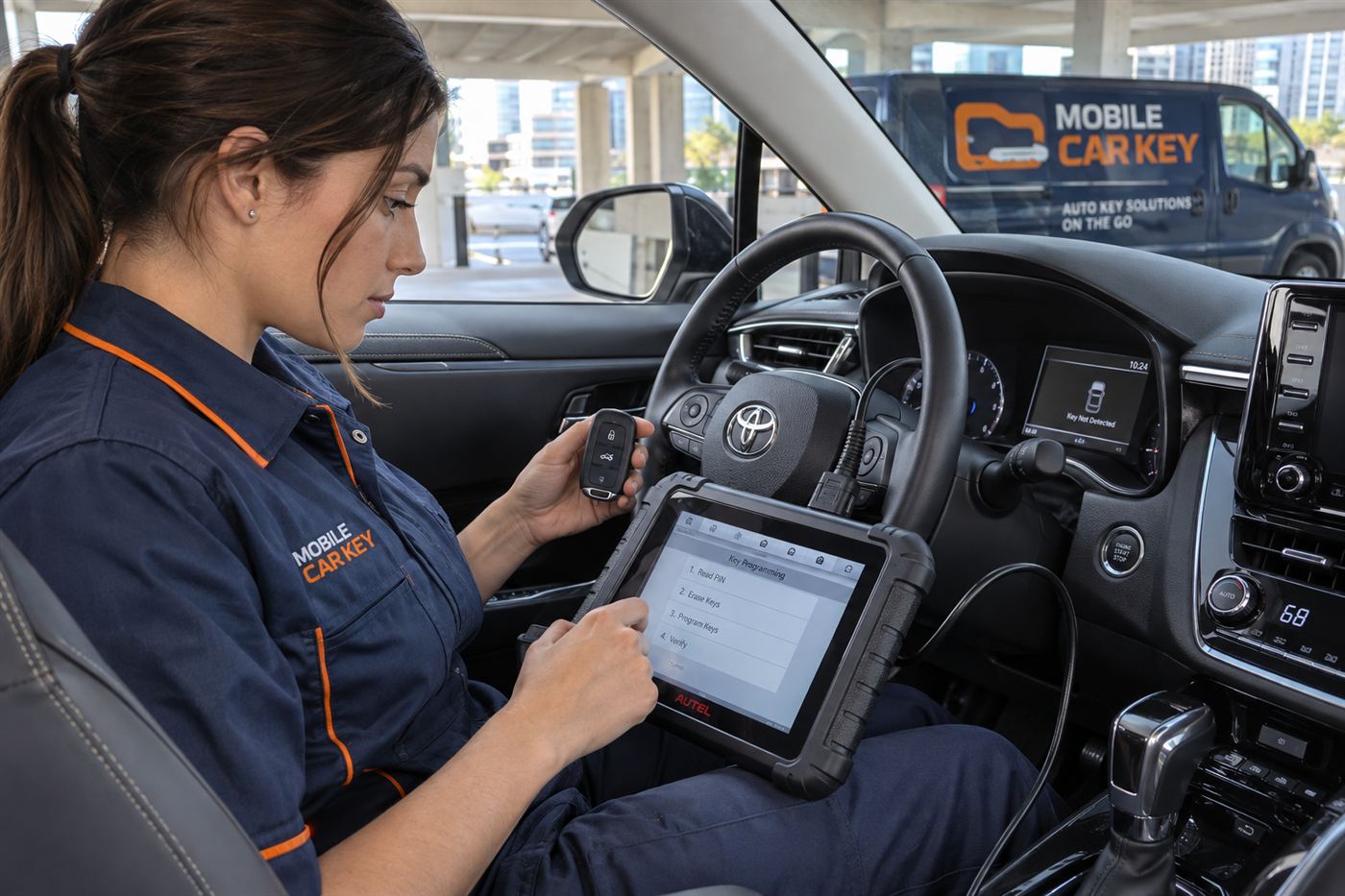
With no key at all, the truck has to be told to accept a new one. A technician identifies the vehicle, accesses its security system and pairs a new key. Depending on the model and year, this can often be done where the truck is parked.
Newer vehicles from some makes may need dealer-level tools or manufacturer access. If your Ram falls into that category, a responsible service will tell you early. This matters if the truck is loaded, in a remote place or part of a schedule.
The page on all car keys lost sets out the general steps, from the first call to the final test.
Think about timing and about what depends on the truck. If tools, materials or crew are waiting, tell the service what is at stake. It does not change the method, but it helps you decide whether to arrange a backup vehicle while the key issue is resolved.
- Registration or title
- Photo identification
- Vehicle identification number
- Business paperwork if the truck is company owned
- Exact location and any access rules
Company trucks, fleets and authorization
Many Ram trucks belong to companies. The person who needs the key may not be the owner. In this case, the service needs to know who is authorized to request work. A manager, an owner or a fleet administrator may need to confirm.
It helps to have the registration, a company letter or a work order available. If the truck is leased, the leasing company may be involved. These steps can feel formal, but they protect the business from unauthorized keys.
Small business owners with several trucks can benefit from the guide on key management for small fleets and work vans. It covers spares, logs and authorization in practical terms.
Where a business has several trucks, it may be wise to appoint one person as the key contact. That person knows the ownership documents, can authorize work and can answer questions from the service. It avoids the delay of tracking down a decision maker when a truck is stranded.
A simple key log
A notebook or a spreadsheet that lists each truck, how many keys exist and who holds them takes ten minutes to set up. It saves hours when a key goes missing.
Fob batteries and wear in a hard working truck
A Ram fob's battery will eventually weaken. Symptoms include reduced range, a delay when pressing a button, a dash message about the key and a truck that sometimes refuses to start. Replacement is usually simple, and a small coin cell can be changed with a coin or a small screwdriver.
Work conditions speed the wear. Dust in the buttons, moisture in the case and cold mornings that sap battery power all contribute. If your fob sits in a pocket with metal tools, the case can scratch and the buttons can wear.
A protective cover or a silicone sleeve can extend a fob's life. So can keeping the fob in a pocket by itself. Avoid clipping it to a ring with heavy tools, which strains the hinge and the ring hole.
Cold weather deserves a note. A fob left in a freezing cab overnight may behave poorly in the morning, because cold reduces battery output. Warm the fob in your hand or pocket before trying again, and replace the battery before winter.
Lockouts at fuel stops and loading docks
Locking keys inside a truck is common, especially when you step out to fuel, to open a gate or to check a load. A fob left on the seat or in a cup holder is within sight but out of reach. The doors may even lock automatically.
Do not use improvised tools on a modern truck door. Wedges, wires and hangers can damage the weatherstripping and the wiring inside the door, and some doors have side airbags. A trained technician has made-for-purpose tools.
The page on vehicle lockouts explains what the work involves. If someone is trapped or a child or pet is inside a hot cab, call 911 first.
Some trucks have a hidden or secondary lock, such as a tailgate lock or a toolbox lock, that uses a different key. Do not confuse these with the ignition key. If those are the problem, mention it, since they are handled differently.
- Check every door and the rear window latch
- Do not use wire hangers or pry bars
- Tell the service about any canopies, caps or locks
- Stay with the truck if it is secure to do so
Towing, loads and why location matters
A Ram truck at a boat ramp, with a trailer attached, or loaded with materials presents different challenges from a car in a driveway. The technician needs space to work, and the truck may be in a place with limited room.
Tell the service if the truck is hitched to a trailer, parked on a slope or blocking a lane. Mention if it is carrying cargo that cannot be left unattended. These facts help the service plan what to bring and how to approach the work.
Do not move the truck unless necessary. If it must be moved, avoid damaging the drivetrain by following the owner's manual. If it needs to be towed, ask a professional.
If you work around water, dust or chemicals, a sealed fob cover is worth considering. Wipe the fob with a damp cloth when it is dirty and avoid solvents that can damage the case. A cleaner fob is a more reliable one.
Remote and rural locations
Farms, ranches and rural roads can be far from town. Say so on the first call. The service will confirm what is possible before anyone is dispatched.
Planning a spare for a working truck
A spare key is one of the lightest forms of protection against downtime in terms of effort. Because a Ram key is electronic, the spare has to be paired to the truck, and it is much simpler to do while a working key exists.
Store the spare away from the truck and away from the main key. A magnetic box under the bumper may seem clever but is also an invitation to theft and a source of lost keys when it drops off on a rough road. A locked drawer at the shop or a trusted person is better.
If several people drive the truck, consider more than one spare. A key for each regular driver, plus one held by the owner, reduces the chance that a single loss stops the work.
Remember that keys wear in step with each other. If the main key is five years old and failing, the spare of the same age may soon follow. Replace both batteries at the same time and test both.
- Keep the spare away from the truck
- Test every function of the spare
- Replace old batteries together
- Note who holds each key
Buying a used Ram truck
Used trucks are a big market, and key history varies. A truck with one key is a truck with no margin. Ask to see every key, test every function and ask when the batteries were last changed.
Check that the key starts the truck, not just that it opens the doors. If the seller says the other key is lost, plan for the cost and effort of replacing it. A truck sold by a business may also have been used by several drivers and keys may be scattered.
After the purchase, consider asking a technician whether old keys can be removed from the truck's list. Support depends on the model. The page on Jeep car keys covers a similar issue for a related brand.
One more point: a truck that has been sitting for a long time may have a flat battery that looks like a key problem. Try a jump or a charger first if you suspect that. A technician can help judge which problem you have.
What a visit looks like
After your call, the service confirms availability, coverage and terms before dispatch. A technician travels to the truck, checks identification and ownership, identifies the key type and does the work. The result is tested before you accept it.
This page is educational and does not form a service agreement. Terms are settled on the call. If something cannot be completed, you should hear that plainly, along with the options.
See car key replacement for the overall process and the list of makes for other brands.
Finally, keep a record of the work: which keys now work, the date and any notes the technician gave you. Put it with the truck's paperwork so it is there for the next driver or the next owner.
Common questions
Can a Ram truck key be replaced on a job site?
Often, depending on the model, the year and the access available. The service confirms availability and coverage before sending a technician. Tell them about any site rules, gates or check-in requirements, because a technician cannot enter a restricted area without the right arrangement. Have ownership documents ready. Always mention site rules when you call so the plan fits.
Why won't my Ram start with a copied key?
The truck's security system expects a chip it recognizes. A blade cut to match may turn the lock but does not carry a paired chip. A complete key has the chip matched to the truck. Ask any provider to confirm that the key starts the engine before the work is finished. Ask for the key to be tested by starting the truck.
What if the truck belongs to my employer?
The service will need to confirm that you are authorized. That may mean a call from the owner or a manager, a company letter or a work order. Leased trucks may involve the leasing company. Have registration and identification ready and be prepared for a short verification. Keep the paperwork in a separate folder where it can be found.
Is a Ram the same as a Dodge for keys?
Not necessarily. The brands share history and some engineering, but keys, fobs and pairing steps can differ by model and year. Do not buy a key because someone says it matches the other brand. Give a technician your exact year and model to see what applies. Check the exact year and model before ordering anything.
Can a lockout be handled without damaging the door?
A trained technician uses tools made for the purpose and works to avoid damage to the paint, seals and wiring. Ask how the work will be done. Avoid improvised tools, which can damage the door and its electronics. If a child or pet is inside a hot cab, call 911 first. Tell the service about any aftermarket locks or accessories.
Should I keep a spare key in a magnetic box?
It is risky. The box can fall off on rough roads and is a known target for thieves. A locked drawer, a trusted person or a secure spot away from the truck is wiser. Test the spare regularly and replace its battery on a schedule so it works when you need it. If the box is already installed, consider moving the spare.